Blog
Sales teams do not lose deals in the follow-up. They lose them at the moment of capture and share. Industry research consistently points to 48 hours as the outer edge of the warm-contact window at most B2B events. After that, response rates drop by more than half. Every minute a new contact sits in a card pile or a badge export waiting to be cleaned is a minute that window is closing.
Generic "best NFC card" roundups grade on card materials, finish options, and tap speeds. Those things matter for brand impression, but not for quota. This guide ranks by the criteria commission-carrying salespeople actually need: CRM depth, rep-departure continuity, inbound lead capture alongside outbound sharing, and field reliability when the venue Wi-Fi fails.
Read this Blog to understand why nfc matters in 2026
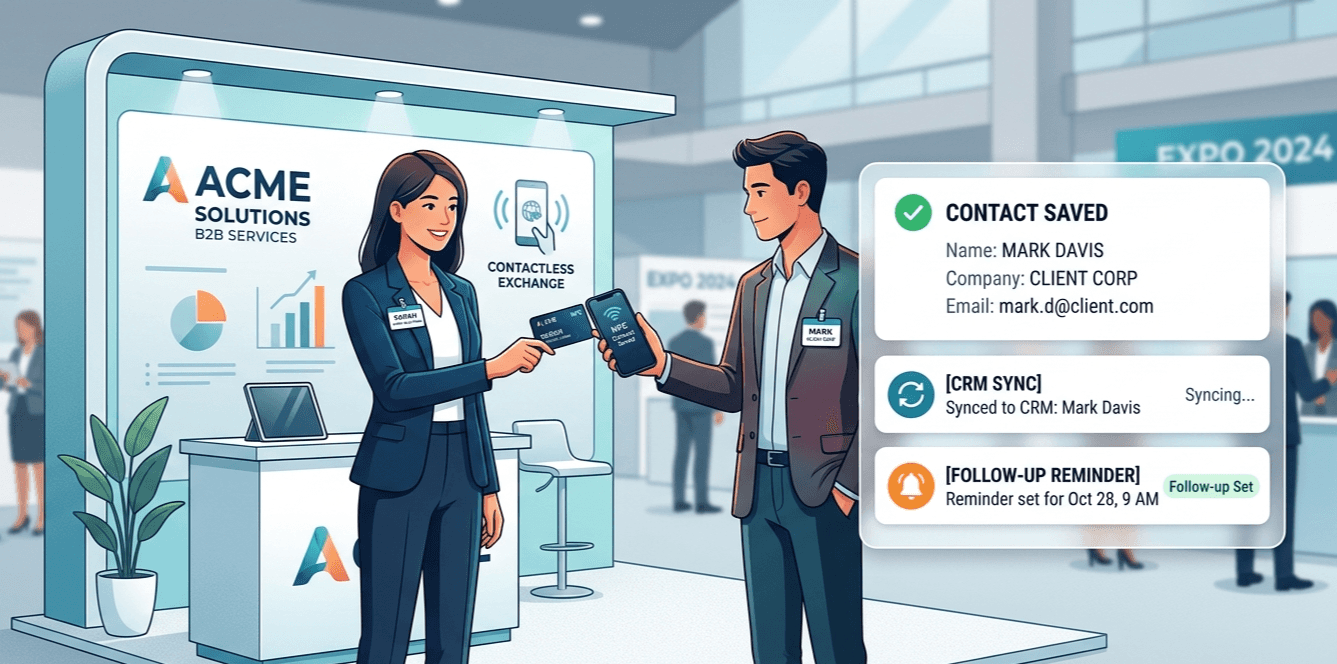
Compare the 6 best NFC business cards for sales teams in 2026. Ranked by CRM depth, lead capture, offline reliability, and pipeline impact.
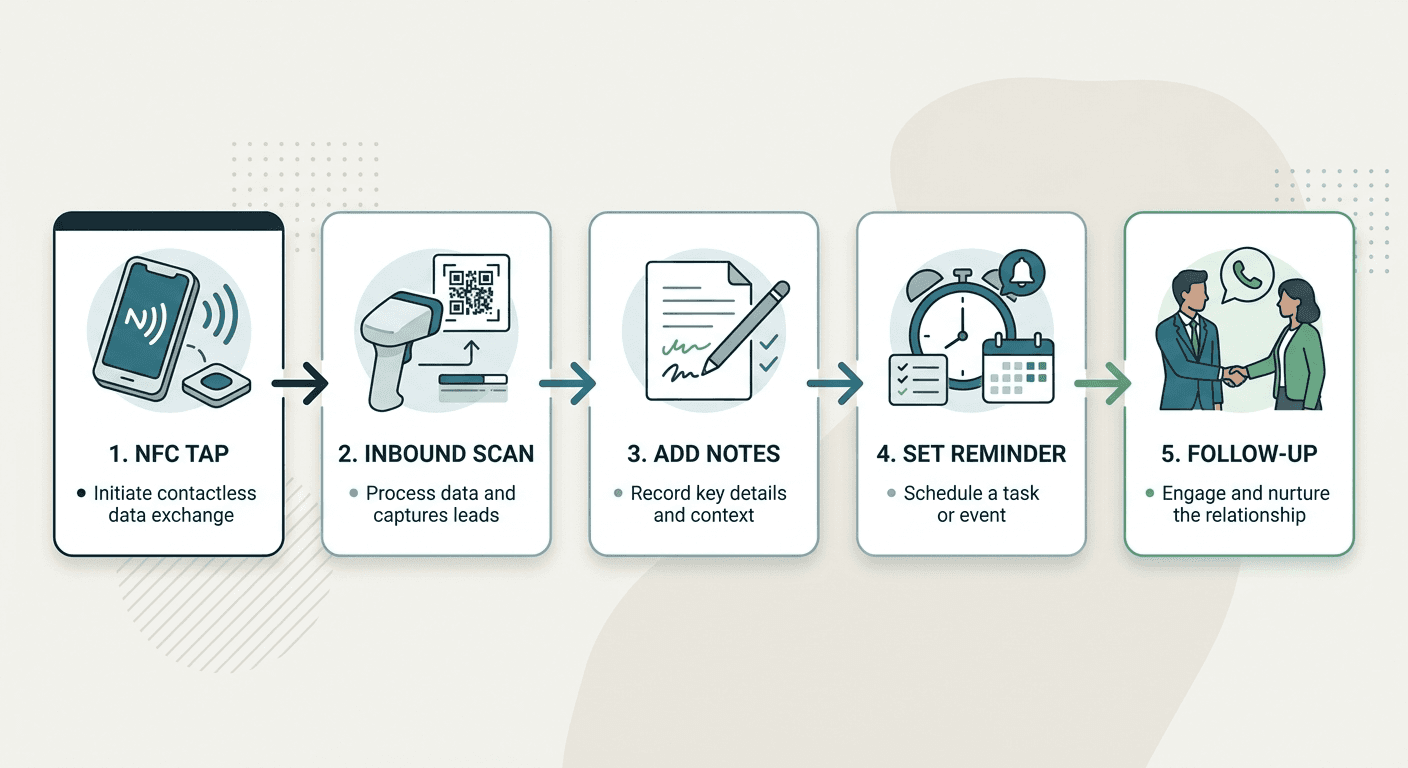
Paper cards break the CRM handoff chain. A business card handed over at a conference lives in a jacket pocket until the rep returns to their desk, at which point the context of the conversation is already 40% gone. By the time the card is typed into a CRM, it is a name and a company with no notes and no next step.
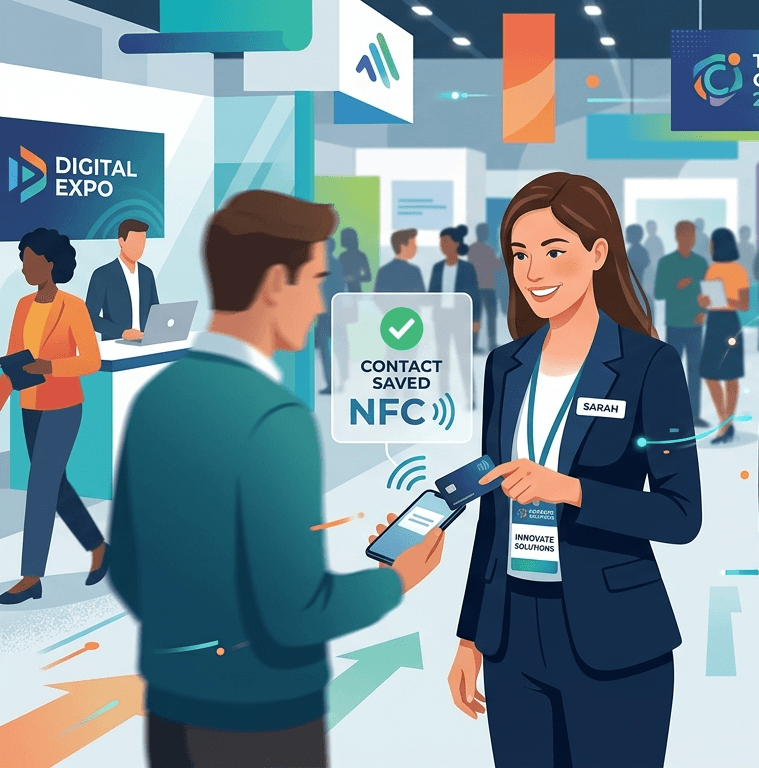
NFC taps put contact data into a prospect's phone in under 2 seconds. No typing, no photo, no manual entry. The contact saves directly with the rep's full details, including the link to schedule a call or view the product page.
But NFC alone only solves half the problem. Sharing your own card does not capture the prospect's card, their interest level, or what they said about their buying timeline. The tools that close both sides of that loop give sales teams a measurably faster path from conversation to pipeline.
Where Sales Teams Actually Use These
Trade shows and industry conferences: High-volume tap-to-share across dozens of conversations per day, combined with inbound lead capture so reps leave the show with a qualified list rather than a card stack.
Outside field sales: Consistent brand identity across 40 or more stops per week, with each interaction logged as a CRM activity so managers have visibility without requiring manual updates from reps.
Enterprise sales meetings: A premium first impression that lands the rep's full profile in the buyer's contacts in seconds, combined with a calendar link, a one-page product brief, and a same-day follow-up trigger.
Match the Tool to Your Sales Motion
Not every sales role has the same workflow, so the right tool varies by motion:
Event-driven AEs: Prioritize offline reliability and inbound capture. If the tool cannot capture leads without Wi-Fi and record context at the moment of the conversation, it will fail during a packed expo floor.
Field reps with CRM dependency: Prioritize native CRM sync and territory tagging. Every contact should flow into the CRM automatically with the right owner and source fields, without rep intervention.
Enterprise sellers: Prioritize brand control and rep-departure continuity. When a rep leaves, the account relationships and conversation history should stay with the company, not leave with the individual.
The table below scores each platform against the criteria that matter for quota-carrying salespeople.
Feature | Habsy | Popl | Mobilo | Blinq | HiHello | Covve |
|---|---|---|---|---|---|---|
NFC Card Sharing (Outbound) | Yes | Yes | Yes | Yes | Yes | Yes |
NFC Card Reading (Inbound) | Yes | No | No | No | No | No |
Phone-to-Phone NFC (Both Directions) | Yes | No | No | No | No | No |
Reads Any NFC Format (Text, URL, VCF, LinkedIn) | Yes | No | No | No | No | No |
NFC + QR + Business Card in One App | Yes | Partial | No | Partial | No | No |
Digital Business Card | Yes | Yes | Yes | Yes | Yes | Yes |
Offline NFC Capture | Yes | No | No | No | No | No |
Voice Notes at Capture | Yes | No | No | No | No | No |
Follow-up via Email and WhatsApp | Yes | Email Only | No | No | No | No |
CRM Sync | Yes | Yes | Yes | Yes | Partial | Yes |
Export as CSV or VCF | Yes | Yes | Partial | Partial | No | Partial |
Every other tool in this list helps you share your card. Habsy does that, and it also captures the other side of the conversation: the prospect's details, their buying intent, what they said at the booth, and what needs to happen next. The rep walks away from the show with a qualified, clean lead list, not a badge export that still needs three days of cleaning.
The workflow is built around the moment of conversation, not the moment of clean-up.
Scan a business card, tap an NFC card, or scan a QR badge. Assign the contact to the right category before moving to the next conversation: Distributor, Enterprise Prospect, Partner, or whatever fits the team's segmentation. While the card is still in hand, record a 10-second voice note summarizing the key takeaways: what they asked about, what they said about their requirements, what the product page would never tell you. Then log intent signals: interest level, buying timeline, product line priority. One tap sets the reminder: Tomorrow Morning 9:00. The next step is locked in before leaving the booth.
When the reminder fires, the contact record is already open with everything captured at the booth. Habsy generates a personalized email or WhatsApp draft using the full context: the scanned card, the voice note, the intent signals. Write a brief prompt describing the follow-up goal and Habsy returns a draft that references the actual conversation. Review it, adjust one line, and send. For repeat outreach formats, manual templates with parameters like {contact.name} and {contact.company} handle the standard cases without starting from scratch.
When the event closes, export contacts as CSV or VCF, or send directly to an email address for team handoff. For teams on Habsy Platform, the CRM integration handles everything automatically. Connect once to HubSpot, Salesforce, Zoho, or any CRM of choice, and every contact flows through with source, owner, and intent data already structured. Set it up once. Every event after that runs the same way.
What it does
NFC Card Reading (Inbound): Every other platform in this list assumes the prospect will tap your card and save themselves. Habsy flips that. Hold a prospect's NFC card to the phone and Habsy reads it, parses the data, enriches it, and creates a clean structured contact record on the spot. No typing, no copy-paste, no screenshot sitting in the camera roll waiting to be dealt with later. The contact is captured, categorized, and ready for a voice note before the conversation ends.
Reads Any NFC Format: Not every NFC card stores data the same way. Habsy handles all of them. Basic text with contact details, a URL pointing to a profile or vCard page, a VCF file, a LinkedIn URL, or any other format that carries identifying information: Habsy pulls it, parses it, and builds the same clean structured record regardless of what is on the chip. The rep does not need to know what format the card uses. Habsy figures it out.
Phone-to-Phone NFC, Both Directions: This is the capability no competitor offers. Habsy shares your card outbound via NFC and reads the prospect's card inbound via NFC, in the same app, in the same workflow, phone to phone. On a busy expo floor where prospects carry their own NFC cards or tap from their own devices, this closes the loop that every other tool leaves open. One direction gets your number into their phone. Both directions get their details, their context, and their next step into your CRM.
Scans, taps, and reads in every format: Scan a business card, scan a QR badge, or tap an NFC card. Every capture method creates the same structured contact record, with the same category, voice note, and intent signal fields ready to fill. One app, one workflow, regardless of what the prospect hands over.
Assigns the right category at capture: Every contact is segmented the moment it is scanned. No post-event cleanup, no batch tagging from memory. The lead list is structured and ready before the show floor closes.
Captures the conversation, not just the card: Record a 10-second voice note the moment a card is scanned. The note is transcribed, attached to the contact, and keyword-searchable. When the SDR calls two days later, they know the prospect's specific requirement, not just their job title.
Qualifies leads before they leave the floor: Intent signals capture interest level, requirement size, product line, and buying timeline at the booth. The hottest contacts are sorted and ready to act on the next morning, without anyone having to reconstruct context from a spreadsheet.
Sets the next step before moving on: One tap sets a follow-up reminder tied to the contact and voice note. Tomorrow Morning 9:00. The reminder fires with the full record already open, so no lead is left waiting on memory alone.
Enriches contact profiles on the spot: With a single tap, Habsy pulls the prospect's LinkedIn profile, company size, industry, and background. The rep has context for the next question before the conversation ends.
Clean Exports and CRM syncs : Export as CSV or VCF, or send directly to an email address. For teams on Habsy Platform, connect once to HubSpot, Salesforce, Zoho, or any CRM of choice. Every contact flows through with source, owner, and intent data already structured. Set it up once. Every event after that runs the same way.
Offline : Every scan, note, category, intent signal, and reminder is stored locally with no connectivity required. The app syncs automatically the moment a signal returns.
Gives managers full visibility across the team: The Sharing your card outbound is table stakes. Every tool here does that. The question that separates a networking tool from a sales tool is what happens on the other side: does it capture the prospect's details, their intent, their timeline, and the agreed next step, or does it hand you a name in a contact book and leave the rest to memory?
Of the six tools reviewed, only Habsy closes both sides of that loop. Inbound NFC reading, voice notes, intent signals, follow-up reminders, and AI-drafted messages built from real conversation context, all in one app, with no separate tools stitched together.
For SDR teams, booth managers, and field sales organisations on the event circuit, that is not a feature difference. It is a pipeline difference.
Download Habsy and capture your next event the right way. For teams that want email automations, CRM sync, and full visibility across every rep and every event, Habsy Platform takes it further. Set it up once and every event after that runs the same way. shows every scan in real time, broken down by rep and event. Account relationships are tied to the company record, not the individual rep, so knowledge stays in the business when someone moves on.
Why it earns the top spot
Habsy wins on card finish, tap speed, and everything that happens after the handshake. It is the only tool in this list that solves the problem the others do not address: what happens to the lead once the conversation ends. A voice note, an intent signal, and a next-step reminder give the SDR a reason to call and something to say when they do. That difference is measurable in pipeline.
The offline mode is the feature that separates a productive show from a costly one. Expo hall connectivity is unreliable by default. Habsy queues every scan, note, intent signal, and reminder on the device and syncs automatically when a signal returns. The lead list does not wait for the venue to fix the Wi-Fi.
Popl is the most widely deployed NFC card platform in the US market and has built a strong enterprise team management layer on top of its hardware roots. It is a proven choice for organizations whose primary need is consistent outbound sharing backed by prospect enrichment.
Core capabilities
Multi-form-factor NFC hardware: Cards, phone tags, and wristbands cover every rep preference without changing the underlying workflow.
AI enrichment from 20+ data sources: Pulls public company context when a prospect saves the card, shortening the research step before the follow-up call.
Direct CRM sync: Native sync with Salesforce, HubSpot, and Zoho drops contact records straight into the CRM with source attribution.
Universal lead scanner: Captures inbound business cards, though sequentially rather than in batch, which slows high-volume post-event processing.
Limitations
Popl does not generate WhatsApp follow-up drafts, which limits its usefulness in markets where WhatsApp is the primary business channel. There is no one-tap reminder tied to the moment of capture, so follow-up discipline depends on rep memory or external task tools. De-duplication relies on CRM-side logic rather than a clean pre-export step, which can create duplicate records downstream. Batch card scanning is sequential, which adds friction for post-show card stacks.
Mobilo focuses on the outbound share experience and pairs it with a sales analytics layer that tracks engagement with the digital card over time. It is the strongest option in this list for sales teams that want to measure the card itself as a content delivery mechanism.
Core capabilities
Custom-branded NFC cards: Premium finishes and strong brand control make the physical card a deliberate extension of the brand.
Engagement analytics: Tracks card views, saves, and link clicks per rep, giving managers coaching conversations backed by data.
CRM integrations for enterprise: Direct sync with major CRMs logs every share as a CRM activity without manual entry.
Lead capture forms on the card. Prospects self-serve their details through a form attached to the digital card, useful for inbound interest.
Team identity controls. Central control over layouts and brand assets keeps every rep's card consistent at scale.
Limitations
Mobilo is hardware-dependent: teams cannot meaningfully use the platform without ordering physical cards first, which adds procurement lag to any rollout. There is no offline-first capture of inbound prospect cards at events. Card material quality is thinner than premium competitors, noted frequently in user reviews. There is no voice note or conversation context workflow at the moment of capture, so the rep must rely on memory or separate note-taking.
4. Blinq: Fast and Flexible for Individual Reps
Blinq built its reputation on share speed and multi-channel reach. It is a strong choice for individual reps and small teams that want an effortless outbound experience without committing to a full lead management platform.
Core capabilities
Live-sync digital profile: The NFC card ties to a profile that updates in real time, so previously shared cards stay current when a rep changes role.
Multi-channel share options: NFC, QR, Apple Wallet, and smartwatch sharing covers every contact scenario even without the physical card.
Enterprise CRM integrations: Native sync with HubSpot, Salesforce, and Microsoft Dynamics keeps source attribution clean across the enterprise stack.
Team branding control on paid plans: Admins enforce consistent team branding across every rep's card without manual policing.
Limitations
Inbound card scanning is single-card only, not optimized for post-show batch processing. There is no native voice note capture at the moment of meeting. Lead capture context such as interest level, priority, and intent requires external tools layered on, which fragments the workflow. Less suited for high-volume trade show floors where speed of inbound capture is the defining constraint.
5. HiHello: Best for Design-Led First Impressions
HiHello sits closest to the design and identity end of the spectrum. Its strength is giving individual reps creative control over how their card looks across different contexts. Strong for teams where design and personal brand carry real weight in first impressions.
Core capabilities
Multiple card profiles: Up to 16 profiles on paid plans let a rep maintain separate cards for different products, events, or audiences.
Branded layouts per role or event: Layouts can be tuned to context, so a healthcare conference card can differ from a startup event card.
Optional NFC hardware: Teams add NFC cards when they want the tap experience, without the platform being hardware-dependent from day one.
Multi-channel sharing: QR codes and shareable links work across email, messaging, and virtual meetings when the physical card is not present.
Limitations
HiHello does not capture conversation context at the point of meeting. There is no offline-first lead capture workflow for event floors. Follow-up automation requires external tools to be layered in, which breaks the workflow into multiple steps. Less suited for structured sales team deployment where manager-level visibility into every rep's scan activity is required.
6. Covve: Built for Long-Cycle Relationship Sales
Covve is built for relationship-led sales with long cycles and frequent re-engagement. It excels at keeping long-cycle accounts warm over 12-plus-month buying processes. Less suited for the high-volume event motion, but strong for account management workflows.
Core capabilities
Relationship memory and smart reminders: Tracks interaction frequency and nudges reps to reconnect before key accounts go cold.
Contact enrichment over time: Surfaces role changes and company moves, so reps reach out at the right moment on long-cycle accounts.
NFC and QR profile sharing: Standard outbound sharing channels covered without added workflow complexity.
Limitations
Covve is not optimized for high-volume event capture with multiple reps on the floor. The real-time lead qualification workflow at the point of capture is limited. The platform is better suited to long-cycle relationship nurture than booth-style event work. The subscription model at USD 9.99 per month runs higher than direct alternatives over a two-year horizon.
The best NFC card for a salesperson is the one that survives a full fiscal year of pipeline pressure. Some tools focus on sharing. Some on identity. Some on analytics. The question worth asking before a decision is: does this tool cover the full conversation, or just the handshake?
Teams that work high-volume events, trade shows, conferences, and field meetings consistently benefit most from platforms that close both sides of the loop. Outbound sharing gets your contact into a buyer's phone. Inbound capture with context gets the buyer's intent, their product interest, their timeline, and a scheduled next step into your CRM by tomorrow morning. That second half is where quota is made or missed.
Of the six tools reviewed, Habsy is the only platform that covers both halves natively, without stitching together separate tools, and the only one that scans inbound NFC cards in-app rather than dropping them into the phone's contact book. For SDR teams, booth managers, and field sales organisations working the event circuit, that coverage translates directly into shorter time-to-first-touch and more pipeline from the same number of conversations.
FAQ: NFC Cards for Sales Teams
What is the best NFC business card for B2B sales teams?
Habsy. It is the only platform that covers both outbound sharing and inbound NFC reading in the same app, with voice notes, intent signals, and follow-up reminders attached to every contact at the moment of capture. For teams that want pure outbound sharing with CRM sync, Popl or Blinq are solid alternatives.
How are NFC business cards different from digital business cards?
A digital business card is a profile accessible via a link or QR code. An NFC business card adds a physical card with an embedded chip that triggers the same profile with a tap, no scanning required. In high-noise environments like expo floors, removing that extra step matters.
Do NFC business cards integrate with Salesforce and HubSpot?
Habsy Platform integrates with any CRM of choice, including HubSpot, Salesforce, and Zoho. Connect once and every contact captured in the app flows through automatically with source, owner, and intent data already structured.
Which NFC cards work offline at trade shows?
Habsy is the only platform reviewed with a purpose-built offline capture mode. Every scan, voice note, intent signal, and reminder is stored locally and syncs automatically when connectivity returns. Expo hall Wi-Fi is unreliable by default. Habsy does not depend on it.
Are NFC business cards worth it for commission-carrying sales reps?
Yes, when the platform goes beyond the tap. An NFC card that only shares contact details is a faster printed card. Habsy pairs NFC sharing with inbound reading, conversation context, follow-up reminders, and CRM-ready exports, compressing the time between first contact and first qualified touch.
Does phone-to-phone NFC sharing work with Habsy?
Yes, and it is the capability no other application in this list offers. Habsy shares your card outbound via NFC and reads the prospect's card inbound, phone to phone, in the same app. Whatever is stored on their chip, plain text, URL, VCF, or LinkedIn profile, Habsy parses it and creates a clean structured contact record instantly.
Be Day-1 ready at your next event Habsy closes both sides of the capture loop: share your card outbound via NFC or QR, scan inbound NFC and business cards with context, and export a CRM-ready list within 24 hours. Your contacts stay under your control. Export or delete any time. See how Habsy works at habsy.ai |