Blog
From AI-powered business cards to Gen Z's return to in-person events, here are the five professional networking trends 2026 has already set in motion, and what to do about each one.
TL;DR
|
Something interesting is happening to professional networking in 2026. After a decade of LinkedIn-first, webinar-heavy, digital-only habits, the pendulum is swinging back. People are showing up in person again. They are also scanning fewer paper cards, drafting fewer cold follow-ups by hand, and relying more on AI to handle the admin around every real conversation.
The professional networking trends 2026 is settling into are not about choosing digital or in-person. They are about combining the two in smarter ways. AI is quietly rewriting the playbook behind the scenes. Event formats are getting more intentional. And a new generation of professionals is redefining what a genuine connection looks like.
If you attend conferences, run a sales or marketing team, or exhibit at trade shows, the shifts below will shape how you plan, show up, and follow up for the rest of this year. Here are the five trends reshaping professional networking in 2026, plus a practical framework for acting on them.
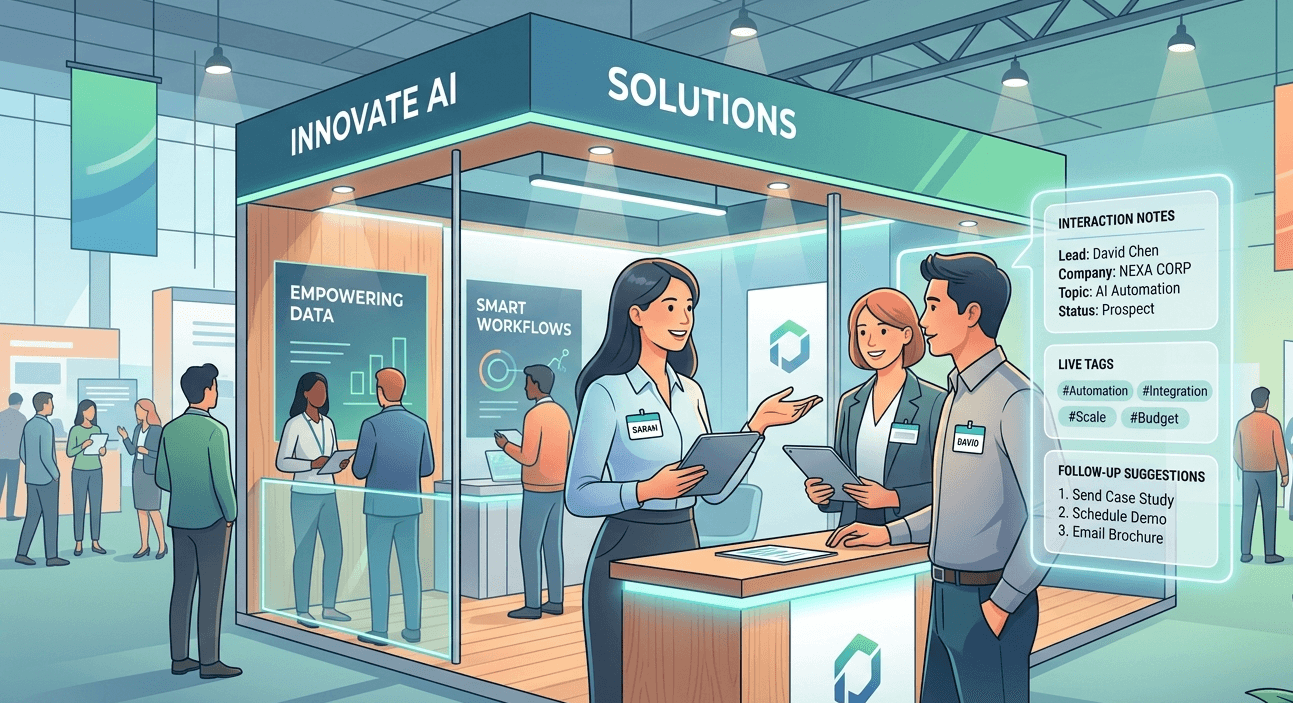
Networking in 2026 is no longer about collecting contacts. Learn the 5 trends reshaping events, AI, and follow-ups, and how to turn conversations into real pipeline.
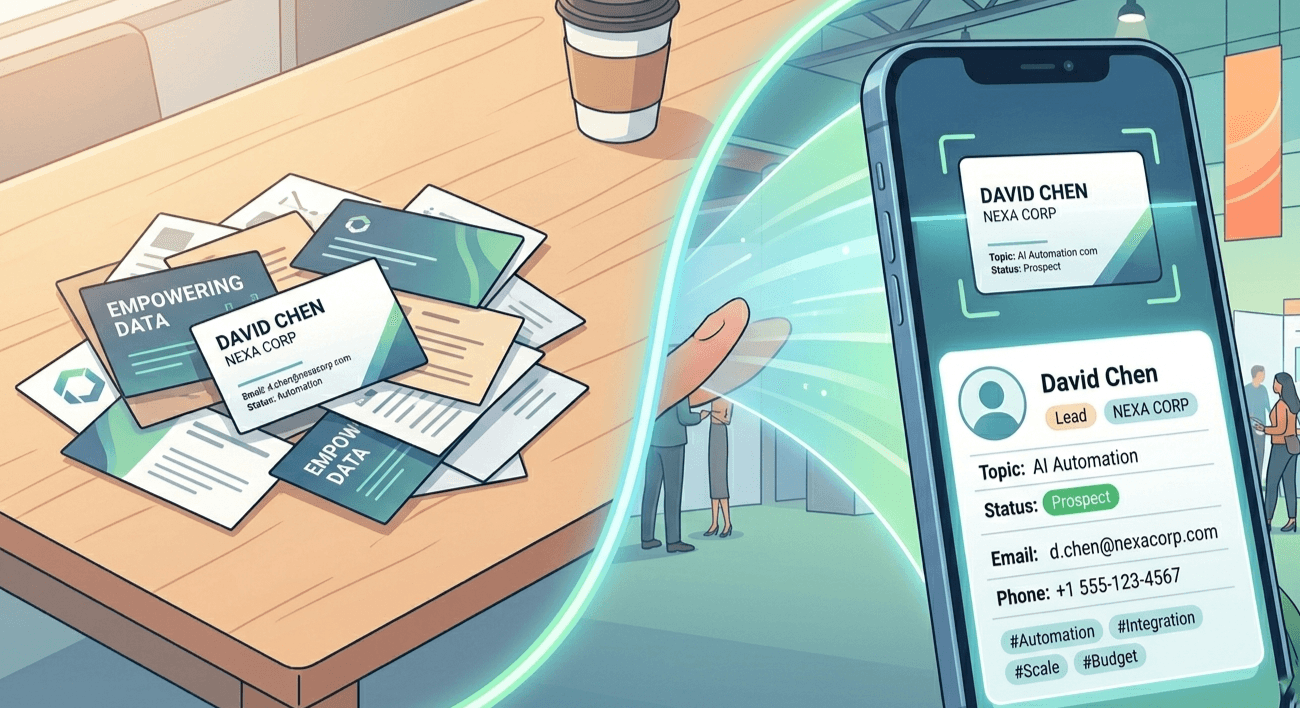
AI networking is the defining shift of 2026. A year ago, AI at events meant a chatbot that booked your demo. Today it means a working assistant that sits between you and every contact you meet, capturing context, suggesting talking points, and drafting the follow-up before you leave the venue.
This matters because the slowest, most error-prone parts of networking have always been the admin: typing cards into a spreadsheet, remembering who wanted a pricing deck, getting the follow-up out within 48 hours instead of forgetting for three weeks. AI handles that layer now. What it cannot do is replace the quality of the conversation itself, which is why the best teams are pairing AI tools with a stronger focus on genuine human interaction.
From Paper Cards to AI-Powered Digital Profiles
Paper business cards are not dead, but they are no longer the default. Digital business card trends have accelerated fast, with QR-based sharing, NFC-enabled cards, and phone-to-phone handoffs becoming common at most B2B events. When someone does hand you a paper card, an AI business card scanner now captures the data in seconds, enriches it with company context, and files it into a searchable contact library before you have walked ten feet.
37% of professionals surveyed in late 2025 had adopted a digital business card as their primary sharing method, up from 12% two years earlier. |
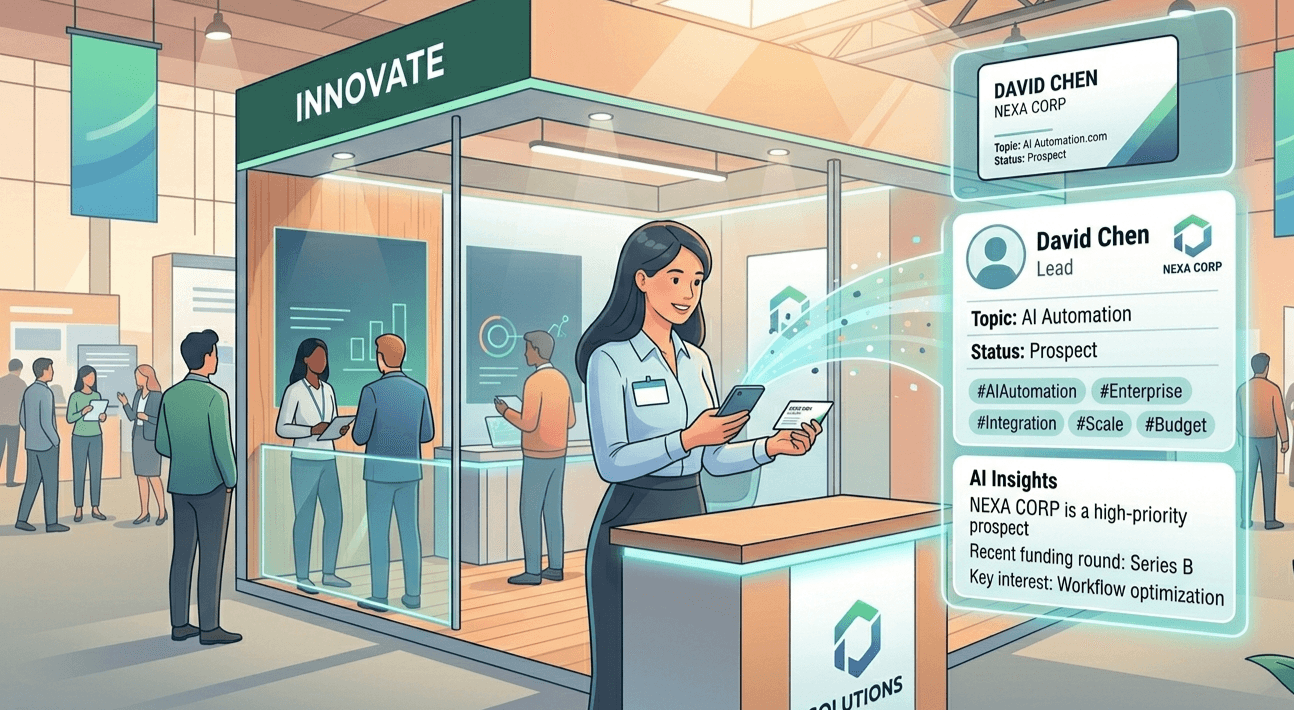
The shift matters for two reasons. First, it removes friction, which means more contacts actually make it into a system where follow-up can happen. Second, it opens the door to real-time enrichment. When a badge or card gets scanned, your tool can pull the person's role, the company's industry, and relevant public signals, so you walk into the next part of the conversation informed rather than guessing.
Predictive Insights and Follow-Up Intelligence
Networking analytics is the other half of the AI story. Modern platforms can now show you which contacts are most likely to convert, which conversations need a reminder, and which leads have gone cold. Paired with CRM integrations, this turns a stack of business cards into a ranked action list, not a backlog.
Habsy's contact intelligence enrichment is one example of this shift. Scan a card, and the platform layers company data, role context, and AI-generated conversation starters around the contact before you even sit down for the next meeting. The goal is simple: less typing, more thinking about the relationship itself.
Trend 2: Events Are Getting More Intentional
The second of the professional networking trends 2026 has locked in is a format shift. Big, generic conferences are still running, but they are no longer where the most valuable networking happens. Smaller, more intentional formats are rising quickly, driven by professionals who want better-fit conversations and less noise.
The Rise of Hyper-Niche Gatherings
Niche networking events are one of the clearest winners of 2026. Think twenty-person CFO dinners, industry-specific founder breakfasts, or curated meetups for heads of revenue operations. These events swap scale for signal. Attendees meet fewer people, but the people they meet are significantly more relevant to their current goals.
For marketers and sales leaders, this creates a planning question: do you invest in one large flagship trade show, or in a cluster of smaller, higher-intent gatherings? The answer for most teams in 2026 looks like both. Large trade shows still drive volume and discovery. Niche events drive deeper relationships and warmer pipeline.
Hybrid Formats Become the Default
Hybrid networking events have moved from pandemic-era workaround to standard operating procedure. The format usually combines a core in-person gathering with a digital layer that extends reach, captures content, and lets remote attendees participate in select sessions. Platforms supporting this model reported over 123 million hybrid event sessions globally in 2025, according to industry data shared by MOO and others.
The practical implication is that your networking strategy needs to account for both rooms. A business card scan at the in-person event, and a LinkedIn connection request to the remote attendee, should flow into the same contact record with the same follow-up logic.
Speed Networking, Reinvented
Structured networking formats are back. Speed networking, roundtables with rotating hosts, and AI-powered matchmaking sessions are appearing on more event agendas. The common thread is that they remove the awkward opening and replace it with a defined structure, so attendees can get to substance faster.
These formats also happen to generate cleaner data. When a conference uses AI matchmaking, every conversation has context attached, which makes post-event follow-up dramatically easier. If you are organizing or exhibiting, this is worth building around.
Here is the tension at the heart of the professional networking trends 2026 is navigating. AI networking tools are more powerful than ever, and at the same time, professionals are rejecting mass-automated outreach more strongly than ever. The lesson is not that automation is bad. It is that automation without a real relationship behind it no longer works.
Why Gen Z Is Pulling Networking Back Offline
Gen Z networking trends are worth paying close attention to, because they often preview where the rest of the professional world is heading. Surveys in 2025 showed that 73% of professionals aged 18 to 35 had attended an in-person networking event in the previous six months, and that number has continued climbing through the first quarter of 2026.
73% of professionals aged 18 to 35 attended an in-person networking event in the past six months. |
Run clubs, breakfast meetups, hobby-based gatherings, and interest-specific communities are where a lot of this energy is going. For Gen Z, networking in the age of AI looks less like adding 500 LinkedIn connections and more like showing up to the same small community every Saturday until real relationships form. The signal for B2B teams is clear: invest in relationship-based networking, not just reach.
Community Over Contacts
Authentic networking in 2026 is increasingly community-led. Instead of optimizing for the most business cards collected, professionals are optimizing for the smallest number of deep relationships that compound over time. This changes what good looks like. A networking year measured in 20 meaningful conversations can outperform one measured in 2,000 superficial ones.
For organizations, this shifts the internal scorecard. Meetings booked from a warm community relationship tend to convert at much higher rates than cold outreach, and they cost less to nurture. The winners in 2026 are the teams that invest in the few communities where their customers actually gather, and show up consistently.
Two years ago, a typical event marketer's networking stack looked like a badge scanner from the organizer, a business card scanner app, a separate lead capture tool, a notes app, a spreadsheet, and a CRM. In 2026, networking tools are consolidating into fewer, smarter platforms that handle capture, enrichment, follow-up, and CRM handoff in one flow.
The reason is straightforward: every handoff between tools is a chance for data to get lost, duplicated, or delayed. Teams are cutting the handoffs. The new expectation is that a single platform should scan the card or badge, enrich the contact, capture voice notes, suggest a follow-up, and push the clean record into the CRM, all without a human re-typing anything.
Networking Tool Layer | What It Used to Take | Where It Is in 2026 |
|---|---|---|
Contact capture | Paper cards + manual typing | AI business card scanner with real-time OCR and enrichment |
Lead qualification | Separate form or spreadsheet | Intent fields and tags captured inline at the booth |
Follow-up drafting | SDR writes emails from memory | AI drafts personalized emails using conversation notes |
CRM sync | CSV export + manual import | Native integrations with HubSpot, Zoho, Salesforce, with CSV fallback |
Analytics | End-of-quarter manual report | Live dashboards with scans, companies, and team performance |
For exhibitors, this consolidation is both an opportunity and a filter. The opportunity is cleaner data and faster follow-up. The filter is that the platform you pick for event lead capture (habsy.ai/event-lead-capture) needs to do more than scan. It needs to enrich, qualify, and hand off to your CRM without friction.
How Habsy fits the consolidation trend Habsy combines badge scanning, business card capture, voice notes, AI lead enrichment, and post-event follow-up in a single app. Scans sync to HubSpot, Zoho, and Salesforce through native integrations, with CSV export as a fallback for other systems. The goal is to replace a stack of five tools with one workflow your team will actually use at the booth. |
The final of the professional networking trends 2026 has made obvious is also the least glamorous: the follow-up is now the competitive edge. Events have always been followed by a drop-off, but the teams that win in 2026 are the ones that treat the 48 hours after an event as the most important part of the whole exercise.
A networking follow-up strategy in 2026 has three parts. First, capture enough context at the conversation itself, whether through a voice note, a custom tag, or a quick intent field. Second, draft the follow-up while the context is fresh, using AI to personalize at scale. Third, route the contact into the right CRM workflow so that the relationship does not die in an inbox.
Why Most Follow-Up Fails
Follow-up fails for two reasons. Either the context is missing, because nobody captured what the conversation was actually about, or the timing slips, because the list does not reach the sales team until a week later. Both failures are solvable with the right capture workflow at the event itself.
The teams doing this well in 2026 share a common pattern: they capture intent at the moment of the conversation, not afterward. They use AI to draft the first follow-up within 24 hours, and they measure follow-up completion rates as rigorously as they measure leads captured. Lead capture without follow-up discipline is just a more expensive way to collect paper.
What This Means for You: A Networking Stack for 2026
Pulling the five trends together, here is a practical framework for modernizing your professional networking in 2026. Use it as a checklist for your next event, or as a planning tool for the quarter ahead.
Replace paper-first capture with a digital business card and an AI business card scanner.
Make sure every member of your team can share their contact details digitally and capture inbound cards and badges in seconds, not minutes.
Design for intentional events, not just large ones.
Split your event budget between one or two flagship trade shows and a steady cadence of smaller, niche networking events where your customers actually gather.
Capture context at the conversation, not after it.
Use voice notes, custom fields, and quick tags to record interest level, product line, and next steps while the conversation is fresh. This is the single biggest lever for better follow-up.
Let AI draft the follow-up within 24 hours.
Use AI-generated email and WhatsApp drafts to send personalized, context-aware follow-ups before the event ends in most cases, and always within a day.
Measure follow-up completion, not just lead count.
Leads captured is a vanity metric. Follow-ups completed within 48 hours and meetings booked within 14 days are the real health indicators of a modern networking program.
The professional networking trends 2026 is settling into all point in the same direction: AI handles the admin, humans focus on the relationship, and the follow-up window is where real pipeline is built. The tools are consolidating, the events are getting more intentional, and the winning behavior is showing up consistently in a small number of high-signal communities.
None of this requires abandoning what works. LinkedIn still matters. Big conferences still matter. But the professionals who adapt fastest are the ones pairing modern capture and follow-up tools with more human conversations in better-fit rooms. That combination is what networking looks like now.
1. How is professional networking changing in 2026?
Professional networking in 2026 is shifting from digital-first, high-volume outreach to a hybrid model where AI tools handle capture and follow-up while humans focus on deeper, in-person relationships. Paper business cards are being replaced by digital cards and AI scanners, events are getting more intentional and niche, and follow-up is becoming the main competitive edge.
2. What is the future of professional networking?
The future of professional networking is a blend of AI-powered tools and authentic human connection. AI handles admin tasks like card scanning, enrichment, and follow-up drafting, while professionals invest more time in smaller, interest-led communities and curated in-person events. The networking stack will keep consolidating into fewer, smarter platforms.
3. Are paper business cards becoming obsolete?
Paper business cards are not obsolete yet, but they are no longer the default. Digital business card trends have accelerated, with QR sharing, NFC cards, and phone-to-phone handoffs now common at B2B events. When paper cards do appear, AI business card scanners capture the data into a searchable system in seconds.
4. How is AI changing professional networking?
AI is changing professional networking by automating the admin layer around every conversation. AI tools now scan cards and badges, enrich contact data with company and role context, suggest conversation starters, draft personalized follow-ups, and route leads into the CRM. This frees professionals to focus on the quality of the conversation itself.
5. Is LinkedIn still the best platform for networking in 2026?
LinkedIn remains an important platform for professional networking in 2026, especially for asynchronous research and long-distance connections. However, many professionals now treat LinkedIn as one layer in a broader stack that includes digital business cards, event lead capture apps, and AI-powered CRM tools. It is no longer the only place networking happens.
6. What are the best networking apps in 2026?
The best networking apps in 2026 combine contact capture, AI enrichment, and CRM handoff in one flow. Tools like Habsy focus on event lead capture with AI badge scanning, voice notes, and native CRM sync.
7. How do you network in a remote-first world?
Networking in a remote-first world works best when you combine digital tools with selective in-person investment. Use hybrid networking events and virtual conferences for reach, join a small number of online communities where your ideal contacts gather, and travel for one or two high-signal in-person gatherings per quarter. Consistency matters more than volume.
8. Do Gen Z professionals network differently?
Yes. Gen Z networking trends favor in-person gatherings, interest-based communities, and genuine relationships over mass LinkedIn outreach. Surveys in 2025 showed 73% of professionals aged 18 to 35 attended an in-person networking event in the previous six months. Gen Z networking looks less like adding connections and more like showing up to the same community repeatedly.
9. Are hybrid networking events better than in-person ones?
Hybrid networking events are not strictly better or worse than in-person events. They are better for reach, content capture, and including remote attendees, while pure in-person events remain stronger for building deep relationships. In 2026, most successful networking programs use both formats and route leads from each into the same follow-up workflow.
10. What is a digital business card and how does it work?
A digital business card is an online version of your contact details that can be shared instantly via QR code, NFC tap, or direct link. When someone scans your digital card, they receive your name, role, company, and contact information in a format that saves directly to their phone. Many digital business cards also integrate with CRM tools so shared contacts flow into your sales or networking system automatically.
See how Habsy fits your 2026 networking stack Habsy is an AI-powered event lead capture platform built for exhibitors and networking teams. Scan business cards and QR badges, enrich contacts in real time, capture voice notes, and sync cleanly to HubSpot, Zoho, or Salesforce. Learn more here. |