Blog
You have seen the LinkedIn videos. Someone taps a sleek metal card against a phone, a profile pops up, and the old paper card suddenly looks like a relic. NFC business cards promise to replace the stack in your wallet with one reusable tap. The question is whether they actually earn the hype, or whether they solve a problem most people do not have.
This guide is an honest breakdown of how NFC business cards work, what they cost over two years, where they fall short, and who should actually buy one. No vendor pitch.
TL;DR
An NFC business card stores a link to your digital profile on a tiny chip. Tap it on a phone and the profile opens. No app needed on the receiver’s side for most modern phones.
They work on iPhone 11 and newer without any setup, and on most Androids made after 2018 with NFC turned on.
Upfront cost is $20 to $80 for the card. Many vendors add a $6 to $15 monthly subscription for the profile page, which is where the real cost lives.
The biggest wins are reusability, richer profiles, and zero reprints when your title changes. The biggest gaps are social awkwardness at scale, subscription lock-in, and the fact that they do not solve the real problem, which is what happens to the contact after the tap.
Worth it for individual sellers, consultants, and execs who meet a handful of prospects at a time. Less useful for booth teams scanning dozens of people per hour at trade shows, where batch scanning and universal badge capture still win on speed.
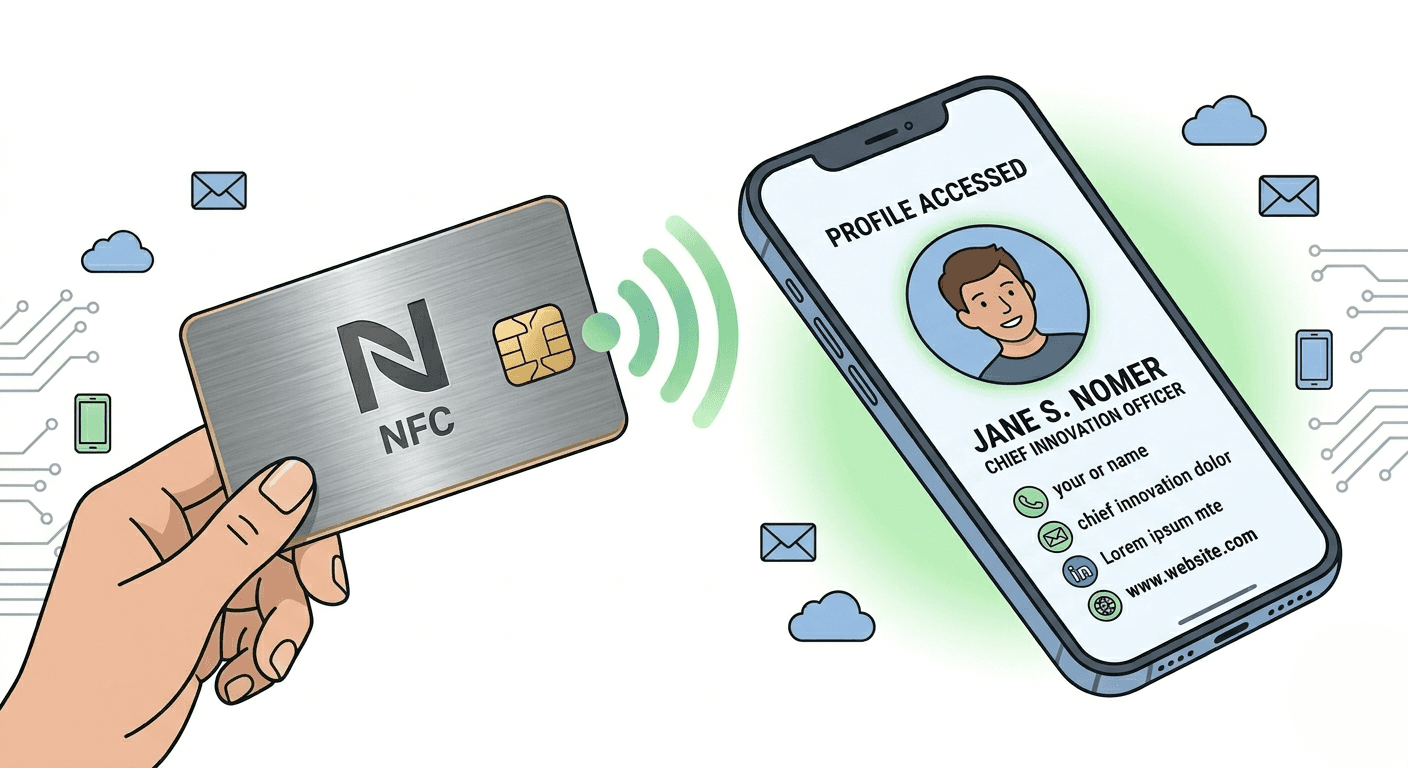
NFC business cards promise tap-to-share networking, but are they worth it? Honest breakdown of how they work, real costs, pros, cons, and who should buy one.
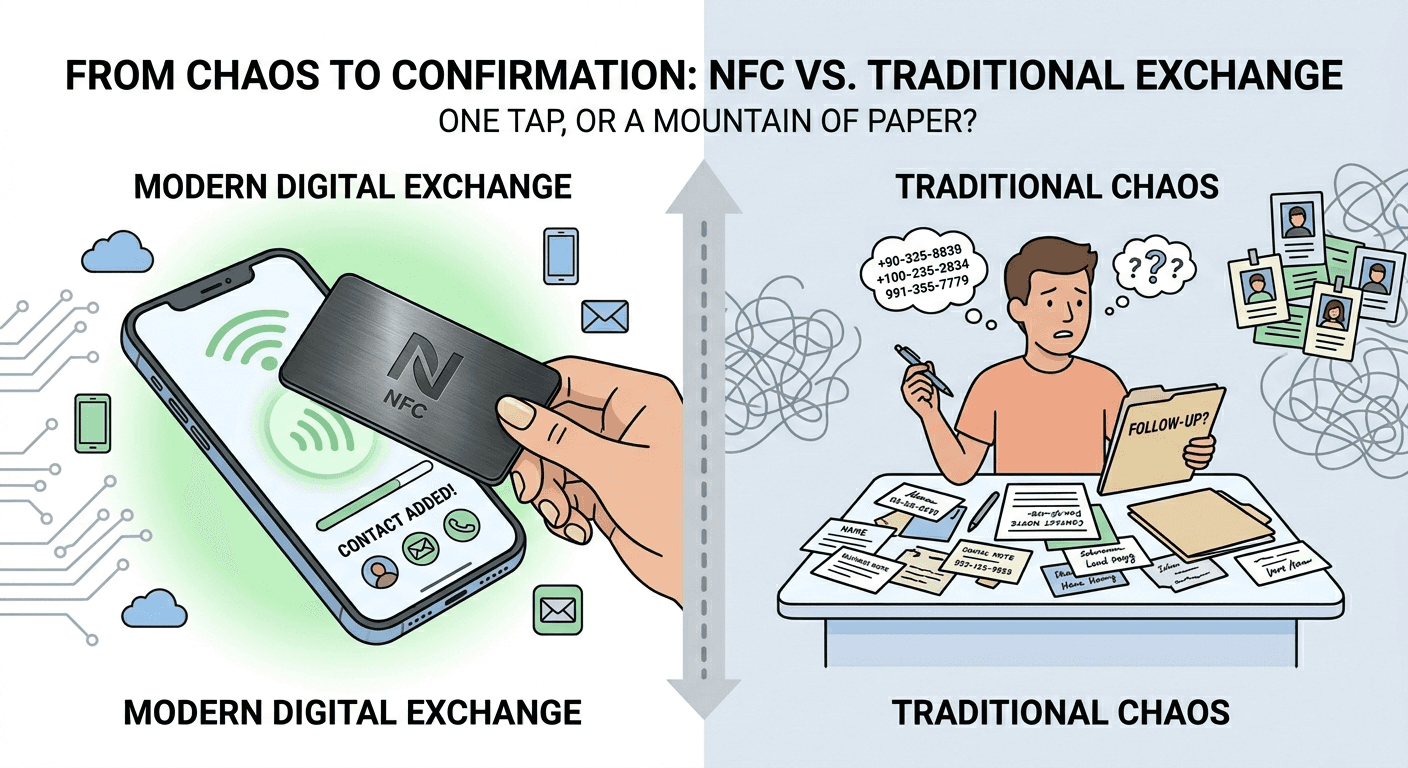
An NFC business card is a physical card with a small NFC chip embedded inside. NFC stands for Near Field Communication, the same short-range wireless tech that powers Apple Pay and Google Pay. The chip holds a tiny bit of data, usually a URL that points to your digital profile page.
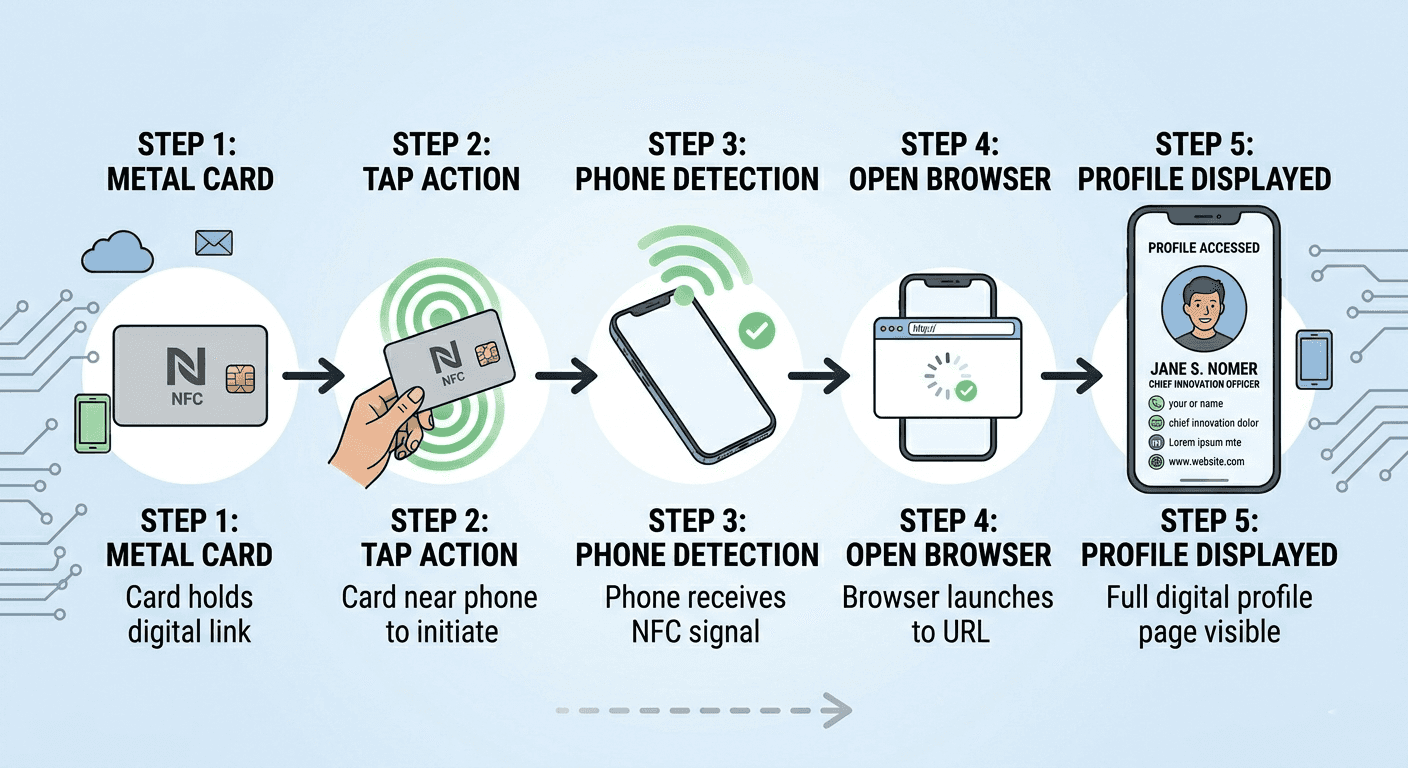
When someone taps their phone against the card, the phone reads that URL and opens your profile in the browser. The profile usually shows your name, title, company, photo, contact buttons, and links to your website or LinkedIn. Some vendors let you add a vCard download button so the receiver can save you directly to their phone’s contacts.
People also call these tap business cards, smart business cards, or digital business cards with NFC. They are not the same as a purely digital card, which is just a shareable link with no physical object. More on that distinction below.
How Do NFC Business Cards Actually Work?
The flow is simpler than the marketing makes it sound:
You buy a card with an NFC chip, usually an NTAG 215 or 216.
You sign up with the vendor and build a profile page on their platform.
The vendor writes your profile URL to the chip, or you write it yourself using a phone app.
At a meeting, you hand the card to someone and ask them to tap it on the back of their phone.
Their phone reads the URL and opens your profile. They can then save your details or hit the contact buttons.
On iPhone 11 and newer, NFC reading happens automatically from the lock screen. No app, no setup. On older iPhones (iPhone 7 to XS), the user has to open the Control Center NFC reader first. On Android, NFC needs to be enabled in settings, which it usually is by default on phones made after 2018.
The chip itself has no battery. It pulls a tiny amount of power from the phone’s NFC field during the tap, which is why these cards never need charging and can last for years.
This is where most explainer articles get lazy. Here is the clean comparison:
Factor | Paper card | QR code card | NFC card |
|---|---|---|---|
Cost per card | $0.10 to $0.50 | $0.15 to $0.60 | $20 to $80 |
Works on any phone | Yes (manual entry) | Yes (camera scan) | iPhone 11+, most Androids |
Reusable | No | Yes | Yes |
Update info without reprinting | No | Yes (if dynamic QR) | Yes |
Requires subscription | No | Sometimes | Often |
Feels novel | No | No | Yes |
Works when battery is dead | Yes (for the sharer) | Yes | Yes |
Receiver needs to open camera | No | Yes | No (tap is faster) |
The honest read: QR codes do 90 percent of what NFC does for 1 percent of the cost. What NFC buys you is the tap gesture itself, which is smoother and more memorable than asking someone to open their camera. Whether that gesture is worth $40 and a monthly subscription is the real question.
1. Reusability and zero reprints:
Change jobs, change titles, update your number, and the card still works. You just edit your profile on the vendor’s dashboard. For anyone whose role shifts frequently, this alone can justify the cost.
2. Richer profiles than a paper card fits:
A paper card holds maybe 10 data points. An NFC profile can hold your bio, portfolio links, calendar booking link, video intro, social accounts, and a vCard download button. That depth matters for consultants, creators, and execs.
3. The tap gesture is genuinely memorable:
People remember the interaction. At a networking event where everyone is trading paper cards, the tap stands out. That is not nothing, especially for personal branding.
4. No app required on the receiver’s side:
This is the big upgrade over older “digital card” apps that demanded both people install software. Modern NFC cards just open a web page.
5. Battery-free and durable:
The chip has no moving parts and no battery. Metal NFC cards in particular can survive years of wallet use.
1. The subscription is where the cost actually lives. A $40 card sounds cheap until you realize the profile page often costs $6 to $15 per month. Over two years, that is $144 to $360 on top of the card itself. Stop paying and the link on your chip can go dead.
2. It does not solve the real problem. The hard part of networking is not sharing your details. It is remembering who you met, why, and following up on time. An NFC card moves your info to their phone faster. It does nothing to capture what they told you, what they needed, or when to call them back. That is a workflow problem, not a card problem. (For teams, this is exactly why tools like Habsy’s event lead capture workflow exist.)
3. Receiver friction at scale. Tapping works great one-on-one. At a booth with 200 visitors per day, asking every person to unlock their phone, accept the URL prompt, tap a save button, and then actually look at the profile later is slower than scanning their badge or card into a structured database. Booth teams who switch from scanners to NFC tap cards usually switch back.
4. Social awkwardness is real. A meaningful percentage of people, especially outside the US and tech circles, have never tapped a card on a phone and will fumble the first time. You become the person explaining NFC instead of talking about your work.
5. iPhone quirks. Writing a new URL to the chip from an iPhone requires the phone to be awake and unlocked with the vendor’s app open. Reading the chip is automatic on iPhone 11 and later, but earlier iPhones need the user to start the NFC reader manually.
6. Scratching and screen protectors. Metal NFC cards can scratch phone backs and cases. Some thick cases and magnetic wallets (including MagSafe accessories) block the NFC signal and force a second or third tap.
7. Lock-in. Your profile lives on the vendor’s platform. If they raise prices, go out of business, or change their terms, your card either stops working or you are stuck. Export options vary. Read the fine print.
Vendors lead with the card price. That is the smallest part. Here is a realistic two-year total for the common options:
Option | Card price | Subscription | 2-year total |
|---|---|---|---|
Basic plastic NFC card (no subscription) | $15 to $25 | $0 | $15 to $25 |
Popular mid-tier (Blinq, Popl, Linq) | $25 to $50 | $6 to $10/mo | $169 to $290 |
Premium metal card (V1CE, Mobilo) | $60 to $120 | $10 to $15/mo | $300 to $480 |
Free digital-only (link or QR) | $0 | $0 | $0 |
Paper cards (500 reprints per year) | $30/yr | $0 | $60 |
The honest comparison is not NFC vs paper. It is NFC vs a free digital card link you paste into your email signature. The link does most of the same work. You are paying the NFC premium for the physical object and the tap gesture.
Who Should Actually Buy One?
Good fit: - Individual sellers, consultants, and execs who meet 5 to 20 people per week in one-on-one settings.
Founders and creators building a personal brand where the gesture itself is part of the impression.
People whose title or company changes often and who hate reprinting.
Real estate agents, financial advisors, and anyone whose job is relationship-led.
Bad fit: - Trade show and expo booth teams. At volume, you need structured capture, qualification fields, and de-dup before your CRM sees the data.
NFC cards are a one-way broadcast. They do not help you capture who you met. Booth teams are better served by a purpose-built event lead capture platform with a universal badge scanner and batch card capture.
Field sales reps meeting dozens of contacts per day. Same reason. You need to capture their info fast and qualify on the spot, not hand them yours.
Anyone on a tight budget who already has a digital profile link. A free link in your email signature and a paper backup is 95 percent of the value.
People who meet mostly in regions or industries where tap-to-share is still unfamiliar. The explanation overhead kills the gesture.
For the right person, yes. For most people, no, at least not for the reasons the vendors push.
If you are a solo professional whose personal brand benefits from a memorable gesture, and you will actually update your profile and use the analytics, an NFC card is a reasonable $150 to $300 investment over two years. It is a nice object, it is reusable, and the tap is genuinely smoother than a QR code.
If you are buying one because you think it will fix your networking follow-up, it will not. The card only moves your information outward. The real pipeline problem is capturing, qualifying, and following up on the people you meet, and no chip on earth solves that. That problem needs a workflow: structured capture, notes while the context is fresh, a reminder for tomorrow, and a clean export to your CRM. Your contacts stay under your control and you can export or delete any time.
The honest answer: buy an NFC card if you want a better-looking way to share yourself. Buy a capture workflow if you want to actually close the loop on the people you meet. They are different tools for different halves of the same problem.
FAQs
Do NFC business cards work with iPhone? Yes, on iPhone 11 and newer they work automatically from the lock screen with no setup. On iPhone XS and earlier, the receiver has to open the NFC reader from Control Center first. Writing a new URL to the chip from an iPhone requires the vendor’s app.
Do NFC business cards work on Android? Yes, on most Android phones made after 2018. NFC needs to be enabled in settings, which it usually is by default. Very old or budget Androids may not have NFC hardware at all.
Are NFC business cards safe? Can they be hacked? The chip itself only stores a URL. It cannot install apps, steal data, or access the receiver’s phone. The main risk is someone writing a malicious URL to a stolen card, which matters only if you lose the card. You can also lock most chips to prevent rewriting.
Do you need an app for NFC business cards? The receiver does not need an app on iPhone 11+ or modern Android. The URL just opens in their browser. The sender usually needs the vendor’s app or web dashboard to edit their profile.
How long do NFC business cards last? The chip has no battery and no moving parts. A well-made card can last 5 to 10 years of normal wallet use. Metal cards outlast plastic ones. The bigger risk is your vendor’s subscription lapsing or the company shutting down, which can take the profile page offline.
What is the difference between a digital business card and an NFC business card? A digital business card is just a shareable link or QR code to your profile. An NFC business card is a physical object with a chip that opens the same kind of link when tapped. The NFC version adds the tap gesture and a physical artifact, at a much higher cost.
Can one NFC card be used by multiple people? No. Each card writes to one profile URL. Teams who want this usually buy one card per person and manage profiles from a shared dashboard.
Related Reading
Try the other half of the problem. An NFC card shares your info. Habsy captures theirs, adds voice notes, tags, reminders, and AI enrichment, then exports a clean CRM-ready CSV by tomorrow. See Habsy in action or check pricing.