Blog
You didn't lose leads at the event. You lost them after it.
The conversations were strong, interest was clear, and intent was real. Yet a few days later, those high-value leads disappear. Not because they were poor prospects, but because the system behind capturing and acting on them failed. Most professionals assume lead loss is a networking problem, but in reality, it is a workflow problem.
If you want to understand why sales teams lose event leads, you have to look beyond the booth. The real issue begins after the interaction, when information becomes fragmented and momentum starts to fade. The gap between meeting someone and acting on that connection is where most opportunities are lost.
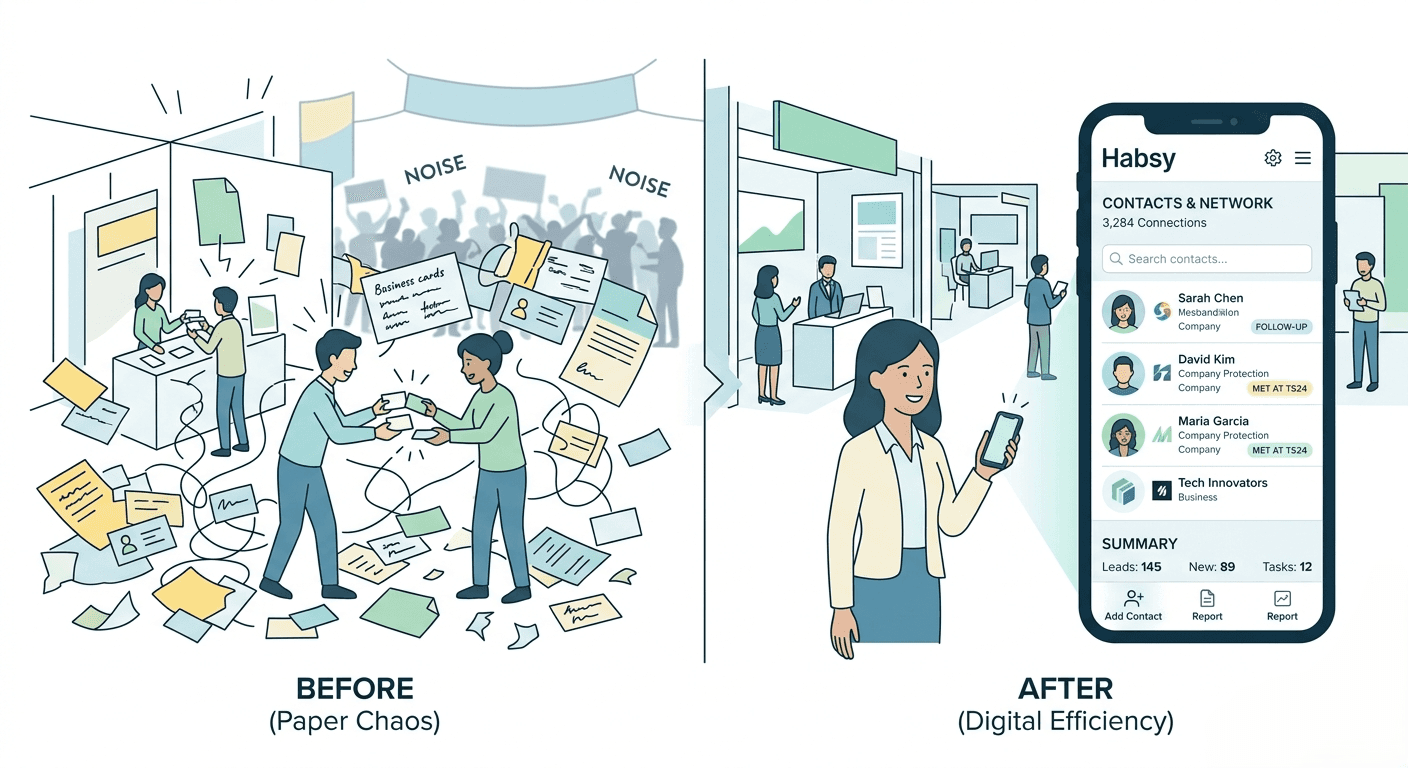
Why do professionals lose high-value leads after events? Learn the capture, context, and follow-up gaps that cause leads to go cold and how to fix them.
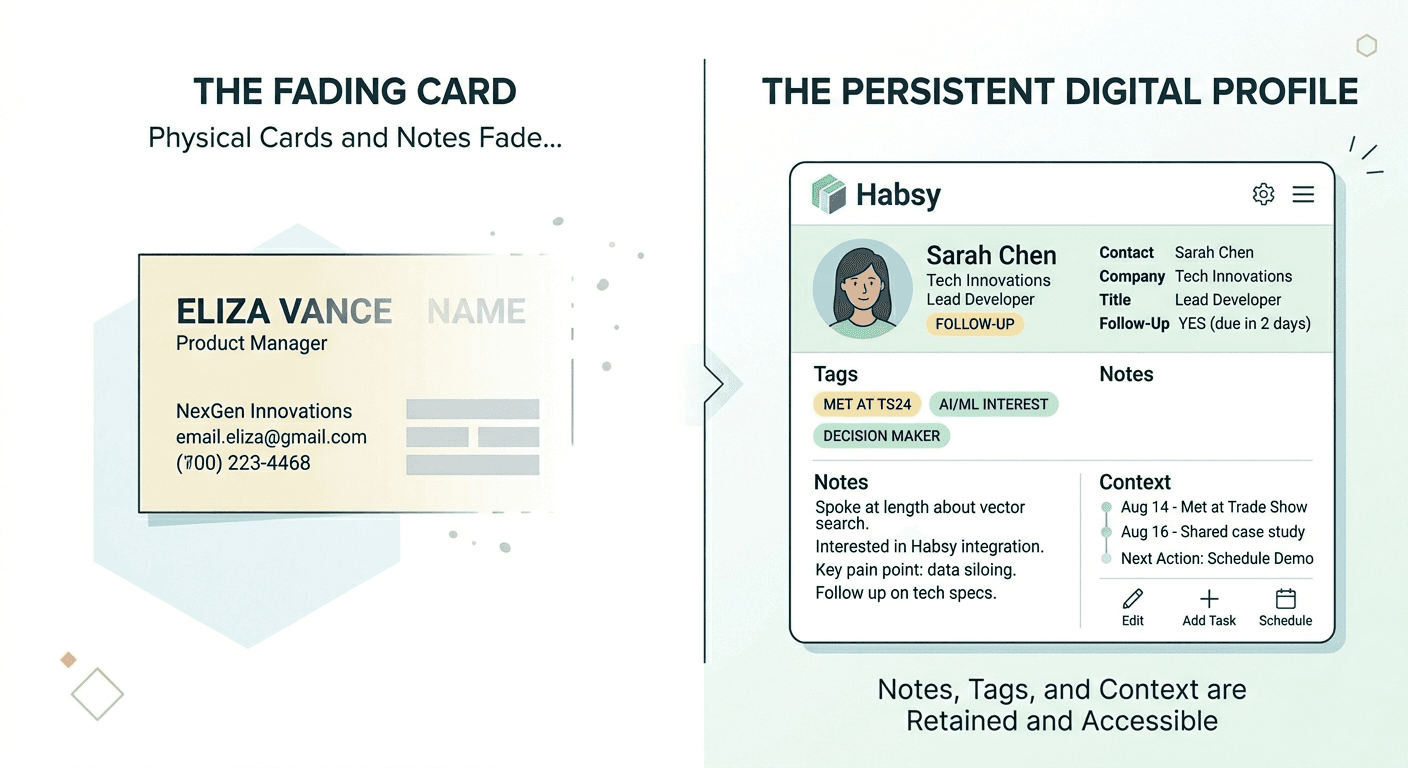
Leads are rarely lost during conversations. They are lost in the transition from interaction to execution. At the event, everything feels fast and intuitive, but once the event ends, contacts are scattered across business cards, notes, and memory. Without structure, even strong opportunities become difficult to prioritize or act on.
This breakdown typically happens in three stages: capture without structure, context without documentation, and follow-up without timing. Each stage weakens the quality of the lead, until it no longer feels actionable. By the time teams revisit their contacts, the clarity of the original conversation is gone, and with it, the opportunity.
Tools like Habsy address this by keeping capture, context, and follow-up inside a single workflow. When a card is scanned or a badge is tapped, the contact does not land in a flat list. It lands in a structured record with fields for notes, intent signals, and a follow-up reminder, all set before the next conversation starts.
The Capture Problem Most Teams Ignore
Capturing contact details is not the same as capturing usable leads. Most teams collect names, companies, and phone numbers, but fail to capture intent, urgency, or next steps. This creates a surface-level dataset that looks complete but lacks the depth needed for meaningful follow-up.
Without a clear event lead capture process, teams end up with lists instead of prioritized opportunities. There is no way to distinguish between a casual interaction and a high-intent prospect. As a result, follow-up becomes broad and unfocused, reducing the chances of conversion even for the most valuable leads.
Habsy addresses this at the point of capture. When a business card is scanned or a QR badge is tapped, intent signals can be marked immediately: interest level, urgency, product line discussed. By the time a rep moves to the next conversation, that contact already has a priority score attached. The list is ranked before the event ends, not reconstructed from memory three days later.
Capturing context in real time, whether through quick notes or structured inputs, ensures that the original conversation can be revisited with clarity. This is what enables relevant follow-up rather than guesswork.
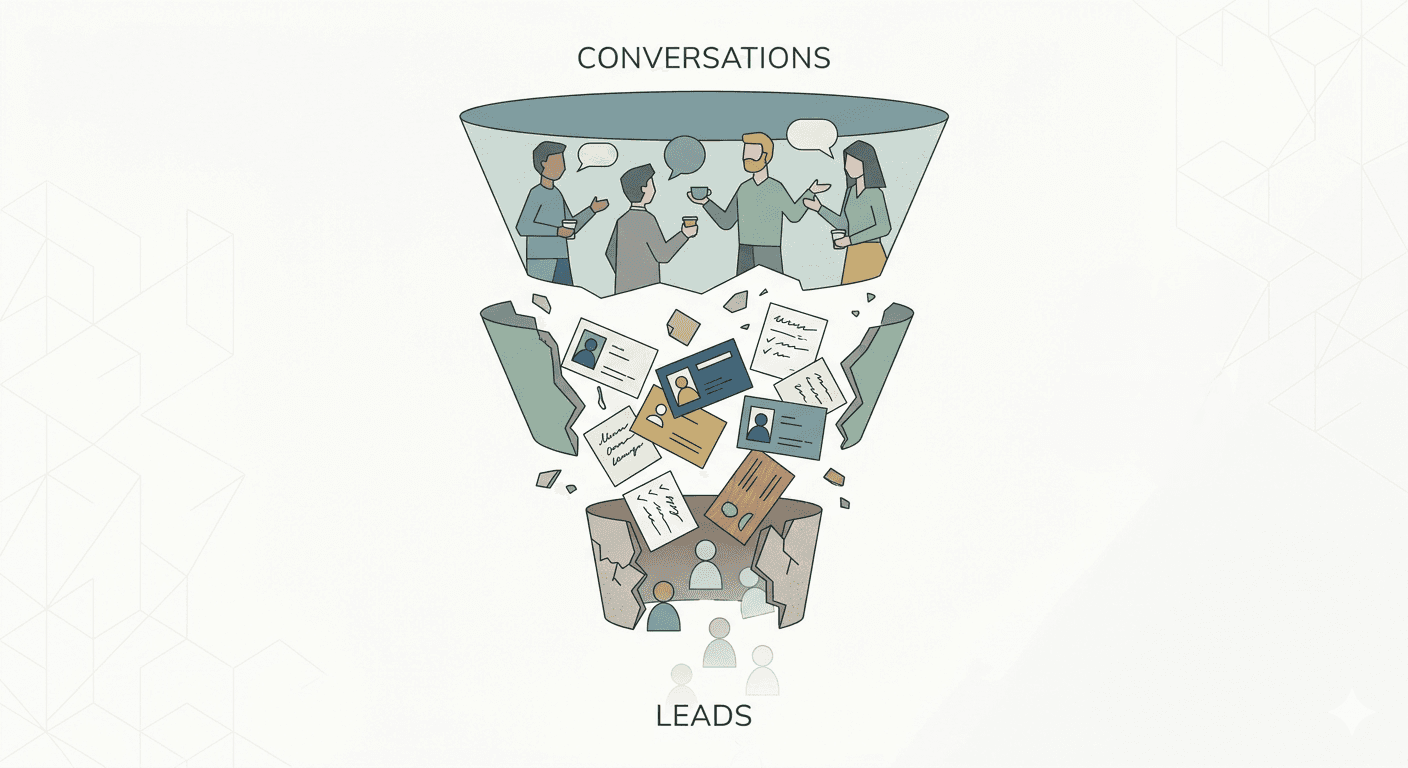
A high-value lead is defined by context, not just contact information. What the person was looking for, what problem they mentioned, and what was agreed during the conversation are the details that drive effective follow-up. Yet most of this context is never captured in a structured way.
Instead, it lives in memory, incomplete notes, or fragmented inputs that are difficult to interpret later. When teams return to their leads, they see names but not meaning. This leads to generic outreach that fails to reflect the original conversation, which is one of the primary reasons why leads go cold after events.
Habsy's voice notes feature is built for exactly this gap. After a conversation ends, a rep speaks a 10-second note: what the person needs, what was agreed, what the next step is. That note is transcribed, attached to the contact, and searchable by keyword inside the app. When follow-up happens two days later, the rep reads the note and writes a message that reflects the actual conversation, not a generic template that could have been sent to anyone.
Reducing this delay often comes down to removing friction. When follow-up steps are defined at the time of capture, teams can act immediately instead of revisiting and reconstructing information later.
Speed is one of the most critical factors in converting event leads. The value of a conversation declines rapidly after the event, especially when follow-up is delayed. Many teams spend days organizing data before taking action, which weakens the connection they built.
In most cases, follow-up happens 48 to 72 hours later, when the context is already fading and the prospect has shifted focus. High-performing teams operate differently. They treat follow-up as a continuation of the conversation, not a separate task. Acting within the first 24 hours significantly increases response rates and keeps the interaction relevant.
Habsy shortens this window in two ways. First, reminders are set at the point of scan, so there is no reliance on memory or a separate to-do list to trigger action. Second, AI-generated email and WhatsApp templates pull context from the contact's record and voice note, so the first message is ready to send the same evening without writing from scratch. The follow-up does not wait for the data to be organized because the data was already organized at capture.
A well-designed workflow reduces the number of steps between capture and action. When information flows smoothly from one stage to the next, teams spend less time organizing and more time engaging with high-value leads.
Most professionals do not lose leads because they lack effort. They lose them because their process introduces friction at every step. Manual data entry, scattered notes, and delayed decision-making create a system where action is always postponed.
This is why trade show leads disappear even when initial engagement is strong. The workflow does not support immediate, structured action. Instead of moving from conversation to follow-up seamlessly, teams are forced into a cycle of cleanup and reconstruction, which leads to missed opportunities.
For teams operating across multiple events, Habsy Platform adds another layer of reliability. Managers can see every contact captured by every team member in real time, across all campaigns. There is no end-of-show consolidation, no chasing exports, no guessing who followed up on which lead. The workflow is consistent regardless of how many reps are working the floor, because the system enforces structure rather than relying on individual discipline.
The difference is not in how top teams network. It is in how they handle what comes next. They capture information in a structured way, attach context during the interaction, and define the next step before the conversation ends. This removes ambiguity and ensures that every lead has a clear path forward.
More importantly, they reduce the time between capture and action. Follow-up is not treated as a delayed task but as an immediate continuation of the interaction. By maintaining context and acting quickly, they preserve the quality of the lead and significantly improve conversion outcomes.
Teams using Habsy assign each captured contact to the right team member before leaving the venue, with a reminder already set. The contact is enriched with company and role context at the tap of a button, so the person doing the follow-up knows who they are reaching out to and why before they write a single word. When this shift happens, the focus moves from volume to quality. Instead of measuring success by the number of contacts collected, teams measure how many conversations turn into meaningful next steps.
How Habsy Closes the Gap Between Conversation and Follow-Up
The three problems described above: unstructured capture, lost context, and delayed action, are not independent. They are stages in the same broken workflow. Habsy is built to address all three at the point of capture, before any of them have a chance to compound.
Structured capture in the moment: Scan a business card, QR badge, or NFC tag and the contact lands in a structured record immediately. No manual entry, no loose stack of cards to deal with later. Every contact captured through Habsy arrives with a consistent format, ready to act on.
Context that stays with the contact: After the conversation, add a voice note in 10 seconds. Speak the key takeaway, the product they mentioned, the next step you agreed on. It is transcribed and attached to the contact, searchable by keyword inside the app. The context that normally fades by the next morning is preserved exactly as you captured it.
Intent signals at the point of scan: Mark each contact's interest level, urgency, and priority before you move to the next conversation. By the time you leave the venue, your list is already ranked. You know who to call first without having to reconstruct it from memory.
Follow-up that starts the same day: Set a reminder at the point of scan. Generate a personalized email or WhatsApp message using AI, informed by the contact's details and your voice note, without switching to another app. The follow-up is ready before the event ends.
For teams, Habsy Platform adds visibility across the whole operation: Managers can see every contact captured by every team member, across every campaign and event, in real time. No consolidation, no chasing exports. The leads are already structured, ranked, and ready to move into your CRM.
The workflow problem this post describes is solvable. Habsy replaces the gaps between capture, context, and follow-up with a single, connected system so high-value leads do not disappear after events. They convert.
Professionals do not lose high-value leads because they fail to connect. They lose them because their system fails to support action. When capture lacks structure, context is lost, and follow-up is delayed, even the strongest opportunities fade.
Fixing this is not about working harder. It is about building a workflow where every conversation leads to a clear next step. When that system is in place, leads do not disappear. They convert.
FAQs:
1. Why do professionals lose high-value leads after events?
A: Professionals lose high-value leads after events because the follow-up process breaks down. While conversations are strong during the event, the lack of structured capture, missing context, and delayed follow-up causes leads to lose momentum and eventually go cold.
2. Why do sales teams lose event leads even after strong conversations?
A: Sales teams often lose event leads because they focus on collecting contacts rather than capturing intent. Without clear context and next steps, even high-quality conversations turn into generic follow-ups that fail to convert.
3. How quickly should you follow up after an event?
A: Follow-up should ideally happen within 24 hours. This ensures that the conversation is still fresh in the prospect’s mind and increases the likelihood of a response. Delays beyond 48 hours significantly reduce engagement.
4. What is the biggest mistake in post-event lead management?
A: The biggest mistake is treating follow-up as a separate task instead of part of the same workflow. When teams delay action to organize data, they lose context and weaken the connection built during the event.
5. Why do leads go cold after trade shows?
A: Leads go cold when context is lost and follow-up is delayed. Without personalized and timely communication based on the original conversation, prospects lose interest or move on to other priorities.