Blog
Your sales reps are spending more time typing contacts into spreadsheets than closing deals. Here is what that is actually costing you, and how to stop it.
TL;DR |
|
|
|
|
|
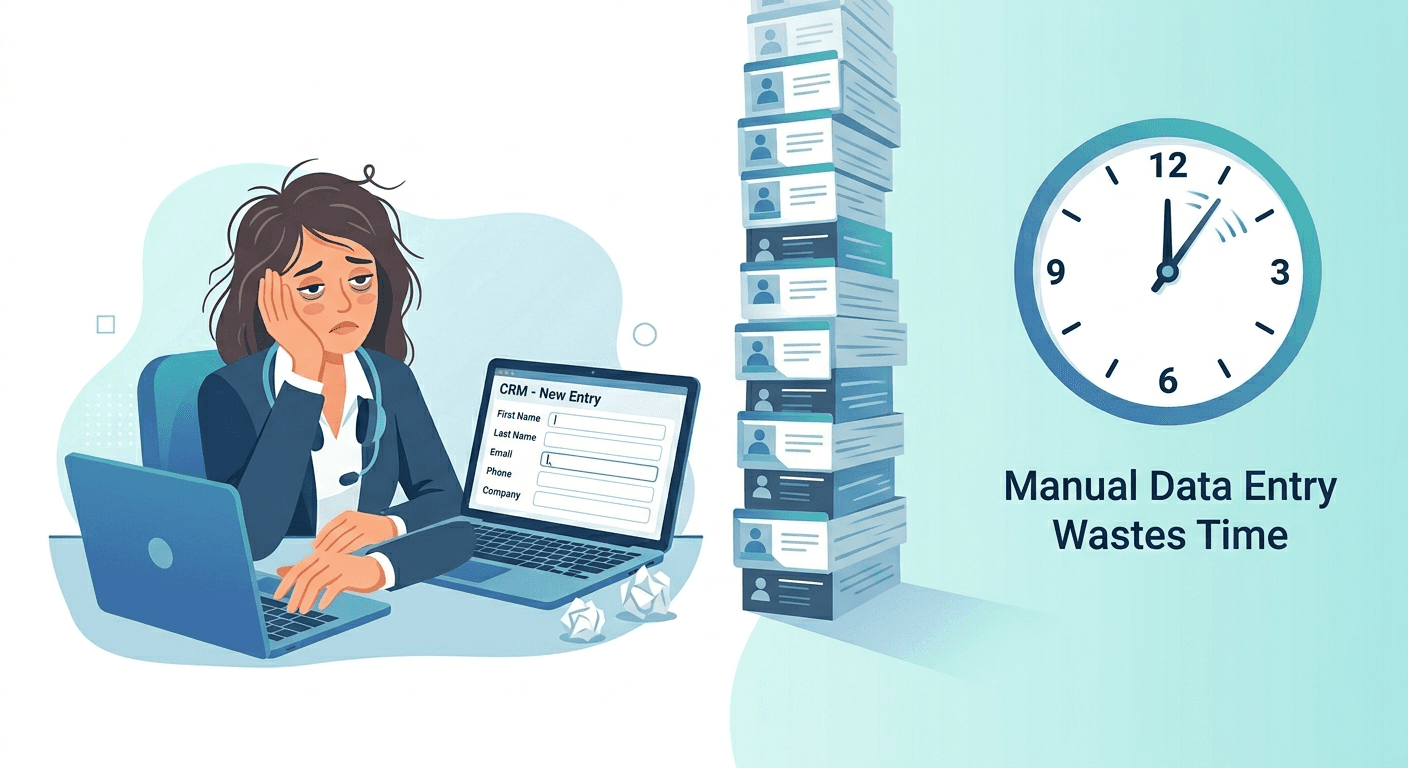
Manual contact entry costs enterprise sales teams up to $2.7M per year in salary hours, lost pipeline, and dirty CRM data. Learn how to eliminate it with automated lead capture.
Your enterprise sales team just returned from a three-day industry trade show. They worked the booth for 30 hours, scanned badges, collected business cards, and had hundreds of conversations. Now it is Monday morning. The cards are in a pile. The badge scans are in a CSV from the event organiser. And the actual follow-up has not started, because nobody has entered the contacts yet.
What happens next is the most expensive, least-measured waste in enterprise sales: manual contact entry. Reps type names, emails, phone numbers, company names, and job titles into a CRM one by one. They create duplicates. They misspell emails. They skip fields because they are behind on quota and the entry feels pointless.
By Wednesday, the follow-up window has closed. The hottest leads have already heard from your competitors. And your CRM is full of half-complete records that nobody trusts. This article puts a real number on that process, and shows you how to eliminate it.
The Time Tax: What Manual Data Entry Actually Costs
According to Salesforce's 2026 State of Sales report, sales reps spend 60% of their time on non-selling tasks. CRM data entry is one of the largest single contributors. Separate research from CRM.org found that 32% of sales reps spend more than one hour every day on CRM data entry alone.
The data entry cost formula Team of 10 reps at $120K On-target Earnings, spending 5.5 hours per week on data entry:10 x 5.5 x $57.70 x 52 = $165,000 per year. The equivalent of 1.4 full-time employees who generate zero revenue. For a 20-person team, that number doubles to $330,000. |
Industry analysts call these ghost employees: full-time-equivalent headcount on your payroll that produces no pipeline, no deals, and no revenue. For a 50-rep enterprise team, the ghost employee count reaches seven.
Events make it worse
Enterprise teams that work trade shows face a volume spike that compounds the baseline cost. A five-rep booth at a major show might capture 200 to 400 contacts over three days. After the event, those contacts need entering, enriching, deduplicating, and routing before the follow-up window closes.
Scenario | Contacts Captured | Manual Entry Time | Cost at $57.70/hr |
Single trade show (5 reps) | 300 | 25 to 40 hours | $1,440 to $2,310 |
Quarterly calendar (4 shows/year) | 1,200 | 100 to 160 hours | $5,770 to $9,230 |
Enterprise programme (12 shows/year) | 3,600 | 300 to 480 hours | $17,310 to $27,700 |
Remove Duplicates and enrichment overhead | +40% | +120 to 192 hours | +$6,920 to $11,080 |
For an enterprise team running a full event programme, the annual cost of manual contact entry from events alone can exceed $35,000 on top of the $330,000 baseline. That is close to $400,000 per year in data entry labor from a team whose job is to sell.

The direct cost of manual data entry is significant. The indirect cost, the revenue you lose because follow-up is delayed, is far larger.
Research published in the Harvard Business Review found that leads contacted within five minutes of expressing interest are 21 times more likely to qualify than those contacted after 30 minutes. In trade show contexts, where every competitor is collecting the same leads, industry data consistently shows that contacts followed up within 24 to 48 hours convert at significantly higher rates than those left for a week or more.
Manual contact entry creates a structural bottleneck between capture and follow-up. Here is what the timeline looks like for most enterprise teams:
Day | What Actually Happens | What Should Happen |
Day 1 (event ends) | Reps fly home. Cards in a bag. | Contacts exported, cleaned, in CRM by midnight |
Day 2 to 3 | Reps catch up on email and internal meetings | Personalized follow-ups sent to hot leads |
Day 4 to 5 | Someone starts entering contacts manually | Warm leads receive resource and case study emails |
Day 6 to 7 | Half the contacts entered. No enrichment. | Cool leads added to nurture sequence |
Day 8 to 14 | Entry finished. Missing fields everywhere. | Pipeline reviews using complete event data |
Estimating the lost pipeline 300 leads at a show. 10% are genuinely hot: 30 high-intent contacts. If delayed follow-up drops conversion by 30 to 50% (a conservative estimate), and your average deal value is $50K, that is $450K to $750K in pipeline that never materializes. Per event. |
Even when reps complete the entry, the data they produce is unreliable. This is not a criticism of the reps. It is a structural problem: you are asking highly skilled, highly compensated salespeople to do a low-skill, high-precision task that they have no incentive to do well.
The data quality numbers
37% of sales reps admit to fabricating CRM data because the entry burden conflicts with quota pressure.
Only 2% of sales teams have greater than 90% confidence in their own CRM data.
70% of CRM data remains incomplete despite billions invested in CRM platforms globally.
70.8% of B2B contact data changes something material within 12 months: job title, company, email, or phone.
The downstream consequences are concrete. Pipeline forecasts become unreliable when deal stages are not updated and lead sources are not tagged. Duplicates waste rep time and erode prospect trust when two reps send conflicting messages to the same contact. Event ROI becomes impossible to measure when source tags are missing. And CRM adoption collapses: the industry average sits at 19%, primarily because reps forced into extensive manual entry see the CRM as a burden rather than a tool.
The morale cost
Enterprise sales reps are hired to build relationships and close high-value deals at $120,000 to $250,000 OTE. Asking them to spend five to six hours per week on data entry is the equivalent of hiring a surgeon and asking them to file insurance paperwork between operations.
Annual sales turnover sits at approximately 25%. Exit interview data consistently shows that administrative burden is a top-five reason reps leave. Each departure costs six to twelve months of ramp time for the replacement, plus recruiting costs. Top-performing reps spend 34 to 40% of their time selling. Bottom performers spend 23%. The gap correlates directly with admin load. Manual data entry is not just a nuisance. It is a measurable drag on the metric that matters most.
The solution is not better discipline. It is not a mandatory CRM field. It is not Friday afternoon data-entry sprints. All of these approaches have been tried and the data is clear: they do not work. The fix is structural. You need to remove the manual step entirely.
Four principles
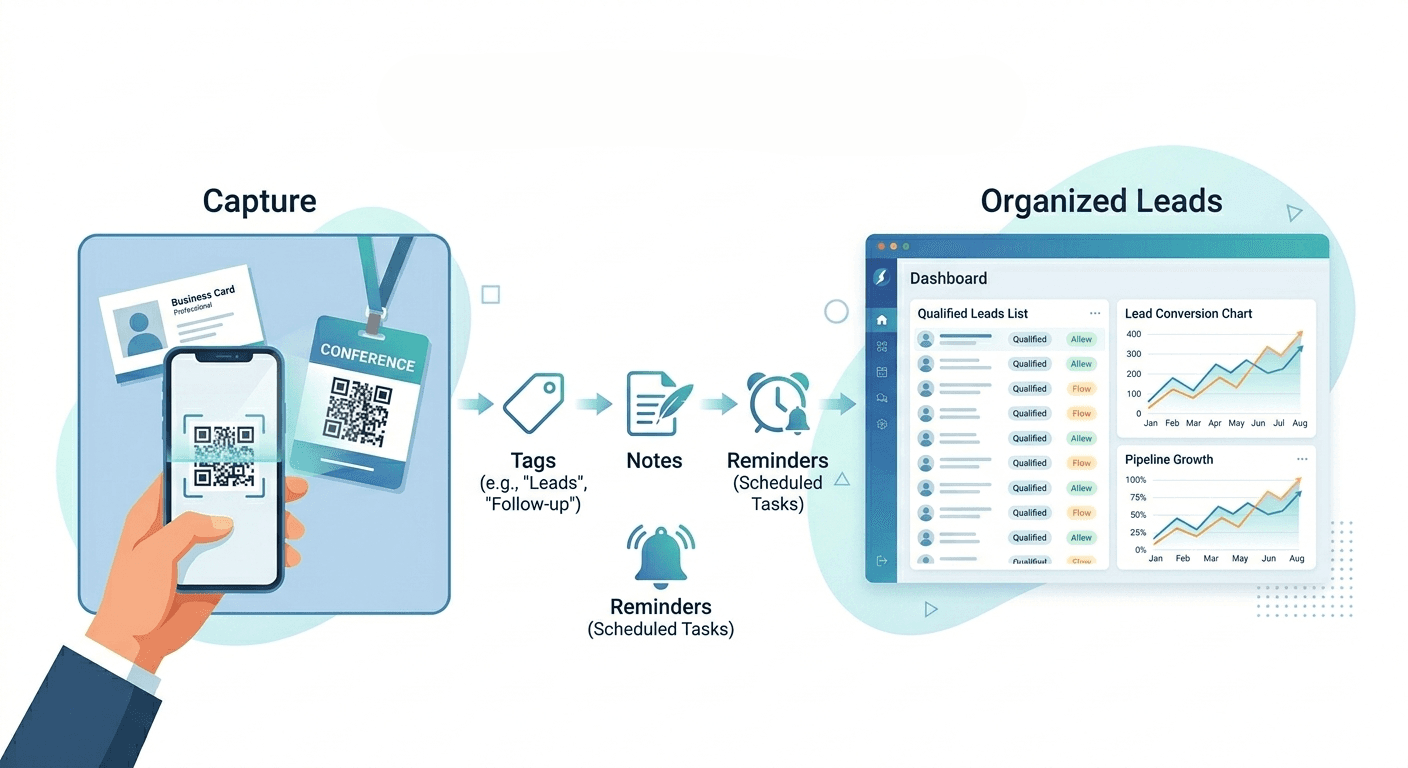
Capture digitally at the source. If a contact is scanned from a badge, photographed from a business card, or exchanged via a digital card, the data never needs to be retyped. The capture itself is the entry.
Qualify at the moment of capture. Reps lose context between an event and the CRM because they capture the who but not the why. Add qualifier fields, voice notes, and follow-up reminders at capture. The record arrives in the CRM ready for action, not just storage.
Deduplicate before import, not after. CRM deduplication tools are unreliable and disruptive on a live database. Match on email, then phone, then name plus company, and merge records before a single contact enters the CRM.
Export clean, CRM-ready data. The output should be a clean CSV with standardised fields, all qualifier data included, duplicates removed, and column headers mapped to your CRM import schema. One upload. No reformatting.
How Habsy eliminates manual contact entry Habsy is a contact intelligence and lead capture platform built for trade shows and events. Scan business cards and QR badges in one app with no retyping. Add custom qualifier fields at capture. Record voice notes for conversation context. Set follow-up reminders per contact. Automatic deduplication before export. Clean, CRM-ready CSVs within 24 hours of event close. Over 25,000 exhibitors across 70 plus countries use Habsy to turn event contacts into CRM-ready pipeline without a single minute of manual data entry. |
Enterprise teams that eliminate manual contact entry from their event workflow report a consistent set of improvements across every metric that matters:
Metric | Before Manual Entry | After Automated Capture |
Time from event to first follow-up | 5 to 7 business days | Less than 24 hours |
Contact records with complete fields | 30 to 50% | 90% or more |
Duplicate rate in CRM | 15 to 25% | Less than 3% |
Reps' confidence in CRM data | Low (2% rate above 90%) | High (all data captured at source) |
Event ROI attribution | Anecdotal | Measurable by source tag |
Hours per rep recovered per week | 0 | 4 to 6 hours |
Pipeline from events (first 90 days) | Baseline | 30 to 50% increase from faster follow-up |
The most underappreciated change is how reps perceive the CRM. When contacts arrive pre-enriched, deduplicated, and tagged with source and qualifier data, the CRM becomes a tool that helps reps sell rather than a system that punishes them with admin. Adoption rises, data quality improves, forecasting becomes reliable, and the CRM investment finally delivers its promised return.
If your team is ready to stop paying the data entry tax, Habsy is purpose-built for exactly this workflow. Try it free at habsy.ai and give your sales team back the hours they need to sell.
1. How much does manual CRM data entry cost a sales team?
Manual CRM data entry can cost a sales team hundreds of thousands of dollars per year in lost selling time alone. In the blog’s example, a 10-person team earning $120K OTE and spending 5.5 hours per week on data entry loses about $165,000 annually.
2. Why is manual contact entry a problem after trade shows?
Trade shows create a surge of leads from business cards, badge scans, and conversations, but manual entry slows follow-up. That delay causes lost context, duplicate records, incomplete CRM data, and missed opportunities during the most important 24 to 48 hour follow-up window.
3. How does delayed follow-up affect event lead conversion?
Delayed follow-up lowers conversion rates because hot leads cool off quickly. The blog notes that if follow-up is delayed after an event, teams can lose substantial pipeline value, with estimated losses of $450K to $750K per event in some scenarios.
4. What causes poor CRM data quality in sales teams?
Poor CRM data quality usually comes from manual entry errors, skipped fields, duplicate contacts, and outdated information. When reps are under quota pressure, data entry becomes inconsistent, making forecasting, attribution, and follow-up less reliable.
5. How can sales teams automate contact entry from trade shows and events?
Sales teams can automate contact entry by using a lead capture workflow that scans business cards and QR badges, adds qualifiers and notes at the moment of capture, removes duplicates before import, and exports clean CRM-ready CSV files within 24 hours.