Blog
Contact data tells you who someone is. Contact intelligence tells you why they matter and when to act. Most sales teams have plenty of the first and almost none of the second.
TL;DR |
|
|
|
|
|
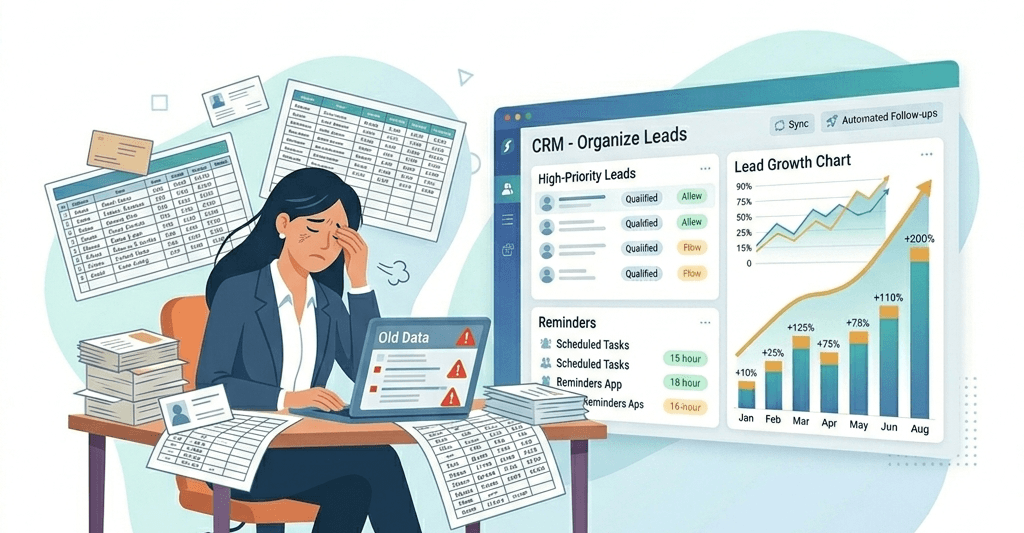
Contact data tells you who someone is. Contact intelligence tells you why they matter and when to act. Here is the difference and why it matters for sales.
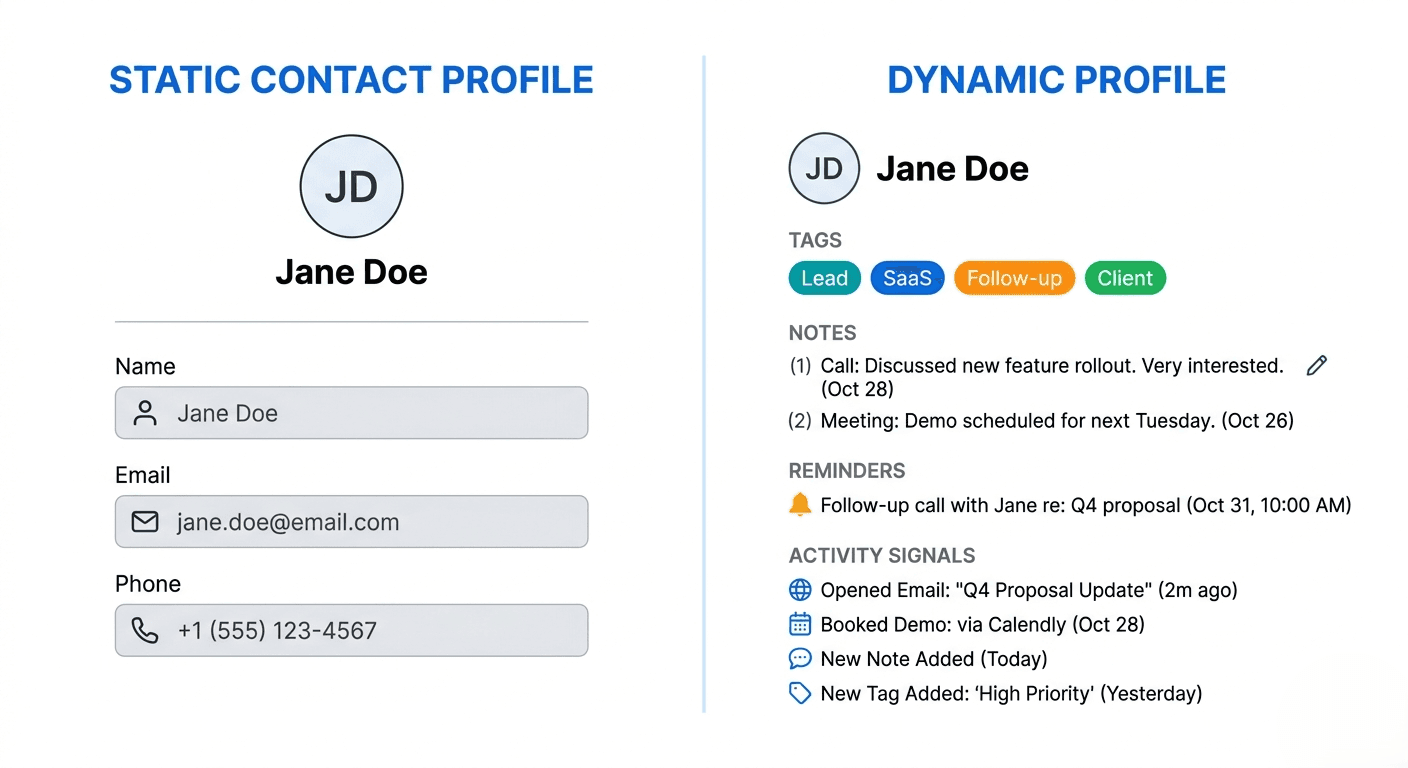
Contact data is the structured, factual record that identifies a person. It is the foundation of any CRM, outbound prospecting tool, or event lead list. If you can find it on a business card, a LinkedIn profile, or a badge scan, it is contact data.
Examples of contact data
The most common contact data fields include full name, work email, phone number, job title, company name, company size, industry, and location. More sophisticated B2B databases also include firmographic data such as revenue range and headcount, technographic data covering the tools a company uses, and basic demographic signals like seniority level or department.
When you export a CSV from a trade show badge system, everything in that file is contact data. When ZoomInfo, Apollo, or Cognism build a prospecting list for you, that is contact data. It is structured, searchable, and relatively easy to acquire at scale.
Where contact data comes from
First-party sources: business cards, badge scans, website forms, event registrations, and direct exchanges with a prospect.
Third-party sources: data providers like ZoomInfo, Apollo, Cognism, and Clearbit that build and maintain B2B contact databases from public and licensed sources.
CRM enrichment: tools that append missing fields to existing records using waterfall enrichment from multiple providers.
The limitations of contact data alone
Contact data answers one question: who is this person? It does not tell you whether they have buying intent, what conversation you already had with them, whether they are the right person to contact, or whether their information is still accurate. Research from Prospeo shows that 70.8% of B2B contact data changes something material within 12 months. A database full of contact data degrades into a database full of outdated contact data unless it is continuously refreshed and enriched with intelligence.
What Is Contact Intelligence?
Contact intelligence is the context layer built on top of contact data. The contact intelligence definition, as it has emerged across the sales and revenue operations industry, is: the signals, qualifiers, and behavioural indicators that tell you whether to reach out, when to reach out, and what to say.
A contact with strong contact intelligence is not just a name and an email. It is a record that tells you this person is the VP of Operations at a manufacturing company attending your booth at Aeroshow 2026, they expressed interest in your enterprise plan, they have a Q3 budget cycle, you left them a 15-second voice note with context from the conversation, and you have set a reminder for tomorrow at 10 AM.
That is what contact intelligence meaning looks like in practice. It transforms a static record into an actionable signal.
The five layers of contact intelligence
Layer | What It Captures | Where It Comes From |
Identity data | Name, email, phone, title, company | Business card, badge scan, form |
Firmographic context | Company size, industry, revenue, location | Third-party enrichment or LinkedIn |
Engagement signals | What they clicked, opened, or attended | Marketing automation, event systems |
Relationship context | Prior conversations, notes, meeting history | CRM activity, rep notes, voice memos |
Qualification layer | Interest level, product fit, buying stage | Qualifier fields set at capture or in discovery |
How contact intelligence works
Contact intelligence works by layering signals on top of a base contact record. In outbound prospecting tools like ZoomInfo and Cognism, the intelligence layer is built by tracking job change signals, intent data from content consumption, and technographic signals from tools a company has installed or removed.
In an event capture workflow, contact intelligence works differently. The intelligence is not purchased from a data provider. It is captured directly from the interaction: the interest level the rep assigns during the conversation, the voice note describing what was discussed, the product the prospect asked about, and the urgency signals that tell you whether to follow up tomorrow or next month. This first-party contact intelligence is often richer and more accurate than anything a third-party provider can append, because it comes from the actual conversation.
Contact intelligence examples
Outbound example: A ZoomInfo intent signal shows that a target account is researching lead capture software. That intent signal, layered on top of the contact record, is contact intelligence.
Event capture example: A rep scans a badge at a trade show, marks the contact as Hot, records a voice note saying the prospect has a Q3 budget and wants a demo by end of month, and sets a follow-up reminder for tomorrow. That qualifier data is contact intelligence.
CRM activity example: A contact who attended three webinars, opened four emails, and visited the pricing page twice has strong engagement signals in your marketing automation tool. Those signals are contact intelligence.
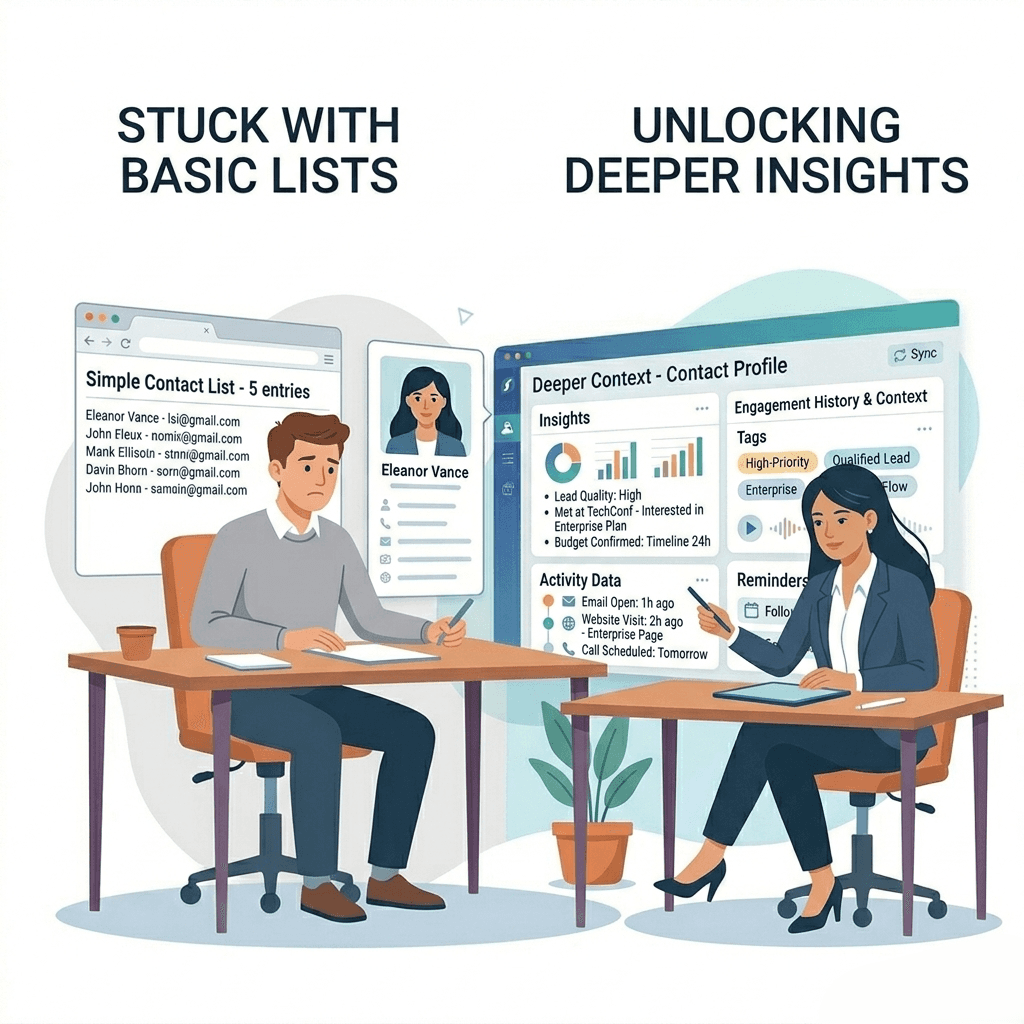
The clearest way to understand the contact intelligence vs contact data distinction is to look at what each one tells you about the same person.
Dimension | Contact Data | Contact Intelligence |
Core question answered | Who is this person? | Why do they matter and when should I act? |
Type of information | Factual, structured, static | Contextual, dynamic, signal-based |
Primary source | Business cards, badges, databases, forms | Conversations, engagement, behaviour, rep judgement |
Decay rate | 70.8% changes within 12 months | Varies by signal; engagement signals are real-time |
Value without the other | Low: a list of names with no reason to contact | Low: signals without verified contact info are unusable |
Where it lives | CRM fields, contact databases, spreadsheets | Notes, tags, activity logs, qualifier fields, voice memos |
What it enables | Identifying who to target | Knowing when to contact and what to say |
Example | Jane Smith, VP Ops, Acme Corp, j.smith@acme.co | Jane attended Aeroshow 2026, wants enterprise demo, Q3 budget, Hot |
Static records vs dynamic profiles
Contact data tends to be static. A name and email do not change how you should interact with someone today versus last quarter. Contact intelligence is dynamic. It updates with every interaction, every signal, every conversation. A contact who had no buying intent six months ago might have a strong intent signal today because their company just announced a new product line or because they attended your booth at an industry event and asked specifically about your enterprise tier.
The best CRM setups treat contact data as the permanent foundation and contact intelligence as the living layer that gets richer with every interaction.
Who, what, when, why
A useful mental model for the contact intelligence vs contact data distinction is the four questions a sales rep needs to answer before making contact:
Who: Contact data answers this. Name, title, company, email.
What: Partial contact data, partial intelligence. What does their company do? What tools do they use? Firmographic and technographic data help here.
When: Contact intelligence answers this. Engagement signals, job changes, event attendance, and trigger events tell you when the timing is right.
Why: Contact intelligence answers this. Interest level, conversation context, pain points discussed, and product fit signals tell you why this person should care about your outreach.
Contact data vs intent data
Intent data is a specific type of contact intelligence signal. It captures third-party behavioural signals such as which content a person or their company is consuming on the web, which categories they are researching, and which competitor sites they are visiting. Contact data vs intent data is not really a comparison: intent data is one layer of contact intelligence that can be appended to a contact record to improve prioritisation. You need the contact data first; intent data tells you which records to act on.
Contact enrichment vs contact intelligence
Contact enrichment is the process of adding missing or updated contact data fields to an existing record, typically using third-party providers. Contact enrichment vs contact intelligence is a distinction of input versus output. Enrichment adds facts to the record (this company has 500 employees, this person changed jobs last month). Contact intelligence is the insight layer those facts, combined with engagement signals and relationship context, produce. You can have a fully enriched contact record that still has no intelligence about why or when to reach out.
Account intelligence vs contact intelligence
Account intelligence operates at the company level: company financials, buying committee structure, organisational changes, and strategic priorities. Contact intelligence operates at the individual level: the specific signals and context that tell you whether this particular person is the right one to contact, and what they care about. In an account-based selling motion, account intelligence identifies which accounts to pursue; contact intelligence tells you which person within that account to contact first and how to approach them.
Most enterprise sales teams have invested heavily in contact data: CRM platforms, enrichment subscriptions, and B2B database tools. The investment in contact intelligence is far smaller, because until recently the tooling was limited and the concept was not well defined. That gap is increasingly costly.
The contact data decay problem
Contact data has a shelf life. Research consistently shows a B2B contact data decay rate of 25 to 30% per year when you account for job changes, company restructures, email address changes, and phone number updates. Prospeo's analysis puts the figure higher: 70.8% of B2B contacts change something material within 12 months.
A database built from last year's event badge exports, with no intelligence layer added, is largely outdated before your team finishes follow-up. Contact intelligence, particularly first-party intelligence captured directly from conversations, decays more slowly and often provides the clearest signal of current buying intent precisely because it is tied to a specific, recent interaction.
Signal-based selling and the role of intelligence
Signal-based selling is a methodology that prioritises outreach based on trigger events and behavioural signals rather than static lists. A rep using signal-based selling does not call every contact in a segment. They call the contacts whose signals indicate active buying motion: a job change, a funding announcement, a product category search, or an event attendance with a hot qualifier assigned by the booth team.
Contact intelligence is what makes signal-based selling possible. Without an intelligence layer, your contact data is a list. With an intelligence layer, it becomes a prioritised queue where the hottest signals surface to the top and the team knows exactly what to say when they reach out.
Stat: the qualification gap Research from Harvard Business Review found that leads contacted within five minutes of expressing interest are 21 times more likely to qualify than leads contacted after 30 minutes. The majority of sales teams are operating on contact data alone, with no intelligence layer telling them which contacts just expressed interest and need immediate outreach. |
The contact intelligence conversation in B2B sales has been almost entirely focused on outbound prospecting: buying intent data from third-party providers, tracking job changes with tools like Cognism or ZoomInfo, and layering firmographic signals onto cold outreach lists.
There is a parallel use case that almost nobody addresses: contact intelligence for event-captured contacts.
When a sales rep meets 40 people at a trade show booth over two days, they collect contact data automatically: badge scans and business cards fill in the name, email, and company fields. What they do not automatically capture is the contact intelligence: which of those 40 people had genuine buying intent, what product they asked about, what objections they raised, how hot the lead is, and what the rep promised to follow up with.
That intelligence exists in the rep's memory at the end of Day 1. By Day 3, it has mostly evaporated. By the time the contacts are manually entered into the CRM a week later, the records contain contact data and almost no contact intelligence.
First-party contact intelligence at the moment of capture
The solution is to capture the intelligence layer at the same moment as the contact data, before it fades. This means adding qualifier fields at capture (interest level, product fit, buying timeline), recording a 10-second voice note with conversation context, tagging the source event, and setting a follow-up reminder linked to the contact.
That is first-party contact intelligence: richer than anything a third-party provider can append, because it comes from an actual conversation rather than inferred from web behaviour. A voice note saying this contact has a Q3 budget, is evaluating three vendors, and wants an enterprise demo by the end of month is more actionable than any intent signal from a data provider.
How Habsy captures contact intelligence at events Habsy is purpose-built for first-party contact intelligence capture. At the booth or meeting, scan the badge or business card to capture contact data instantly. Then add intelligence immediately: set interest level (Hot, Warm, Cool), choose product fit, record a voice note with conversation context, and set a follow-up reminder. The result is a CRM-ready record that carries both the contact data and the intelligence layer, captured in one flow before the conversation ends. Over 25,000 exhibitors across 70+ countries use Habsy to capture contact intelligence at events without manual entry or post-show data reconstruction. |
Building a contact intelligence workflow means designing a system where intelligence is captured and attached to every contact at the earliest possible moment, not reconstructed from memory days later.
For event and field sales teams
Step 1: Define your qualifier schema before the event. Decide which intelligence fields matter most for your sales process. Typical fields include interest level (Hot, Warm, Cool), product line, buying timeline, budget range, and next action.
Step 2: Capture contact data and intelligence simultaneously. Use a tool that lets you scan a badge or card and immediately prompt for qualifier fields and voice notes in the same flow. The two layers need to be captured together, not separately.
Step 3: Set follow-up reminders at capture. A follow-up reminder tied to the contact and the qualifier is part of the intelligence layer. Without it, even a well-captured contact can slip through.
Step 4: Deduplicate before CRM import. Intelligence attached to a duplicate record gets split across two entries. Merge on email, then phone, then name plus company before any contact enters the CRM.
Step 5: Export with all intelligence fields intact. A clean CSV that carries contact data fields alongside intelligence fields (interest level, voice note transcript, source tag, next action date) means the CRM receives the full picture on day one.
For outbound and ABM teams
For teams doing outbound prospecting or account-based selling, the contact intelligence workflow looks different but follows the same logic: capture signals as close to the source as possible, attach them to the contact record, and use them to prioritise outreach.
Use intent data platforms to identify which contacts or accounts are actively researching your category.
Track job changes and trigger events using tools like Cognism, ZoomInfo, or LinkedIn Sales Navigator to surface contacts at moments of high receptivity.
Log every interaction as an intelligence layer. Every call, email, meeting, and demo is intelligence. A CRM that captures interaction history accurately is a contact intelligence system, not just a contact database.
Score contacts on intelligence signals, not just data fields. Lead scoring models that incorporate engagement signals, conversation outcomes, and qualifier data outperform models built on firmographic contact data alone.
If your team captures contacts at trade shows, conferences, or field meetings, Habsy is built for this workflow. Try it free at habsy.ai and capture contact intelligence at the source, before the conversation ends.
FAQs
1. What is contact intelligence?
Contact intelligence is the context layer built on top of contact data. It goes beyond name, email, company, and title to include buying intent, conversation context, qualification signals, engagement history, and next-step timing. In practice, contact intelligence tells sales teams why a contact matters and when to act.
2. What is contact data?
Contact data is the structured factual record that identifies a person. It typically includes fields like full name, work email, phone number, job title, company name, and location. Contact data tells you who someone is, but not whether they are a good opportunity or what follow-up should happen next.
3. What is the difference between contact intelligence and contact data?
The difference is that contact data is static and factual, while contact intelligence is dynamic and contextual. Contact data answers “Who is this person?” Contact intelligence answers “Why do they matter, when should I act, and what should I say?” Sales teams need both, but contact intelligence is what makes contact data actionable.
4. Is contact intelligence the same as contact enrichment?
No. Contact enrichment adds missing or updated facts to a record, such as company size, revenue, or job changes. Contact intelligence is the insight layer created when those facts are combined with behavioural signals, conversation context, qualification data, and relationship history. Enrichment improves the record. Intelligence improves decision-making.
5. Why does contact intelligence matter for sales teams?
Contact intelligence helps sales teams prioritize the right leads, follow up at the right time, and personalize outreach based on actual signals. Without it, CRMs become databases full of names but very little guidance on who to contact first or what message will resonate. That usually leads to generic follow-ups and lower conversion rates.
6. What are examples of contact intelligence for event-captured leads?
Examples include interest level, product fit, buying timeline, source event, conversation notes, voice note context, follow-up reminders, and next action. These details are captured during or immediately after a booth or meeting conversation and help SDRs know what to say and when to reach out.
7. What is the B2B contact data decay rate?
Your blog cites Prospeo’s finding that 70.8% of B2B contacts change something material within 12 months, such as job title, company, email address, or phone number. That makes static contact data unreliable unless it is refreshed and paired with current intelligence signals.
8. How can sales teams capture contact intelligence at events?
Sales teams can capture contact intelligence by scanning the badge or business card, then immediately adding qualifier fields, a quick voice note, source tags, and a follow-up reminder while the conversation is still fresh. This ensures the CRM receives both the contact data and the context needed for timely, personalized outreach.