Why Follow-Up Timing Determines Networking ROI
You scanned the badge. You had a great conversation. You even jotted a note on the back of their card. Then three days passed, then five, then a week. By the time you finally sent that follow-up email, your new contact had already forgotten your name. This is the most expensive mistake in professional networking, and almost everyone makes it. The window between a first meeting and a meaningful follow-up is far shorter than most sales teams assume. In this guide, we break down exactly why timing determines your networking ROI and how to close the gap before your next event.
Marcus Chen3 min read
On this page
- The Hidden Cost of Delayed Follow-Up
- The 24-Hour Rule and When It Actually Applies
- How to Choose the Right Follow-Up Channel
- What a High-Converting Follow-Up Message Looks Like
- Building a Follow-Up System That Scales
- Measuring Networking ROI Beyond the Business Card
- Final Thoughts: Speed Is the New Competitive Advantage
The Hidden Cost of Delayed Follow-Up
What the Data Says About Speed to Lead
Research from Harvard Business Review found that firms responding to a lead within one hour were nearly seven times more likely to qualify that lead than those who waited even one hour longer. That statistic was drawn from B2B sales contexts, but the principle applies directly to networking: the faster you follow up, the warmer the lead.
Speed to lead is not a concept invented by sales trainers. It is a measurable variable that directly affects how often a first conversation converts into a second one. For event-sourced leads specifically, the stakes are even higher. Your contact met dozens of other companies the same day. If you are not first into their inbox, you may not get a second chance.
Why Memory Decay Works Against You After Events
Neuroscience research on the forgetting curve, first documented by Hermann Ebbinghaus, shows that without reinforcement, humans forget roughly 70 percent of new information within 24 hours. Applied to networking: if you meet someone at 3pm and follow up three days later, they will likely remember only fragments of your conversation.
This is why personalization matters so much. A follow-up that references a specific detail from your exchange, such as the product line they mentioned, the challenge they described, or even the booth location where you met, tells your contact that you were listening. That signal cuts through the noise in a way that a generic 'great to meet you' message never will.
The 24-Hour Rule and When It Actually Applies
Same-Day vs Next-Day Outreach: Which Performs Better
For warm, high-intent contacts, same-day follow-up, specifically within two to four hours of the meeting, consistently outperforms next-day outreach. The context is fresh, the emotional momentum from a good conversation is still active, and there is no competing memory of other exhibitors or speakers to displace yours.
That said, same-day follow-up only works if your message is specific. A rushed, generic email sent at 9pm will perform worse than a thoughtful, personalized one sent the next morning at 9am. The rule is not about obsessing over clock time. It is about sending before the contact's mental model of your conversation fades.
When Waiting 2 to 3 Days Is the Smarter Move
There are contexts where a short delay is strategic. If your contact is a senior decision-maker at a three-day conference, their inbox on Day 1 is chaotic. Reaching them on Day 2 or the morning after the event closes, when the rush has passed, can improve your chances of getting a real response.
The key variable is intent signals. If your contact explicitly said 'send me the pricing doc,' follow up immediately. If the conversation was exploratory, a one-day wait is fine. If you are not sure, bias toward sooner rather than later.
How to Choose the Right Follow-Up Channel
Email vs LinkedIn vs WhatsApp for Post-Event Outreach
Channel selection affects both response rate and relationship perception. Here is a practical breakdown:
Email:
Best for professional introductions, sharing documents, proposals, or following up with senior decision-makers. It gives you enough space to add context, personalize the message, and include a clear next step.
LinkedIn:
A personalized connection request feels more natural and relationship-driven than a cold outreach message.
WhatsApp:
Widely preferred in India and APAC for quick and conversational follow-ups. It works best when the contact has shared their number directly and the conversation already has some level of familiarity. Use thoughtfully to avoid appearing intrusive.
Why Multi-Channel Follow-Up Outperforms Single-Channel
Research on sales cadences consistently shows that contacts who receive outreach across two or more channels convert at higher rates than those receiving single-channel messages. The logic is straightforward: different people check different inboxes at different frequencies.
A practical post-event sequence: email on Day 1, LinkedIn connection on Day 2 if no response, a brief WhatsApp message on Day 3 if the relationship warrants it. Do not send all three on the same day. That reads as pressure, not interest.
Keep the momentum
Turn captured contacts into timely follow-up.
Keep the note, intent and next action with every contact so your team knows what to do next.
What a High-Converting Follow-Up Message Looks Like
The Anatomy of a Personalised Post-Event Email
The most effective post-event follow-up emails share five structural elements:
- Reference the moment: Mention where and when you met. 'It was good to speak at the AutoExpo panel yesterday' beats 'I hope this finds you well.'
- Recall one specific detail: Reference something they said. 'You mentioned expanding into the South India market' is a signal that you listened.
- State your value clearly: One sentence. What can you actually do for them?
- Make one ask: A 20-minute call, a document, a reply. Not all three.
- Close with an easy out: 'If the timing is off, I can follow up next quarter' reduces pressure and often increases replies.
Common Mistakes That Kill Response Rates
- Sending a generic template with no personalisation. Contacts can tell.
- Waiting more than 72 hours without a specific reason to wait.
- Sending too much information in the first message. Keep it under 150 words.
- Including three or more CTAs. One ask only.
- Following up at night or over the weekend for B2B contacts, unless you know the relationship warrants it.
Building a Follow-Up System That Scales
CRM Integration and Automated Reminders
Individual discipline gets you through the first ten contacts. After that, you need a system. For sales teams working events, the critical infrastructure is:
- A defined capture schema: Know before the event which fields matter. At minimum: name, company, interest level, and one notes field.
- Reminders at point of capture: Set a follow-up reminder as soon as you save the contact, not the next morning when you have forgotten the context.
- A clean handoff to CRM: Export contact data within 24 hours of the event in a mapped format so your sequences can start without manual cleanup.
The gap that most teams experience is not a CRM problem. It is a capture-to-handoff problem. Contacts get collected in cards, badge scans, and phone photos, then stall at the point of entry. Solving the event lead capture bottleneck is where most networking ROI is actually lost or recovered.
How Digital Business Cards Eliminate the Biggest Bottleneck
The single biggest cause of follow-up delay is manual data entry. When a contact gives you a physical card, every minute you spend typing their details is a minute of follow-up delay accumulating. At scale, across a team working a 200-person event, manual entry is the reason Day-3 follow-up becomes the norm instead of Day-1.
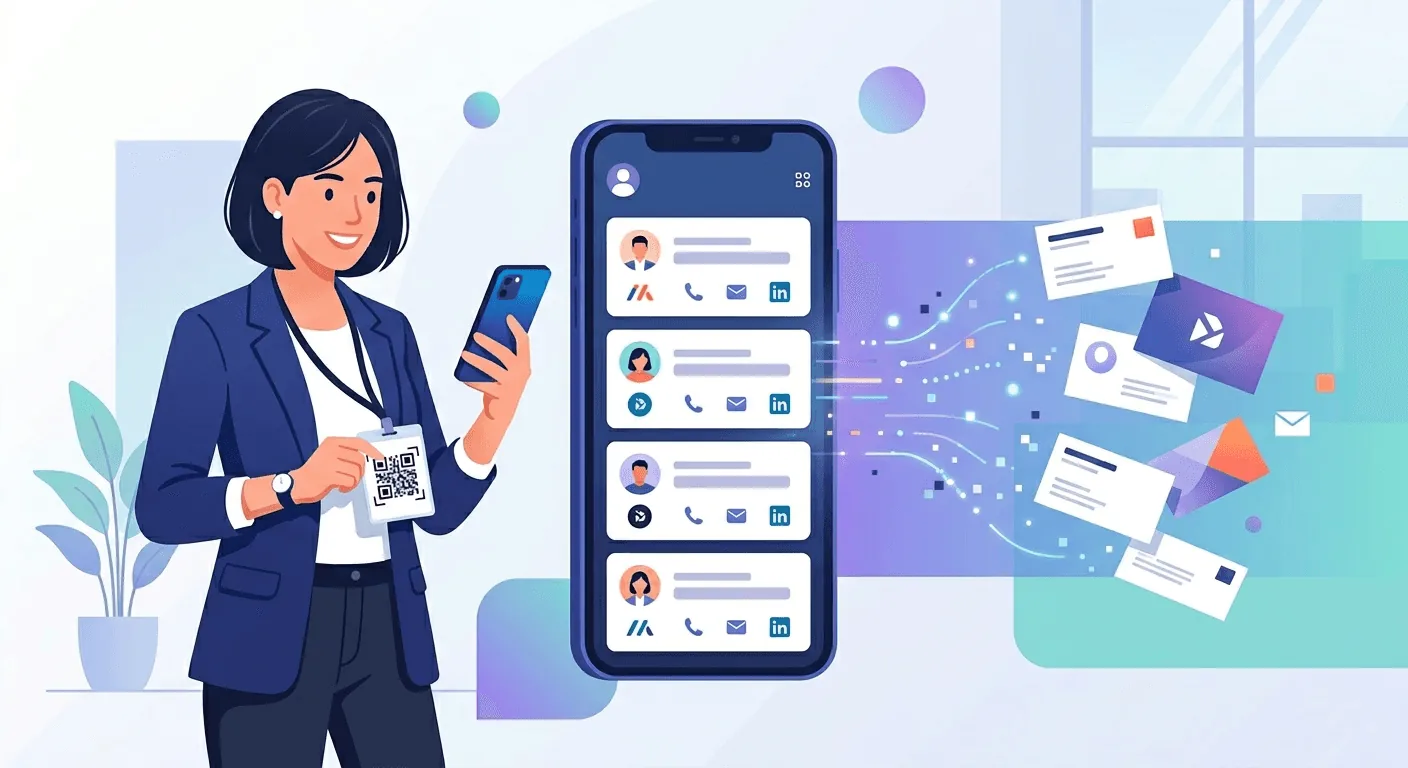
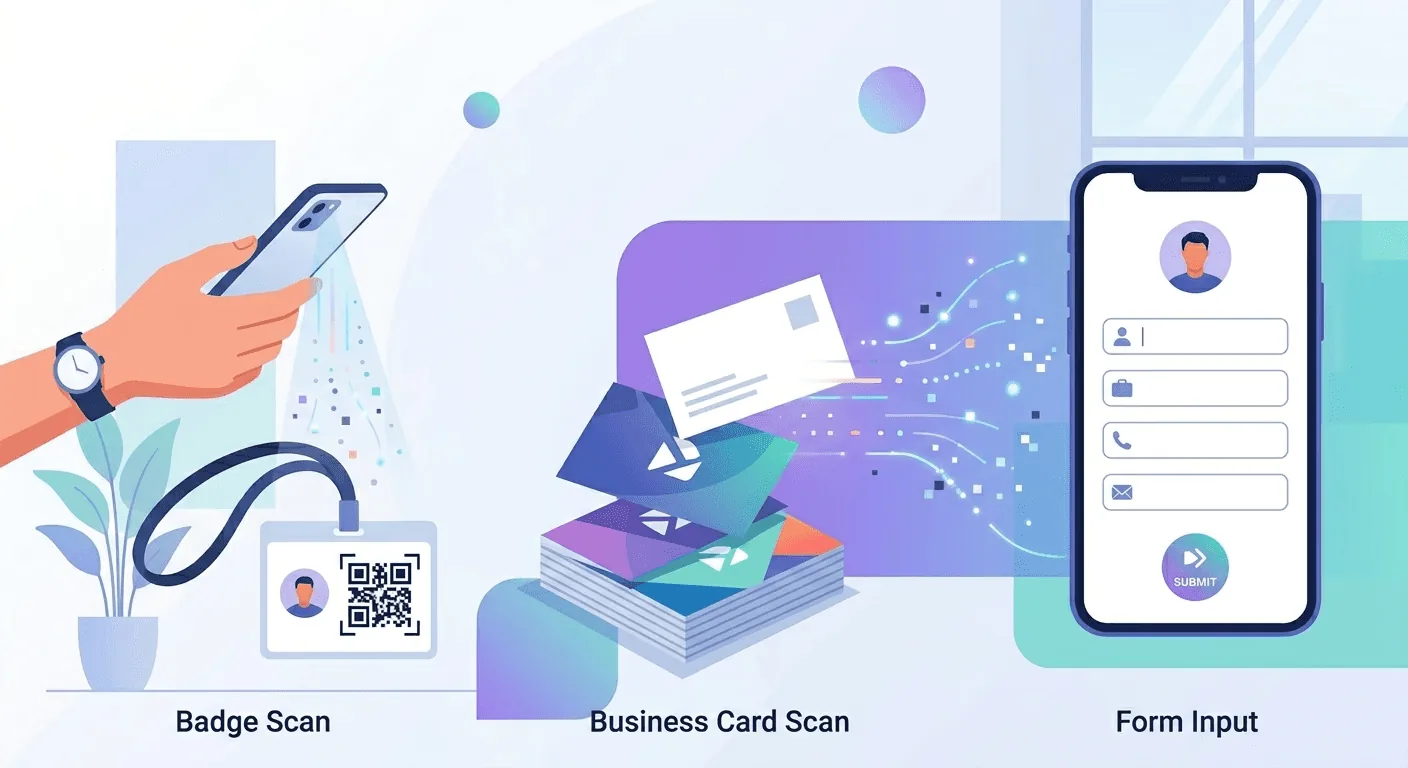
Digital capture removes that bottleneck. Scanning a card or a QR badge takes seconds. Adding a quick note, an interest field, and a reminder adds another ten to twenty seconds. By the time you have walked away from the conversation, the contact is already tagged, contextualized, and scheduled for outreach.
AI-Powered Templates for Email and WhatsApp Follow-Up
The second bottleneck is message creation. Most reps know they should personalize their follow-ups but stall because writing a custom message for every contact feels time-consuming. AI-written email and WhatsApp messages resolve this: the rep writes a short prompt, the AI drafts a personal message from the contact card, and the rep can review, lightly adjust, and send in under a minute.
The combination of fast capture, contact context, and template-assisted outreach is what compresses time-to-first-touch from days to hours. This is not automation replacing personalization. It is infrastructure enabling the personalization that was always intended but rarely executed.
Measuring Networking ROI Beyond the Business Card
Metrics That Matter: Response Rate, Conversion Rate, and Pipeline Value
Most teams measure networking ROI by counting cards collected or badges scanned. Neither number tells you anything useful. The metrics that matter are:
- Response rate: What percentage of your follow-up messages received a reply within 7 days? Below 15 percent suggests a personalization or timing problem.
- Lead-to-meeting conversion: What percentage of contacts booked a call or demo within 14 days? This is the first true revenue signal from an event.
- Pipeline value from event: What was the total value of opportunities sourced from the event, tracked by source field in your CRM?
- Follow-up completion rate: What percentage of contacts with a set reminder were actually contacted within the agreed window? This measures discipline, not outcomes.
Tracking Follow-Up Completion Across Your Team
For managers, the most actionable metric is follow-up completion rate. Response rates depend on the contact, but completion rates depend on your team. Filtering contacts from a specific event and checking which reminders are still open helps identify exactly where the process is breaking down.
Track completion weekly in the first two weeks after an event. After 14 days, measure lead-to-meeting conversion. At 30 days, review pipeline attribution. This three-point measurement cadence gives you a complete picture of what your events are actually generating.
Final Thoughts: Speed Is the New Competitive Advantage
The best networkers are not the ones with the largest stacks of cards. They are the ones whose contacts hear from them first, with a message that proves the conversation actually happened.
Speed is a system advantage, not a personal one. Build the capture flow, set the reminders, prepare the templates, and establish the export cadence before your next event. The people who do this consistently are the ones whose networking converts. Everyone else is building a card graveyard.
Frequently Asked Questions
What is the best time to follow up after a networking event?
Within 24 hours for most contacts. For senior decision-makers at multi-day events, the morning after the event closes can work well. Bias toward sooner, and always before 72 hours.
How many follow-up touches does it take to close a deal?
Research suggests 5 to 8 touchpoints for most B2B deals, but the first two are the most critical. A fast, personalized first message dramatically improves the likelihood of getting to touch 3 and beyond.
Does follow-up timing really affect conversion rates?
Yes. Studies on speed-to-lead consistently show that response and conversion rates drop sharply beyond the 24-hour window. At 72 hours, the gap compared to same-day outreach is significant.
What should I include in a networking follow-up email?
Include a reference to where you met, one specific detail from the conversation, a clear one-sentence value statement, and a single ask. Keep it under 150 words.
How do digital business cards improve follow-up speed?
They eliminate manual data entry. Scanning a card or QR badge takes seconds, and capturing context at that moment means your follow-up is prepared before you leave the event floor.
Keep the momentum
Turn captured contacts into timely follow-up.
Keep the note, intent and next action with every contact so your team knows what to do next.