Blog
You walked away from the conference with a stack of business cards, a handful of badge scans, and several numbers saved in your phone under names you will not remember by the end of the week. The conversations were real. The pipeline potential was real. The system to act on them was not.
That gap is where most founder deals go quiet.
The problem is not effort. It is architecture. Founders invest in their pitch, their product, and their online presence, but almost nobody builds a deliberate networking stack for founders: a layer-by-layer system that captures every contact, adds context at the moment it matters, and routes each relationship into a timely follow-up.
Whether you are meeting investors in Singapore, distributors at a trade fair in Dubai, or early customers at a conference in London, the mechanics are the same. This post lays out the networking stack for founders who want every conversation to become a follow-up, and every follow-up to become a pipeline.
TL;DR
|

Most founders collect contacts. Few have a system. Here is the networking stack that turns in-person conversations into follow-ups, pipeline, and deals.
The Top of the Stack
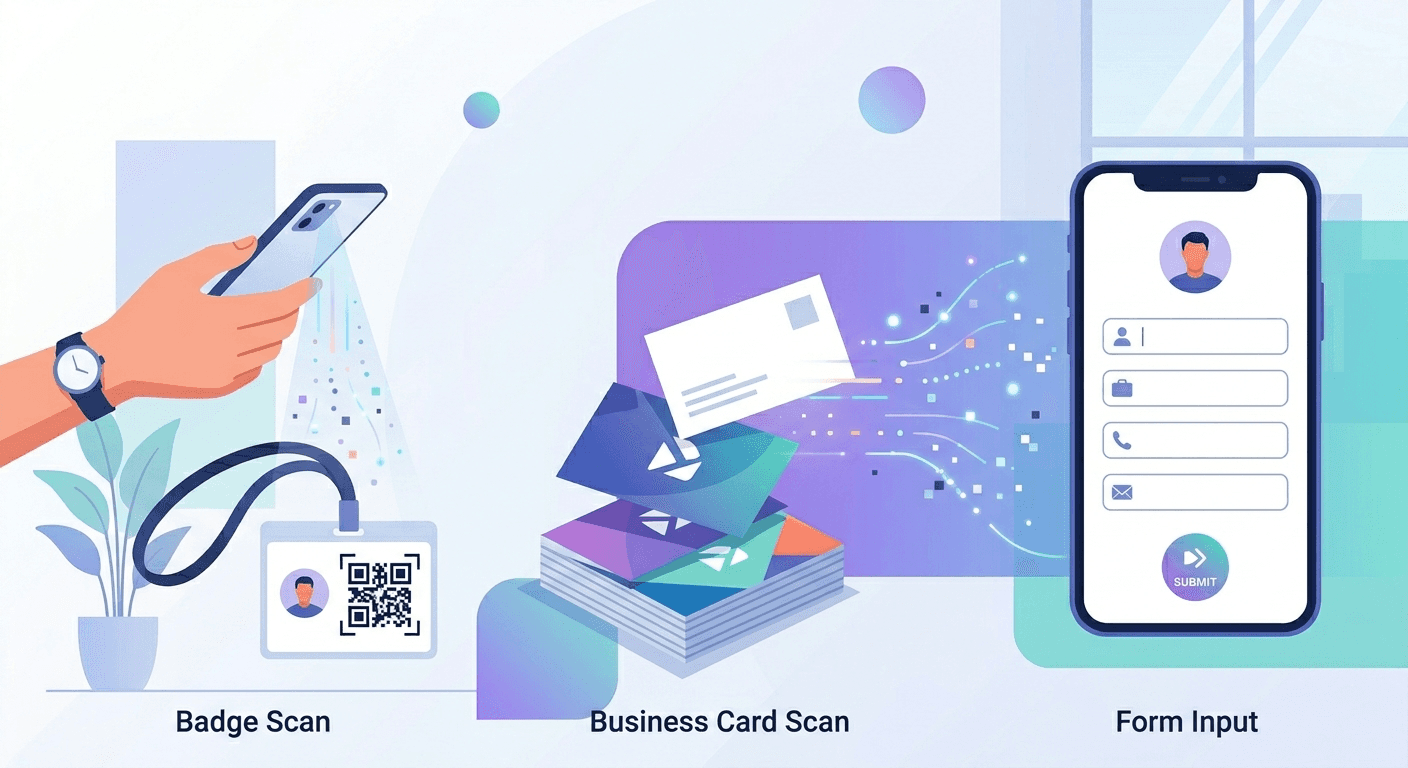
The first job of any networking stack for founders is contact capture: get every conversation into a single place. Not some of them. Not the ones where you remembered to type a note. All of them.
Founders collect contacts across three distinct channels, each with its own friction point.
Events and trade shows
Conference halls and expo floors are the hardest capture environment. Footfall is high, conversations are short, and your hands are rarely free. QR badge scanning handles the bulk of it when organizers issue badges. For visitors who hand you a business card, batch scanning turns a pile into searchable contacts in minutes rather than hours.
The failure mode here is waiting until after the show. By Day 3, context fades and momentum goes with it. The habit to build is same-day capture, even if full qualification happens the next morning.
Coffee chats, calls, and corridor meetings
These are the highest-value connections a founder makes and the easiest to lose. There is no badge to scan. The card usually stays in a jacket pocket. The manual add function, a quick-form entry on your phone, takes 30 seconds and keeps the contact inside your stack where it belongs.
This applies whether you are at a networking dinner in Mumbai, a startup meetup in Berlin, or a side conversation at a trade fair in Chicago. The capture habit is the same regardless of the venue.
Cold outreach and inbound
People you have emailed, messaged on LinkedIn, or who have replied to your campaign deserve a place in the stack too. A manual add with a Source tag (cold outreach, inbound web, referral) keeps attribution clean when you eventually look at what is generating pipeline.
Layer 2: Qualification at the Source
Not After
Raw contacts are not leads. A name and company tell you nothing about what this person needs, what you discussed, or whether you should follow up this week or this quarter. Qualification at capture changes the economics of your follow-up entirely.
The mistake founders make is building a long capture form. More than three required fields at capture time slows everything down and tanks adoption among anyone helping you at a booth. The right schema is lean.
The 3-tier contact framework for founders
Group every contact into one of three relationship types the moment you capture them:
Investors: people who are, or could become, capital allocators for your company. Time sensitivity is highest here. A warm investor who does not hear from you within 48 hours is a cold investor.
Partners and channel: distributors, co-founder candidates, enterprise buyers with long sales cycles, referral sources. Follow-up cadence is medium; depth of context matters more than speed.
Customers and users: anyone evaluating or using your product. These need standard sales qualification: interest level, product line, timeline, and decision authority.
Beyond the relationship type, add two more fields: Priority (P1/P2/P3 or Hot/Warm/Cold) and Source (the event or context where you met). That is your minimum viable capture schema.
If you are using a tool that supports custom fields, this schema takes two minutes to set up and can be saved as a preset so your whole team captures consistently, whether they are at a booth in Tokyo or a conference in Toronto.

The 10-Second Voice Note
This is the part of the networking stack that almost nobody builds, and it is the one that makes the biggest difference to follow-up quality.
During a conversation, you know things that a form field cannot hold: the exact problem the person mentioned, the competitor they are evaluating, the demo they asked to see, the pricing question they had, the specific frustration they described with their current setup. That context is worth money if you preserve it. It evaporates within 24 hours if you do not.
A voice note takes a few seconds. You tap the record after the handshake, say something like: "Wants pricing for the Pro plan. Mentioned they are switching from a competitor in Q1. Follow up with the case study deck." You tap stop. That note travels with the contact record into your CRM and into your team's follow-up queue.
The result is a follow-up that reads like you remembered everything, because you did.
This matters especially at multi-day events where you are meeting dozens of people each day. By the time you land at your home airport, the faces blur. The voice note does not.
The Middle of the Stack
Most founder networking fails here. The contact is captured. The context is preserved. And then nothing happens because there was no explicit next step.
The fix is a one-tap reminder set before you walk away from the conversation. Not a mental note. Not a to-do in a separate app you will open once a week. A reminder tied to the contact, with a date and time, that surfaces in a dedicated follow-up view the next morning.
Default preset: Tomorrow 10:00. That is the right starting point for almost every warm connection. It keeps the window tight enough that context is still fresh and the conversation is still recent.
What fast follow-up actually does
Most deals trace back to a well-timed follow-up, not the brilliance of the initial meeting. The founder who follows up within 24 hours is rare. The one who sends a personalized message that references what was actually discussed is rarer still. The combination of a voice note at capture and a reminder the next morning makes both of those things structurally easy rather than heroic.
For investor relationships specifically, speed signals seriousness. A follow-up the next morning with a short recap and the deck they asked for communicates that you run a tight operation. That perception compounds.
Email and messaging: choosing the right channel
Email is the universal follow-up channel and the right default for professional relationships across every market. A structured email within 24 hours, referencing what was discussed and attaching any materials promised, is the foundation of a good follow-up workflow. Habsy lets you attach note transcripts and contact context directly to your export so whoever sends that email has everything they need.
In many markets, instant messaging adds a useful first-touch layer. A brief message that acknowledges the meeting and confirms you will send materials is a low-friction way to reopen the channel quickly. The email carries the substance; the message keeps the warmth. The right combination depends on what the contact expects in their professional context.
Read the room during the conversation: how did they reach out to others? What did they suggest when they handed you their card? Tag the preferred channel in your contact notes so the person following up has the right starting point.
The Base of the Stack
Capture, context, and follow-up handle the first 7 days after a meeting. The base of the stack handles everything after that.
The dead network problem is real. Founders collect contacts at an event, run the Day-1 follow-up sequence, and then let the relationship drift for months. When they need a warm introduction or a reference, the network is technically there but functionally cold.
Saved searches and segments
A working network maintenance layer relies on being able to find the right slice of your contacts in seconds. Saved searches, filters across your custom fields and tags, let you pull lists like:
All P1 investor contacts with a reminder due this week
All enterprise buyer contacts tagged with a specific product line and a follow-up date in the next 14 days
All contacts from the last event who have not had a follow-up logged yet
These are not complex CRM automations. They are simple saved filter combinations that take 30 seconds to create and give you an actionable list every time you open the app.
The CRM question for founders
Most founders do not need a full CRM on Day 1. The overhead of configuring a heavyweight system before you have a repeatable sales motion is a distraction. A clean, tagged contact list that exports to a spreadsheet is enough to run investor outreach, partnership development, and early customer sequences for the first 12 to 18 months.
When you do move to a CRM, the networking stack for founders described here makes that transition clean. Your contacts are already tagged with relationship type, source, and priority. The CSV maps directly to CRM fields. There is no six-week cleanup project.
One View Across Every Event and Every Team Member
A stack without visibility is just a collection of habits. The Habsy Platform brings your entire networking operation into a single dashboard so you can see what is actually happening, not just what you hope is happening.
From the dashboard you can track:
Capture rates: how many contacts were logged per rep, per event, and per day, with a breakdown by capture method (badge scan, card scan, manual add).
Field completeness: what percentage of contacts were captured with all required custom fields filled. Low completeness on interest or priority means your qualification schema needs reinforcing.
Reminder adherence: how many reminders were set at capture versus how many were completed within 7 days. This is your proxy for follow-up discipline.
Email Automation: Sending
De-duplication activity: how many duplicates were flagged and merged before data hit your Priority list. Fewer duplicates at import means cleaner sequences and fewer wasted dials.
For teams running multiple events across different cities or countries, the dashboard makes it possible to compare performance across venues, identify which reps are capturing context consistently, and spot gaps in the follow-up chain before they cost you a deal.
See the full platform at habsy.ai/enterprise-platform.
"I will just use my phone contacts."
Phone contacts have no qualification, no context, no reminders, and no deduplication. They are searchable by name only. When you have met 300 people in a quarter across three countries, that is not a network. It is a phonebook.
"My team will not adopt another tool."
The adoption barrier for a scanning app is lower than almost any other tool in the stack. There is no configuration required on the day of the event. The capture flow is faster than typing into a phone contact. Voice notes take less time than typing. The habit forms quickly because the alternative is clearly worse.
"I will clean it up after the show."
You will not. The show ends, travel begins, the inbox fills, and the stack of cards sits on a desk for two weeks. By the time you return to it, you cannot remember which P1 lead was the one who mentioned a Q1 budget. The system only works if it captures context at the source.
Start with One Event
You do not need to overhaul your entire contact management system today. Pick your next event, define a 3-field contact capture schema (relationship type, priority, source), save an email follow-up preset, and commit to exporting a clean list within 24 hours.
That is a functioning networking stack. Everything else is optimization.
FAQs:
1. What is a networking stack for founders?
A networking stack for founders is a structured system used to capture, organize, and follow up with every business contact. It includes layers like contact capture, qualification, context (notes), reminders, and export to CRM or spreadsheets. Instead of relying on memory or scattered tools, a networking stack ensures every conversation turns into a trackable follow-up and potential pipeline.
2. Why do founders lose valuable contacts after events?
Founders lose contacts because they rely on memory, unstructured notes, or delayed data entry. When contacts are not captured immediately with context, details fade within 24 to 48 hours. Without reminders or a follow-up system, even high-quality conversations fail to convert into opportunities, causing pipeline loss despite strong initial interactions.
3. What should founders capture during a networking conversation?
At minimum, founders should capture three key elements: relationship type (investor, partner, or customer), priority (hot, warm, cold), and source (event or context). Adding a short note or voice summary about the conversation significantly improves follow-up quality. Keeping the capture process simple ensures consistency across all interactions.
4. How soon should you follow up after meeting a contact?
The ideal follow-up window is within 24 hours of the meeting. Fast follow-ups keep the conversation fresh and signal professionalism. A short, personalized message referencing what was discussed performs significantly better than generic outreach. Delays beyond 48 to 72 hours reduce response rates and weaken the connection.
5. Do founders need a CRM to manage networking effectively?
Not initially. Early-stage founders can manage networking effectively using a clean, structured contact list with tags, notes, and reminders. A CRM becomes useful once there is a repeatable sales or partnership process. Starting with a lightweight system that exports clean data makes the transition to a CRM easier later.


