Blog
A badge scan gives you a name and a company. Sometimes an email. Rarely a direct dial. That is what most exhibitors bring home from a show floor: a list of raw identifiers with no context about what the person does, what they need, or whether they fit your ICP at all.
Contact enrichment fills that gap. It appends verified firmographic and contact data to each captured record automatically, so the moment a badge scan lands in your system, it already carries job title, company size, industry, work email, and more. Your SDRs do not have to research each lead before reaching out. They can prioritise and dial on Day-1.
This post explains what contact enrichment is, how the process works at events, and why it matters for follow-up speed, lead scoring, and pipeline quality.
TL;DR Contact enrichment appends verified data (firmographics, work email, job title) to a raw badge or card scan. Waterfall enrichment queries multiple data sources until a verified match is found, usually in seconds. Enriched leads are ICP-scoreable on Day-1 without manual research. The follow-up window after an event is narrow. Enrichment makes same-day outreach possible. Habsy captures leads at the point of capture with or without Wi-Fi; enrichment syncs automatically when connectivity returns.
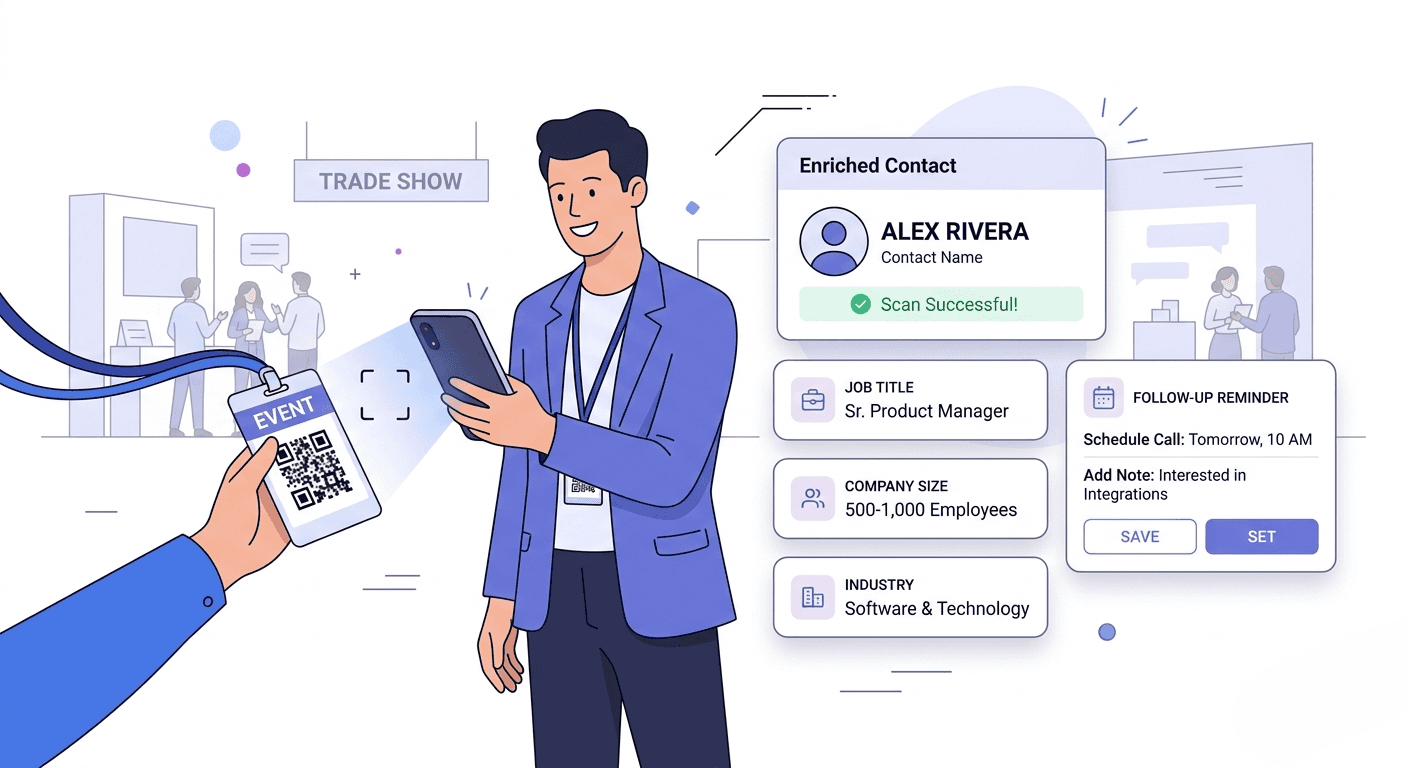
Contact enrichment turns a badge scan into a verified, CRM-ready contact. Learn how it works for event leads and why it matters for follow-up speed and pipeline quality. Primary keyword: what is contact enrichment
Not all enrichment tools are built for the pace of event capture. A tool that works well for enriching inbound form fills may struggle when you are processing 300 badge scans at the end of a show day. Look for four things:
Speed at source. Enrichment should trigger at capture and complete before export, not require a separate batch upload after the event. If you have to upload a CSV and wait for a batch run, the Day-1 window is already closing.
Offline capability. Expo halls have unreliable Wi-Fi. Your enrichment layer needs to queue and sync, not block capture.
Waterfall logic. A single data source will miss records. Waterfall enrichment passes to the next provider automatically until a verified match is found.
Event-specific fields. Standard enrichment covers firmographics and contact data. For events, you also need intent signals (interest level, product line, stall number) that only your team can add at capture.
What a Raw Badge Scan Returns vs What Enrichment Adds
A standard badge scan returns a display name, a company name, and sometimes a personal email address. That is the ceiling of what most organizer systems provide. Enrichment changes the picture significantly.
After enrichment, that same record carries a verified full name, job title, seniority level, verified work email, direct dial where available, company size, industry classification, revenue band, and often a LinkedIn profile URL. The contact who was an identifier is now a scoreable, routable lead.
The practical difference is this: without enrichment, your SDRs spend the first day after an event researching each contact before they can write a relevant outreach. With enrichment already applied, they open the record, read the intent signals your rep captured at the stall, and send the email. Day-1 outreach becomes possible across the full list, not just the handful of contacts someone happened to recognize.
What Is Contact Enrichment?
Contact enrichment is the process of automatically appending verified third-party data to a contact record. When a name and company are captured from a badge scan, a visiting card scan, or a form fill, enrichment queries external data sources to add verified information that the original capture did not include.
The most common enrichment fields are:
Job title and seniority level
Verified work email address
Direct dial phone number
Company size, industry classification, and revenue band
Technology stack (for SaaS and IT-adjacent selling)
LinkedIn profile URL
For event leads specifically, enrichment matters because badge payloads are inconsistent. Some organizers provide full contact data. Many provide only a name, company, and a personal email. Enrichment normalises what you receive across every show, regardless of organizer quality.
What Enrichment Adds to Event Leads
Firmographic data
Firmographic data describes the company, not the individual. Company size, industry vertical, annual revenue, and headquarters location are the fields most sales teams use to determine ICP fit. A badge scan does not capture any of this. Enrichment appends it automatically.
Without firmographic data, lead scoring runs on guesswork. A warm conversation at a stall means nothing if the company has 12 employees and your minimum deal size requires 200. Enrichment surfaces that mismatch on Day-1, before an SDR spends time on the wrong leads.
Verified contact data
Personal emails appear on badges frequently. They are rarely useful for B2B outreach. Enrichment supplements personal addresses with verified work emails and, where available, direct dials. Deliverability improves. Connection rates improve. Your sequences reach the right inbox the first time.
Intent signals
Some enrichment providers append intent data, which are signals showing a company has been actively researching solutions in your category. For event leads, this adds a layer of prioritisation beyond the intent signals your team collects at the stall. A contact who scored Hot on interest and whose company shows buying intent is a Day-0 call, not a Day-3 drip.
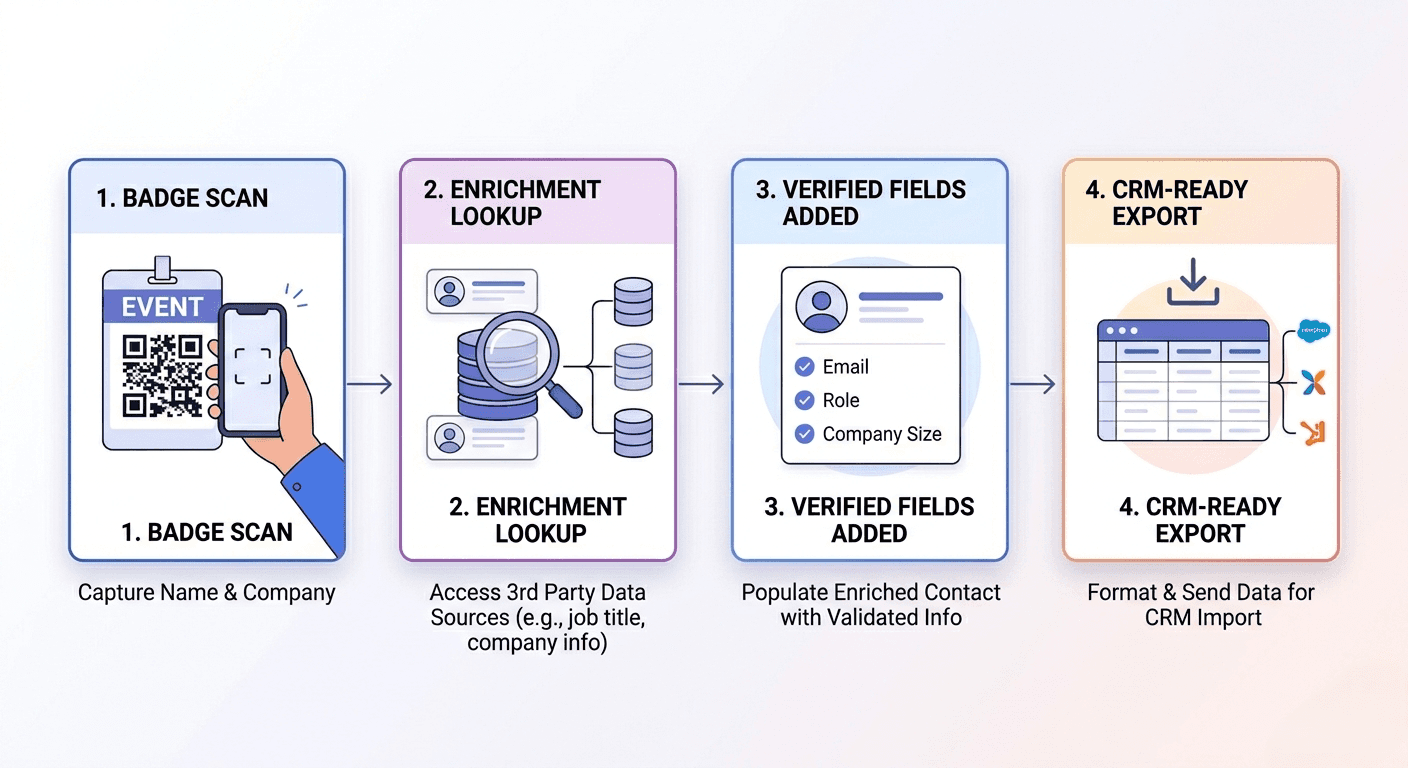
Here is the typical enrichment flow for an event lead:
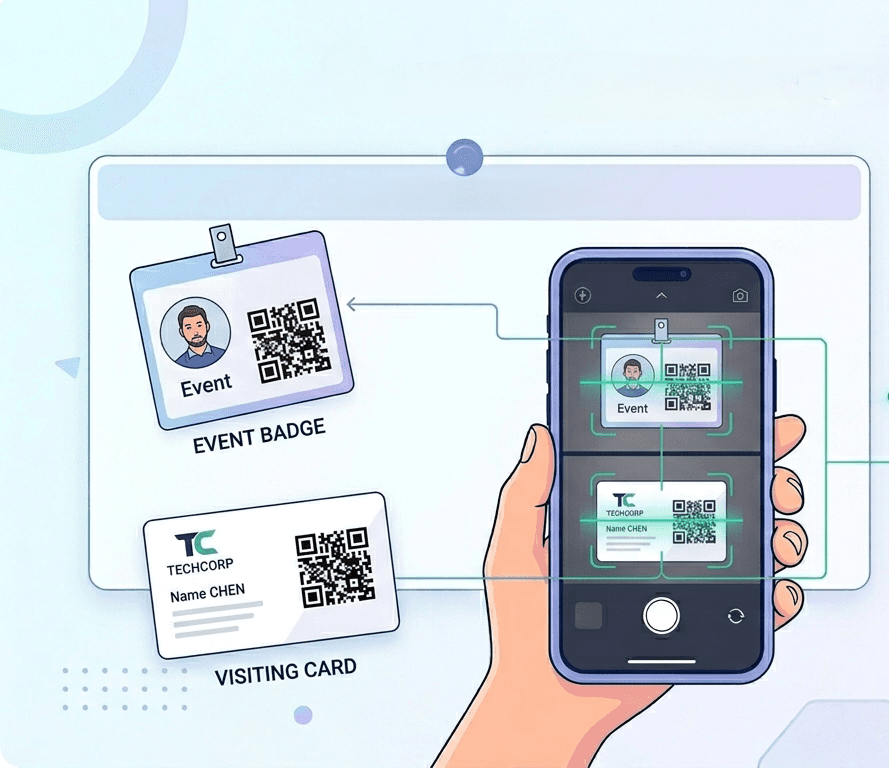
Capture. A badge QR is scanned or a visiting card is photographed. The app parses the available fields: name, company, title if present, email if present.
Enrichment query. The enrichment engine takes the company domain or name and submits a lookup to the first data provider in the waterfall.
Waterfall logic. If the first provider returns no match or incomplete data, the query passes to the next source automatically. This continues until a verified record is found or the waterfall is exhausted.
Append and review. Verified fields are appended to the contact record. Unverified or low-confidence fields are flagged for manual review.
Intent signals. The rep adds event-specific intent signals at the point of capture — interest level, product line, stall number, priority. These are not enrichment fields; they come from the conversation itself and reflect what only your team can know.
Export or sync. The complete record, including enriched firmographics, verified contact data, and intent signals, exports via mapped CSV or direct integration to HubSpot, Salesforce, Zoho, Google Sheets, and more. Follow-up sequences trigger the same day.
Waterfall logic is important because no single data provider has complete global coverage. An enrichment tool that queries only one source will miss a significant portion of records, leaving gaps that require manual research. A waterfall approach reduces those gaps without increasing capture time.
The follow-up window is narrow
Response rates drop sharply as time passes after an event conversation. The context is specific to that moment, the contact met several other vendors the same day, and recall fades quickly. An outreach sent within 24 hours references a shared memory. One sent four days later arrives when that memory is gone.
Contact enrichment makes same-day or next-day outreach possible. Without it, SDRs spend the first day researching each contact manually before they can personalize a message. With enrichment already applied, they open the record, read the voice note from the stall, and write a contextual email.
Lead scoring requires firmographic data
Most lead scoring models weight company size, industry, and job title heavily. These are precisely the fields that badge scans omit. Without enrichment, scoring runs on the event qualifier alone, which is usually just an interest level chosen in haste during a rush conversation. That is a thin signal to build a prioritization queue on.
Enriched event leads carry the firmographic fields scoring models need. A contact marked Hot on interest who also fits your ICP firmographically moves to the top of the queue. One who is warm on interest but outside your target segment gets routed to a lower-priority sequence. This routing happens automatically, on Day-1, with no manual research.
Enriched leads are attributable leads
Event ROI is notoriously hard to measure. Part of the problem is attribution: when a deal closes six months after a show, was it sourced at the event or through a later touch? Enriched leads with consistent source tags, verified company data, and encounter counts make this traceable. Pipeline from events becomes visible and defensible in CRM reporting.
Lead retrieval is the process of collecting contact information at an event, typically by scanning a badge. It tells you who was at your stall. Lead enrichment is what happens after: appending verified external data to that record so it is actionable before it reaches your CRM.
Most organizer-issued badge scanners handle lead retrieval only. You get a list of names and companies. What you do with that list depends entirely on how much manual research your team can absorb before the follow-up window closes.
Lead enrichment for event leads picks up where retrieval stops. The enrichment layer queries external data sources in the background, appends firmographic and contact fields, and returns a record your SDRs can score and sequence on Day-1. The two processes are complementary, not interchangeable: retrieval captures the contact, enrichment makes it usable.
Habsy is built around the gap between what organizer-issued badge scanners return and what sales teams actually need to act. The capture layer covers QR badges, visiting cards, and visiting card scanners used at India-market events. The enrichment layer appends firmographic and contact data at the point of capture, so the record arriving in your export is already CRM-ready.
Key elements of how this works in practice:
Capture at the stall. Scan a QR badge or a visiting card. Habsy parses the available fields and triggers enrichment in the background.
Intent signals alongside enrichment. Interest level, product line, priority, and stall number are added by the rep at capture via intent signals. These sit alongside enriched firmographics in the same record.
Voice notes and reminders. A 10-second voice note captures the conversation context that no enrichment source can provide. A one-tap reminder ensures the follow-up actually happens.
Offline capability. Capture, intent signals, notes, and reminders all work without a live connection. Records sync and enrich automatically when the device reconnects.
Badge scan enrichment and CRM sync. The complete enriched record exports via mapped CSV or direct integration to HubSpot, Salesforce, Zoho, Google Sheets, and more. Owner, source, and campaign fields are included so attribution is built in from Day-1.
A badge scan is a starting point. Without enrichment, it is a name and a company that your team has to research before they can do anything useful. With enrichment, it is a verified, ICP-scored contact with firmographic context, a work email, and the intent signals your team captured at the stall.
The follow-up window after an event is short. Contact enrichment closes the gap between raw capture and sequence-ready outreach so your team can move on Day-1 instead of Day-4.
Be Day-1 ready at your next event. Habsy captures QR badges and business cards, enriches contact data at the point of capture, and exports a clean, mapped CSV to any CRM. See how it works in two minutes. Learn more about contact enrichment and universal badge scanning, or visit habsy.ai to start a trial. |
FAQ
1. What is the difference between lead enrichment and lead retrieval?
Lead retrieval is the act of collecting contact information at an event, typically by scanning a badge. It captures who attended your stall. Lead enrichment is what happens next: appending verified firmographic and contact data to that record so it is ICP-scoreable and sequence-ready before it reaches your CRM. Retrieval captures the contact; enrichment makes it usable.
2. How does badge scan enrichment work with CRM sync?
After a badge is scanned, the enrichment engine appends firmographic and contact fields in the background. The complete record, including enriched data and intent signals, is then exported as a mapped CSV or pushed directly to HubSpot, Salesforce, Zoho, Google Sheets, and more. Habsy is export-first, so badge scan enrichment and CRM sync happen through a clean, mapped handoff.
3. What is contact enrichment?
Contact enrichment is the process of automatically appending verified third-party data to a contact record. For event leads, this typically means adding verified work email, job title, company size, industry, and revenue band to a record that was created from a badge scan or visiting card scan.
4. How does contact enrichment work?
An enrichment engine takes available identifiers, usually a company domain or name, and queries one or more data providers in a waterfall sequence. When a verified match is found, the fields are appended to the contact record. The process typically completes in seconds.
5. Why does contact enrichment matter for event leads specifically?
Badge payloads vary by organizer. Many return only a name, company, and a personal email address. Enrichment normalizes what you receive across every show and adds the firmographic fields required for ICP scoring and lead routing, without manual research.
6. What is waterfall enrichment?
Waterfall enrichment queries a primary data provider first. If that provider returns no match or incomplete data, the query passes automatically to the next source. This continues until a verified record is found. Waterfall logic reduces missed records compared to single-source lookup.
7. What is firmographic data and why does it matter for lead scoring?
Firmographic data describes a company: its size, industry, revenue band, headquarters location, and technology stack. Most lead scoring models weight these fields heavily. Without firmographic data, scoring relies on intent signals alone, which is a thin signal for prioritisation.
8. Does enrichment replace intent signals captured at the stall?
No. Enrichment adds verified external data: firmographics, work email, job title. Intent signals at the stall capture the context that only your team can add: interest level, product line discussed, priority, stall number. Both are needed for a complete, actionable record.
9. Can enrichment work offline at events?
Capture can work offline. Enrichment typically requires a connection to query external data sources, but records are queued and enriched automatically when the device reconnects. Habsy captures all fields and intent signals offline and syncs when connectivity returns.
10. How does enrichment affect follow-up speed?
Without enrichment, SDRs spend the first day after an event researching each contact before they can personalise outreach. With enrichment already applied, they open the record, read the capture context, and write a relevant email. Same-day or next-day outreach becomes feasible across the full list.