Blog
Most event leads die between the booth and the CRM. Badges sit in inboxes, card stacks pile up, and by the time sequences start the conversation is cold. AI is changing that by turning raw scans into prioritized, sequence-ready lists your team can act on by the next morning.
TL;DR |
|
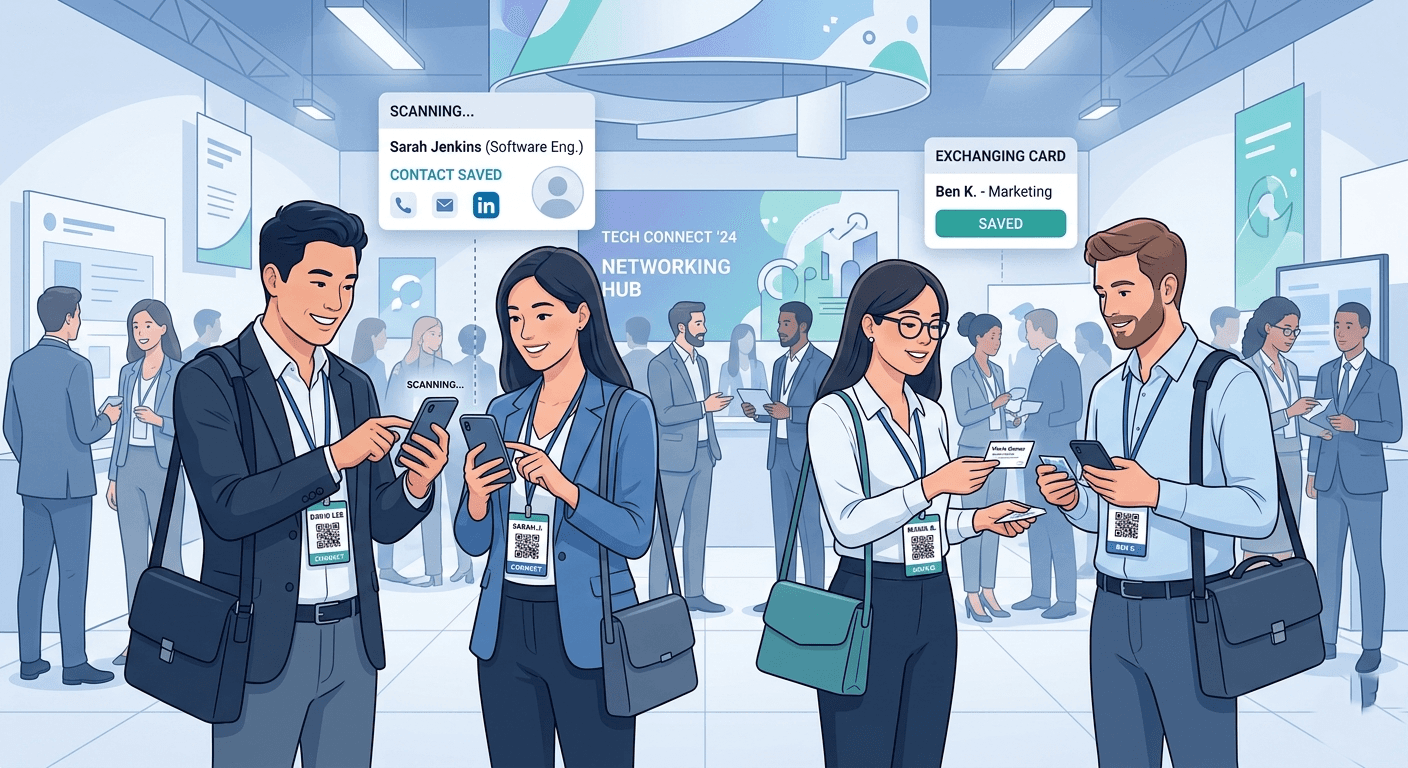
Leverage AI and digital evolution to transform networking. Capture, qualify, and follow up on leads faster with a smarter, modern workflow.
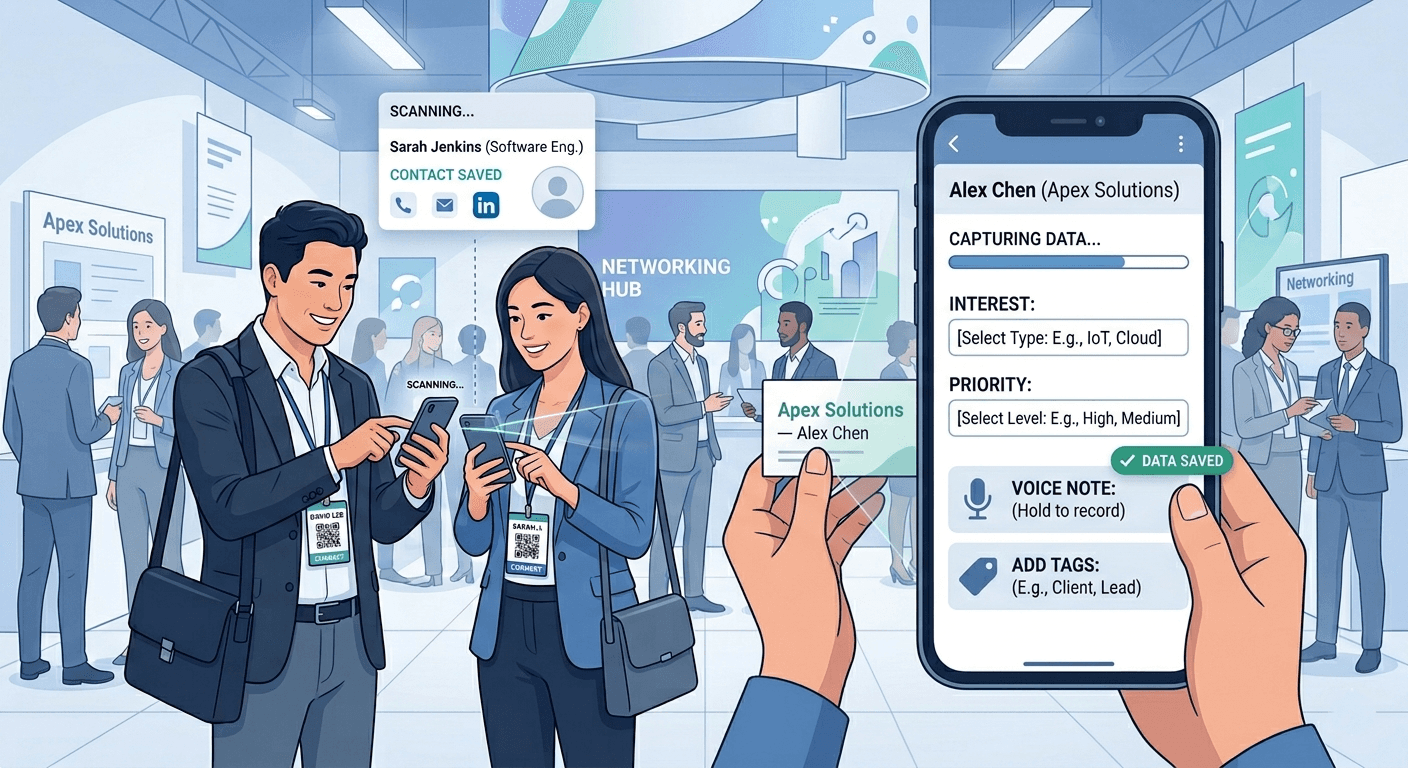
Manual qualification at events is not broken because people are careless. It is broken because the workflow demands perfect execution from reps who are simultaneously selling, demo-ing, and managing a busy booth.
Walk any expo floor and you will see the same pattern repeat. A rep scans a badge, jots a few words on the back of a brochure, tucks the card into a lanyard pouch, and moves on to the next conversation. Multiply that across three show days, two shifts, and six reps, and you have several hundred contacts with almost no usable context attached to any of them.
The failure points are predictable and they compound each other:
Latency kills momentum. Badge files and card exports typically reach the CRM five to ten days after the show closes. By then, buyer interest has decayed, competitors have followed up first, and the rep who had the conversation can barely remember it.
Missing context makes prioritization impossible. Badge data gives you a name and, if the organizer shares it, an email address. It does not tell you whether the person was a serious buyer or someone who stopped for the free coffee.
Inconsistent inputs waste SDR time. Every rep formats notes differently and captures different fields. SDRs spend hours standardizing data before outreach can begin.
Duplicates create friction in the CRM. The same visitor gets scanned on Day 1 and again on Day 2. Two records, competing timelines, and confused ownership.
Weak attribution undermines budget decisions. Without clean source fields tied to each event, marketing cannot prove what the show actually produced in pipeline.
Factor | Manual qualification | AI-assisted qualification (in Habsy Business Card Manager) |
|---|---|---|
Consistency across reps | Varies by individual | Same rules applied to every lead |
Enrichment speed | Manual lookup, often skipped | Seconds per contact via automated enrichment |
Volume capacity | Degrades on Day 3 as fatigue sets in | No fatigue at scale |
Conversation nuance | Human judgment at its best | Requires voice notes as input to preserve context |
Time to prioritized list | 5 to 10 days post-event | Day-0, same day as capture |
CRM handoff | Manual import, often delayed | Native sync with automated workflow triggers |
AI does not replace the rep. It handles the parts of qualification that do not need human judgment so that the rep can focus on the parts that do.
AI capture and Enrichment: Turning Badges and Cards into structured data
The first place AI earns its keep at an event is capture. Two inputs dominate the show floor: QR badges issued by organizers and business cards exchanged during conversations. AI turns both into structured, enriched contact records within seconds.
Universal badge and card scanning
Modern capture apps decode QR badges from any organizer format and automatically populate name, company, title, and where the organizer shares them, email and phone. For business cards, AI-powered OCR handles the realities of on-site scanning: scripted fonts, dual-language layouts, embossed printing, glare from hall lighting, and NFC cards captured without any physical exchange.
In internal tests, batch card scanning clears approximately 150 cards in about five minutes. A review step follows automatically, flagging low-confidence fields so the rep can confirm or correct before the contact is committed to the record.
Real-time enrichment from a domain or email
AI does not stop at what is printed on the card. Given a company domain or email address, enrichment layers pull in company size, industry, website description, and the person's professional background instantly. The rep at the booth already knows whether they are speaking with a procurement decision-maker or a casual browser before the conversation ends. Some platforms also generate AI-powered conversation starters from the enriched company profile, which is useful when meeting dozens of unfamiliar companies across a multi-day show.
The six qualifier fields that change follow-up
Qualification needs more than identity. The fields that actually make a lead actionable look like this:
Field | What to capture | Why it matters |
|---|---|---|
Interest Level | Hot / Warm / Cold | Drives SDR prioritization on Day-0 |
Product Line | Which product or service they asked about | Routes to the right sequence or team |
Priority | P1 / P2 / P3 | Determines first-touch timing |
Stall Number | Where the conversation happened | Adds context for recall and personalization |
Source / Campaign | Event name set as a default | Enables attribution in the CRM automatically |
Owner | The SDR responsible for follow-up | Prevents leads sitting unowned after the show |
This six-field schema, filled at the moment of capture, converts a raw scan into a qualified lead. Pair it with a ten-second voice note recorded on the same device and an AI-generated transcript becomes part of the contact record immediately, with no typing required during peak footfall.
Tip: keep required fields lean at capture |
More than three mandatory fields increases abandonment during rush hours. Start with Interest, Product Line, and Priority. Add the remaining fields as optional defaults that reps can fill during the end-of-day review step. |
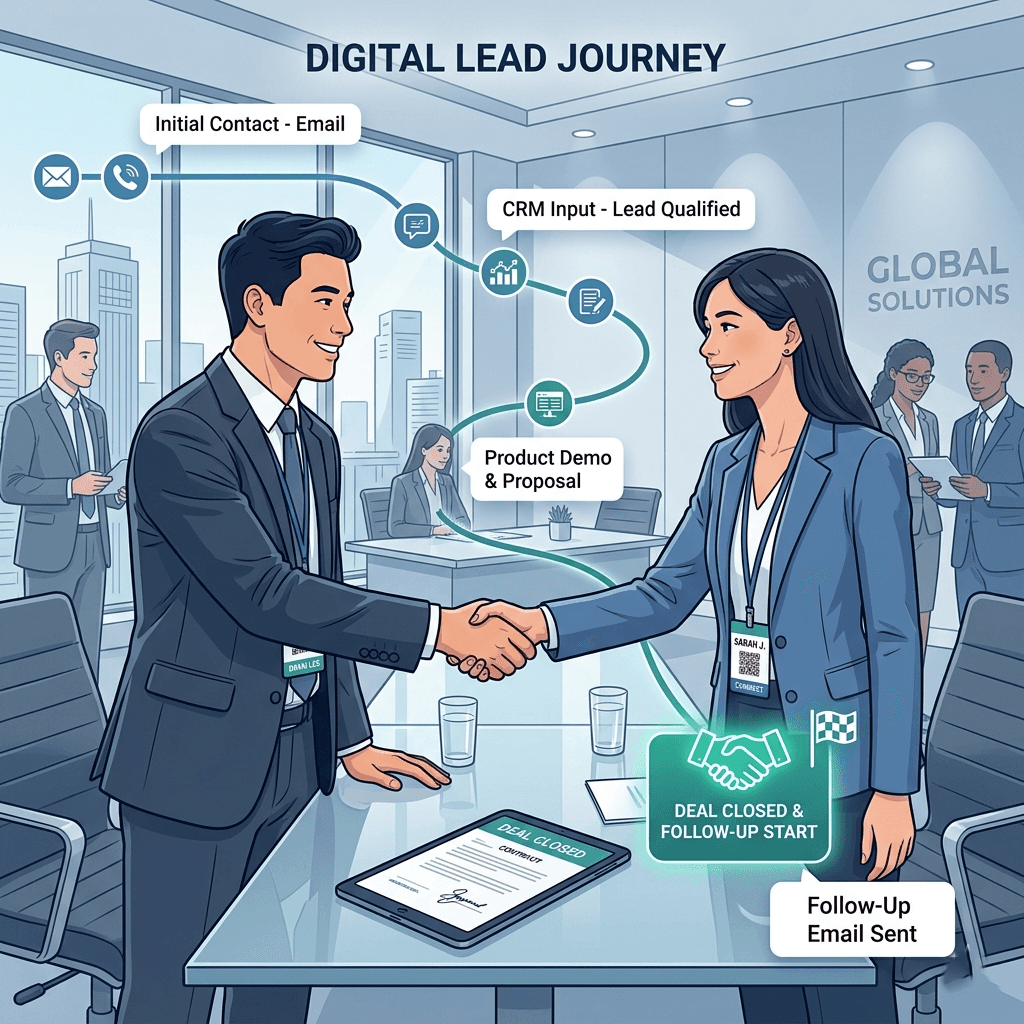
Once leads are structured and enriched, AI can rank them so SDRs do not have to guess. Three scoring approaches work in combination at events, each with different strengths and trade-offs.
ICP fit scoring
The enriched contact is compared against your ideal customer profile: company size, industry, region, seniority, and technology footprint. Leads that match the ICP score higher automatically. This is the most defensible use of AI scoring at events because the rules are explicit and auditable. A company with 200 employees in manufacturing that matches your target sector will score the same way every time, regardless of which rep scanned the badge or how tired they were on Day 3.
Intent signal scoring from capture qualifiers
The qualifiers captured at the booth feed directly into a real-time score. A lead tagged Interest=Hot, Priority=P1, who asked about pricing and requested a demo on the spot, ranks above a lead tagged Interest=Cold who took a brochure and left. This signal is more valuable than any algorithmic inference because it comes from the actual conversation, not a pattern match against historical data.
Behavioral overlay
If your event app or organizer platform tracks session attendance, booth dwell time, or content downloads, those signals can layer on top of ICP and intent scores. A visitor who attended three of your product sessions and then stopped at the booth is displaying buying behavior across multiple touchpoints. Combined with a strong ICP fit and a Hot qualifier, that is a contact worth calling before anything else on the list.
What AI scoring does well and where it still needs a human
AI is good at the mechanical work: applying consistent rules, handling large volumes, and integrating enrichment data that no rep has time to look up on the floor. It is weaker at reading genuine buying signals from a single brief conversation. The best setups keep qualification rule-assisted rather than rule-replaced. The rep tags the lead at capture, AI enriches and ranks, and a manager reviews the top of the list before it flows into sequences.
Stat: the cost of slow qualification |
Research from Harvard Business Review found that leads contacted within five minutes of expressing interest are 21 times more likely to qualify than leads contacted after 30 minutes. Most sales teams work off contact data alone, with no intelligence layer telling them which contacts just expressed interest and need immediate outreach. |
The decay curve on event leads is steep. Contact a lead within 24 hours and conversion rates hold up. Wait a week and most of that potential is gone. AI closes the gap between capture and first touch in three practical ways.
Personalized first-touch email and WhatsApp drafts
Given the contact record, the enriched company profile, and the voice note transcript, AI drafts a first-touch email that references the specific conversation rather than defaulting to a generic post-event template. The SDR reviews the draft, makes minor adjustments, and sends. In markets where WhatsApp is the primary business channel, particularly across India and much of APAC, an AI-drafted WhatsApp message can be generated from the same inputs and sent through the same workflow.
Reminders and routing at scale
A one-tap follow-up reminder set at the moment of capture ensures every lead has a scheduled next step before the rep moves on to the next conversation. A manager can also batch-set reminders across an entire saved search, pushing Tomorrow 10:00 to all Hot leads in a single action without clicking through individual records. Combined with owner assignment at capture, this makes Day-0 blitz execution straightforward rather than something that requires manual coordination each time.
Native CRM integration and automated workflow triggers
Habsy connects directly to your CRM. Native integrations push contacts and lead status to HubSpot, Zoho, Salesforce, and others automatically, so your SDRs can open a sequence the moment a record syncs rather than waiting for a manual import. Automated workflows can also be triggered on sync, so a newly captured Hot lead flows straight into an email sequence without anyone touching a keyboard. For any tool outside the native integrations, a mapped CSV export with stable column names imports cleanly into Google Sheets or any CRM in minutes.
How Habsy handles AI follow-up at events |
Habsy's event lead capture workflow (habsy.ai/event-lead-capture) generates personalized email and WhatsApp drafts using conversation notes, voice note transcripts, and the enriched company profile. Reps review and send from the same app used to capture the lead. Over 25,000 exhibitors across 70+ countries use Habsy to move from first scan to first touch without switching tools or rebuilding context from memory. |
Event ROI collapses in attribution. Without clean source fields on every record, you cannot tell which meetings came from which show, and you cannot justify the budget for the next edition. AI-assisted qualification enforces the structure that makes attribution possible.
Source and campaign fields at every sync
When a capture schema sets Source=EventName as a default for all records captured during a show, every lead carries its origin into the CRM automatically. There is no retroactive cleanup, no trying to remember which leads came from which event six weeks later. The field is there because the workflow required it at capture.
Encounter counts from deduplication
When a contact is scanned twice across two days of a show, or appears in records from two different reps, the deduplication layer flags the overlap and merges the records. The resulting contact carries an encounter count: a useful signal for account-based campaigns that want to identify contacts who sought out your booth more than once.
Field completeness as a leading indicator
The percentage of captured leads with all required custom fields filled is a proxy for pipeline quality, and it is visible before a single outreach call is made. If completeness is low, you know before the event ends that your qualification schema is not working as intended, and you can correct it in real time.
Key metrics to track after every event
Metric | Target | What it tells you |
|---|---|---|
Time to CRM | Less than 24 hours for the majority of leads | Whether your capture-to-sync workflow is working |
Field completeness | Above 80% with required qualifiers filled | Whether reps are qualifying or just scanning |
Duplicate rate | Below 5% post-deduplication | Data cleanliness before CRM import |
Lead to meeting (14-day) | Benchmark against prior events | Whether qualified leads convert faster than raw lists |
Reminder completion (7-day) | Above 70% | Whether follow-up discipline is holding after the show |
Pulling the individual capabilities together into a coherent process is where teams either succeed or stall. Here is what a well-designed workflow looks like from the week before the show to the morning after.
Before the show: set up once, run repeatedly
Agree on a six-field capture schema and load it as an event preset so every rep sees the same required fields the moment they open the capture screen.
Configure your CRM integration or map the CSV export column names to match your CRM fields and save the preset so the same structure runs after every event.
Add Intent signals: Hot Today (Interest=Hot, Reminder due today), Missing Email or Phone (flags incomplete records), and Needs Owner (unassigned leads).
Run a ten-minute onboarding session for booth and SDR staff. The goal is one repeatable flow: scan, fill three fields, record a voice note, set a reminder.
During the show: capture with context
Scan each QR badge or business card using the app. Required qualifier fields appear immediately after the scan.
Fill Interest, Product Line, and Priority while the conversation is still happening or within 60 seconds of it ending.
Record a ten-second voice note to capture what structured fields cannot hold: what the prospect asked about, what objections came up, what was promised.
Set a one-tap reminder for the appropriate follow-up window, typically Tomorrow 10:00 or the next business morning.
At the end of each day, run the Missing Email or Phone saved search and fill gaps while memory is still fresh.
Day-0 and Day-1: from list to sequence
Open the Hot Today saved search and assign owners to any unrouted leads before the next day begins.
Run review and deduplication. Merge duplicate records, keeping the best fields from each source.
Sync to your CRM via native integration. For any tool outside the native integrations, export the mapped CSV and import the same day.
SDRs open My Reminders, read the voice note transcript for context, and send the AI-drafted first-touch email or WhatsApp message.
Track reminder completion and lead-to-meeting rate at the 14-day mark. Compare against your baseline from the previous event.
The category is moving quickly. A few directions worth tracking over the next twelve to eighteen months for any team that depends on in-person lead capture as a pipeline source.
Offline-first AI at scale
Expo halls, warehouses, and manufacturing floors still have unreliable connectivity. The tools that will win in these environments are the ones that run enrichment and basic scoring on-device when the network is unavailable, and that sync cleanly when it returns without creating duplicate records or losing captured context. Offline mode is no longer a nice-to-have for events in emerging markets; it is a baseline requirement.
Hybrid event qualification
As in-person and virtual attendance continue to coexist, the same qualification framework will need to handle both. Virtual attendees behave differently from people standing at a booth, and a single lead score that treats them identically will produce misleading prioritization. Expect separate scoring tracks for each attendance mode to become standard across event platforms.
Privacy-aware enrichment
As data protection regulation tightens across India, the European Union, and parts of APAC, enrichment services will need to demonstrate the provenance of every data point they supply. Teams should prefer vendors who can explain where each enriched attribute came from and who provide straightforward export and deletion paths for every contact on demand. Habsy's contact intelligence enrichment (habsy.ai/contact-intelligence-enrichment) is built around full data ownership: exhibitors can export or delete any contact at any time, with no data resold to third parties.
Less AI theater, more compounding workflow value
The most valuable AI in an event lead capture tool is not a glossy score displayed on a dashboard. It is the quiet, compounding work of cleaning duplicates before they hit the CRM, drafting a decent first email from a voice note transcript, and reminding the right rep to send it at the right time. These are unglamorous capabilities. They are also the ones that add up to measurable improvements in pipeline velocity after every show.
FAQs
1. What is AI lead qualification at events?
AI lead qualification at events is the use of AI to turn in-person contacts from badges, business cards, or conversations into structured, enriched, and prioritized leads ready for sales follow-up. It covers four layers: capture, enrichment, scoring, and CRM handoff.
2. How does AI qualify leads at trade shows?
AI extracts contact data from badge and card scans using OCR and QR parsing, enriches records with company and person context from a domain or email, applies rules or predictive models to score fit and intent, and routes the result into saved search views or directly into your CRM via native integration. A human review step at the end of each day confirms top-tier leads before sequences start.
3. What is the difference between manual and AI lead scoring at events?
Manual scoring depends on rep memory, inconsistent note-taking, and post-event cleanup that often takes a week or more. AI scoring applies the same criteria to every lead regardless of which rep captured it, integrates enrichment data the rep did not have time to look up, and produces a prioritized list the same day. Human judgment remains essential for reading the nuance of an actual conversation, which is why voice notes are such an important input.
4. Can AI replace badge scanners at events?
Not entirely. Organizer-issued badge scanners remain the fastest way to ingest verified attendee identity. AI extends that foundation by adding qualification context such as interest level, product line, and priority, and by handling card scanning for visitors who are not carrying a scannable badge. The combination produces a more complete and actionable record than either approach alone.
5. How accurate is AI lead scoring for events?
Accuracy depends on the inputs and the scoring method. Rule-based ICP fit scoring is highly reliable because the criteria are explicit and consistently applied. Intent scoring based on a single event interaction is directionally useful but should not be treated as definitive. The best practice is to use AI scoring to narrow the list to a reviewable size, then apply human judgment at the top before leads enter automated sequences.
6. How does AI reduce post-event follow-up time?
AI reduces post-event follow-up time by auto-transcribing voice notes into contact records, drafting personalized first-touch emails and WhatsApp messages from those transcripts, batch-setting follow-up reminders across filtered lead lists, deduplicating records before CRM sync, and pushing contacts directly to HubSpot, Zoho, Salesforce, or other CRMs via native integration. The combined effect is a Day-1 sequence start rather than a Day-5 cleanup session.
7. What should teams look for in an AI event lead capture tool?
The key capabilities to evaluate are: unified QR badge and business card scanning, configurable qualification fields with required-field enforcement, a voice notes feature with auto-transcription, deduplication with a review step, offline capture with clean sync, native CRM integrations with automatic contact sync and workflow triggers, CSV export for any tool outside native integrations, and clear data ownership with straightforward export and deletion paths.