Exhibitor Playbook for Healthcare, Manufacturing and Pharma Trade Shows
A generic trade show plan misses what makes each industry different. Healthcare exhibitors meet clinicians and procurement teams. Manufacturers meet distributors with RFQs. Pharma companies meet distributors, institutions and regional partners. This playbook gives each industry its own capture and follow-up plan.
Marcus Chen6 min read
The quick answer
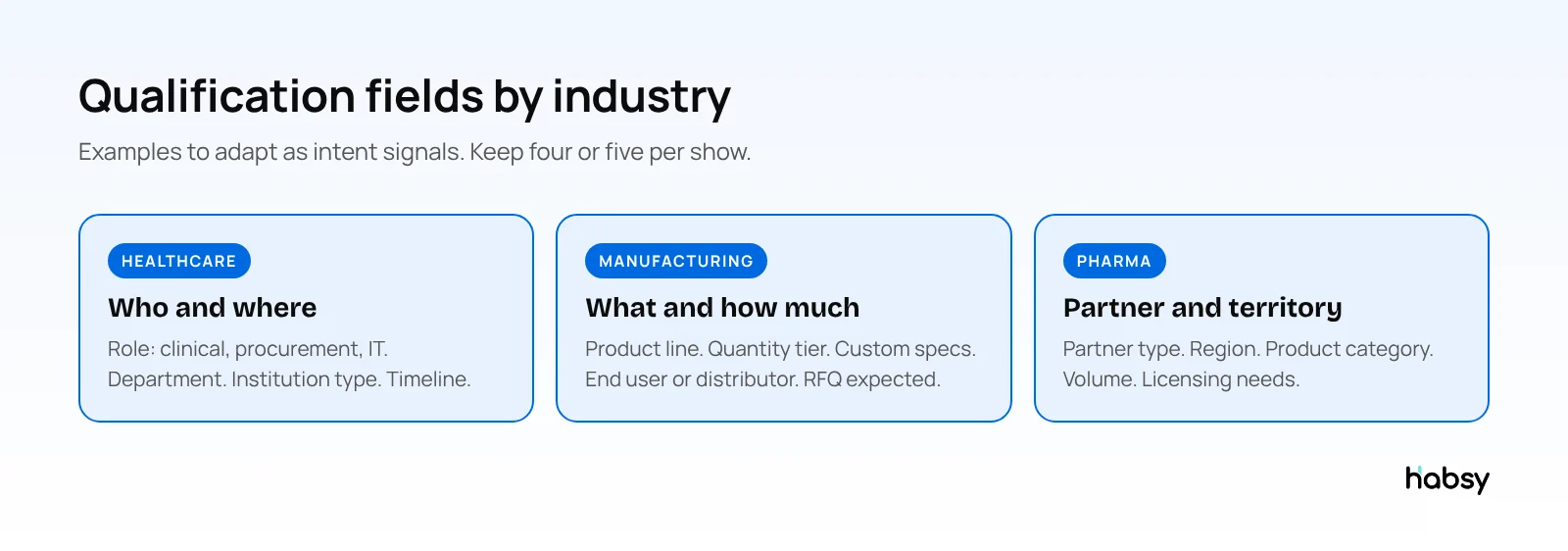
Exhibitors in healthcare, manufacturing and pharma should qualify leads with fields that match how their buyers decide. Healthcare: role, department, institution and timeline. Manufacturing: product line, quantity, specifications, buyer type and RFQ status. Pharma: partner type, region, product category, volume and licensing needs. Capture them with every badge or card scan, add a short note, and follow up on Day 1 with what each visitor asked for.
What is the same in every industry
- Scan every serious conversation: badge, business card or QR code.
- Record four or five fields, not twenty.
- Add one line of context or a 10-second voice note.
- Follow up within one business day with what was asked for.
- Report on quality, not just scan counts. See trade show ROI and the post-event report.
The rest depends on your industry.
Healthcare and medical devices
Who visits
Healthcare shows bring clinicians, department heads, procurement and supply chain teams, IT and digital health leaders, administrators and distributors. Clinical interest and purchasing authority often sit with different people in the same institution.
Fields to record
| Field | Example options |
|---|---|
| Role | Clinical, procurement, IT, administration, distributor |
| Department | Cardiology, radiology, ICU, pharmacy, other |
| Institution type | Hospital group, single hospital, clinic, lab |
| Interest | Information, demo, evaluation, quote |
| Timeline | This quarter, this year, later |
Booth tips
- Note who else is involved in the decision. A clinician’s enthusiasm needs procurement to follow.
- Offer specific materials such as clinical data or integration documents as attachments on your Business digital card, so visitors take them on their phone.
- Keep notes factual, and follow your company’s compliance policies on promotional communication.
Put the guide into practice
Turn every event conversation into a follow-up.
Capture accurate contact details, add the context that matters and stay ready for the follow-up.
Manufacturing and industrial
Who visits
Plant managers, engineers, buyers, distributors and dealers, often with a project or a request for quotation in mind.
Fields to record
| Field | Example options |
|---|---|
| Product line | Your main product families |
| Quantity tier | 100, 500, 1,000, 5,000 units |
| Specification | Standard, modified, custom |
| Buyer type | End user, distributor, OEM |
| RFQ | Expected, not yet, sent at show |
Booth tips
- Use quantity tiers in your own units. They make the post-show priority list obvious.
- Record specification details in a voice note. They are transcribed into English and searchable.
- Scan stacks of cards from busy days with batch scanning, up to 150 cards in about 5 minutes.
- Send the catalogue or datasheet the same evening.
Pharma and life sciences
Who visits
Distributors, institutional buyers, retail chains, regional partners and, at some shows, regulatory and quality professionals.
Fields to record
| Field | Example options |
|---|---|
| Partner type | Distributor, institution, retailer, contract partner |
| Region | Your territories |
| Product category | Your therapeutic areas or product families |
| Volume | Monthly or annual ranges |
| Licensing | Licensed, registration needed, not discussed |
Booth tips
- Territory matters. Note the region on every distributor conversation so the right regional manager follows up.
- Note licensing or registration requirements the partner mentions.
- Share product lists and partner information through your Business digital card.
- Follow your company’s rules on product communication.
Follow-up that fits each industry
What you send after the show should match how each industry buys.
| First follow-up | Who sends it | What to attach | |
|---|---|---|---|
| Healthcare | Within one business day, to the clinician and, where named, the procurement contact | The rep who met them | The clinical or technical material they asked for, nothing promotional beyond your policy |
| Manufacturing | Within 48 hours for RFQs, with the quote or a date for it | The rep, copying the estimator | Datasheets, quote or sample details |
| Pharma | Routed by territory to the regional manager | The regional manager | Product list, partner information, registration details if asked |
On the Habsy Platform, managers filter the event campaign by intent signals or company location and assign contacts with a reminder, so each follow-up reaches the right person. The voice note from the stand travels with the contact, so the person following up does not need to have met the visitor.
Illustrative example. A pharma distributor exhibits at a regional pharma expo. Reps mark partner type, region and product category after each conversation. On the evening of the last day, the sales head filters by region, assigns each region’s distributors to its regional manager with a reminder for the next morning, and each manager starts the day with a short list and the voice notes that explain each one.
How Habsy supports each playbook
- Your own fields: with Habsy Plus, create intent signals for each industry and scale, or let Habsy create them with AI from your website. See what are intent signals.
- Every format: QR and NFC badges, business cards with 99% accuracy (the highest in our in-house tests), QR codes and digital cards from any provider.
- Offline capture in large halls, processed once you are back online.
- Context: text notes, and voice notes with searchable transcripts.
- Follow-up: reminders, AI-written email and WhatsApp messages, templates and CRM sync with 10+ CRMs.
- Team view: event campaigns on the Habsy Platform, with top companies, leadership and access quality, user performance and lead scoring in the post-event report.
For the general checklist, see the trade show lead capture checklist, and for the questions to ask, trade show lead qualification questions.
Bottom line
Your trade show plan should match how your industry buys. Pick four or five fields that matter to your buyers, capture them with every scan, and follow up with exactly what each visitor asked for. Habsy lets you set those fields per industry and capture them in seconds. See event lead capture.
Frequently Asked Questions
How should healthcare exhibitors qualify leads at a trade show?
Record the visitor’s role (clinical, procurement, IT or administration), department, institution type, the problem they described and their buying timeline. Clinical interest and purchasing authority often sit with different people.
What should manufacturers record about trade show visitors?
Product line, quantity tier, specification or customisation needs, whether they are an end user or distributor, region, and whether a request for quotation is expected.
What should pharma exhibitors capture at trade shows?
Partner type (distributor, institution, retailer), region or territory, product category of interest, expected volume, and any licensing or registration requirements they mentioned.
Can Habsy handle different qualification fields for different shows?
Yes. With Habsy Plus, you define intent signals with your own fields and scales, and can create them with AI from your website or a short business description. Teams can use the fields that suit each event.
Should exhibitors in regulated industries be careful with follow-up?
Yes. Follow your company’s compliance policies and local rules on promotional communication, and only send what the visitor asked for. Keep notes factual.
Put the guide into practice
Turn every event conversation into a follow-up.
Capture accurate contact details, add the context that matters and stay ready for the follow-up.