Blog
88% of paper business cards are thrown away within a week. If your networking depends on what happens after you hand over a card, that number matters. Do digital business cards work? For most professionals, the answer is yes. But the reason is not convenience. It is what digital cards allow you to do with the interaction after it ends.
The global digital business card market is projected to exceed 6 million dollars by 2030, according to Allied Market Research. That growth is driven not by novelty but by a measurable shift in how professionals capture and act on connections. Digital business card benefits extend well beyond contact sharing. They change how leads are managed, how follow-ups are executed, and how networking ROI is tracked.

Are digital business cards worth the switch? We break down the real ROI, key benefits for sales teams, and why paper cards are costing you leads.
The Short Answer: Yes, But It Depends on How You Network.
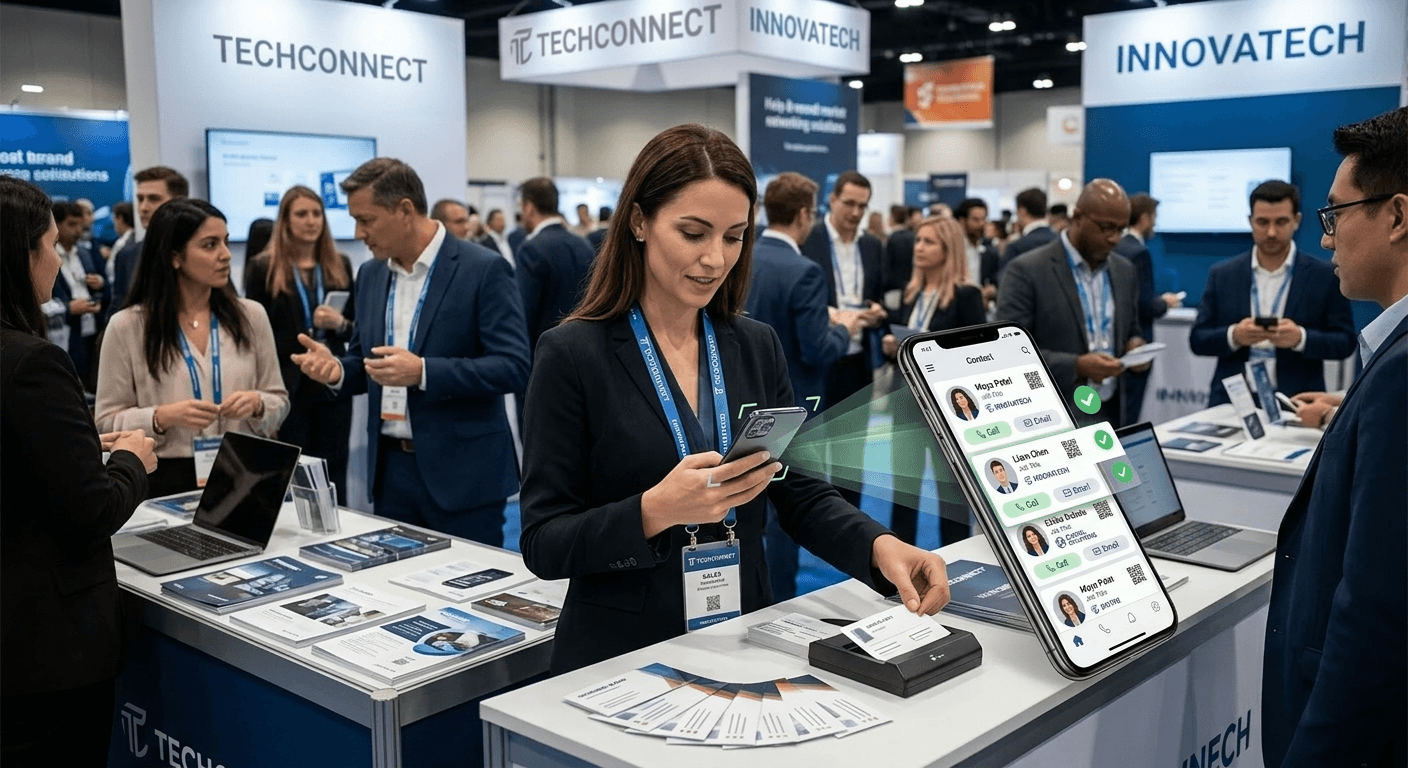
Digital business cards are digital profiles shared through QR codes, links, or NFC that allow instant contact exchange and structured lead capture. The key difference lies in that last part. They do not just share information. They make it usable.
If your networking is occasional, paper cards can still work. But if your work depends on follow-ups, pipeline, or event-driven interactions, digital systems become necessary.
The shift is not from paper to digital. It is from passive contact exchange to active relationship management.
Habsy takes this further. Its Professional QR and Business QR profiles do not just share your details. When a visitor scans your QR code, they can submit their own contact information through a built-in enquiry form, turning a one-way share into a two-way lead capture. You leave every conversation with a structured record, not just a hope that they saved your number.
Who Benefits Most from Digital Business Cards
Digital business cards are most valuable in high-interaction environments. Digital business cards for sales teams are particularly effective because sales professionals handle multiple conversations daily and need to maintain clarity across all of them. Without structure, important details blur together.
Event exhibitors face even more pressure. Conversations happen back to back, often without time to process information between them. Digital business cards for events address this directly by capturing structured data during the interaction itself. Habsy's Business QR profile is built specifically for this scenario: exhibitors share a single QR that captures every visitor's details as a lead automatically, with no manual input required between conversations.
Small business owners and founders face a different challenge. Every connection matters, and missing a follow-up can mean losing a real opportunity. Habsy's home screen widget lets you share your digital card instantly without even opening the app, removing any friction from the moment of exchange.
In all of these cases, the need is the same: capture the interaction clearly and act on it quickly.
Digital vs Paper Business Cards
To understand the value of digital business cards, it helps to look at what actually happens after a conversation.
Paper cards are designed for exchange. Digital cards are designed for continuation.
With paper cards, the interaction ends when the card is handed over. Any follow-up depends on memory, manual effort, and time availability. This creates friction at every step.
With digital business cards, the interaction continues immediately:
Contact details are stored instantly
Context can be captured during the conversation
Follow-up actions can be defined on the spot
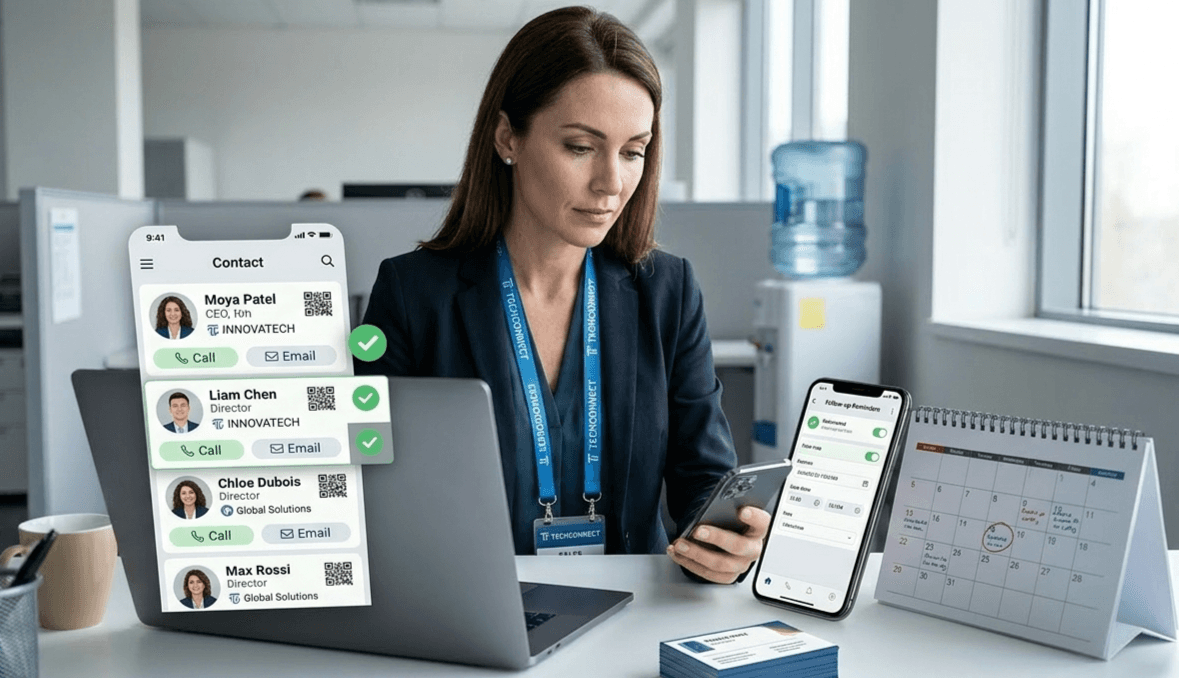
With Habsy, this flow is extended further. After a contact is captured via QR, NFC, or card scan, a voice note can be added in seconds, an intent signal marked, and a follow-up reminder set, all before the next conversation starts. By the end of an event, the list is already ranked and ready to act on.
This difference becomes more important as interaction volume increases. What works for five conversations does not scale to fifty.
When Paper Cards Still Make Sense
Paper business cards still have limited use cases. They work when interaction volume is low and follow-up is simple. They also remain relevant in industries where physical presentation is part of the experience, such as luxury markets or certain legal and financial sectors.
However, these scenarios are the exception. As soon as networking becomes frequent or tied to revenue, paper stops being reliable.
Once networking is tied to outcomes, the conversation shifts from convenience to digital business card ROI. That ROI is not about saving a few seconds during exchange. It is about improving what happens after the exchange.
88% of Paper Business Cards Are Thrown Away Within a Week
Most networking fails before it even begins. Paper business cards thrown away within a week represent 88% of all cards distributed, according to industry data. This means the majority of interactions never translate into any action.
The issue is not effort. It is structure. Without a system, contacts are lost before they are used. Habsy solves this at the source: every contact captured through the app, whether from a card scan, QR tap, or NFC badge, arrives in a structured record that is immediately searchable, filterable, and ready for outreach.
Digital Cards Improve the Business Card Follow-Up Rate
Follow-up is where value is created. Digital systems improve the business card follow-up rate because they remove delay and preserve context. Instead of revisiting a stack of cards days later, you act while the interaction is still fresh.
Research shows that digital cards drive a 35% improvement in follow-up rates compared to traditional paper cards. Consider a common scenario: a sales representative attends a two-day event and meets 150 prospects. With paper cards, those contacts are reviewed days later, often without context. With Habsy, those contacts are already organized, voice-noted, and ranked by intent signal the same evening. The first outreach goes out before competitors have finished sorting their card stacks.
CRM Integration Reduces Lead Management Time
As interaction volume increases, manual work becomes a bottleneck. Entering data into spreadsheets or CRM systems takes time and introduces errors. It also delays follow-up.
Digital business card CRM integration removes this step. Contacts are captured in a structured format and can be moved directly into systems that support outreach. Research indicates that CRM-integrated digital cards show a 63% increase in lead management efficiency, according to industry benchmarks.
Habsy exports clean, mapped CSVs with filters and custom header templates, and integrates directly with Salesforce, HubSpot, and Zoho. For teams not yet using a CRM, Habsy Platform itself functions as a shared contact management layer, giving managers full visibility across every contact every team member captures, without requiring a separate CRM setup.
Instant Sharing Without Friction
Digital business cards function as a contactless business card. They can be shared through QR codes, links, or NFC taps. The recipient does not need to install anything. The exchange is immediate and simple.
Habsy adds a layer beyond sharing. Its NFC sharing capability lets you exchange your digital card phone to phone with a single tap. The other person receives your details instantly, and if they submit their own through the enquiry form, they are captured as a lead in your Habsy Platform in the same interaction.
Real-Time Updates Across All Interactions
Information changes over time. With paper, outdated information continues to circulate. With digital cards, updates are reflected instantly across all shared interactions, ensuring that every contact always has your current details regardless of when they received your card.
With Habsy, this also applies to your branding. Update your background cover, brand color, or linked resources once and every QR profile reflects the change immediately, whether it was shared last week or six months ago.
Lead Capture and Context at Events
The real advantage appears when context is captured alongside contact details. Digital business card lead capture allows you to:
Capture contacts from multiple sources including QR scans, NFC taps, and badge scans
Add notes during the conversation
Record intent signals such as interest level or follow-up priority
Habsy goes further by letting you attach voice notes to each contact at the point of capture. Speak a 10-second note after the conversation ends, and it is transcribed and attached to the contact record, searchable by keyword. When follow-up happens two days later, the rep reads the note and writes a message that reflects the actual conversation rather than guessing. You can further improve this by using contact intelligence enrichment, which enhances the quality and completeness of captured data.
Cost Savings and Sustainability
Companies can save up to 87% annually on business card expenses per employee by switching from print to digital, according to industry data. Printing cards repeatedly adds up over time, and every role change or contact update requires a full reprint with paper. Digital cards eliminate this recurring cost entirely.
The sustainability benefit is a secondary but real advantage. Approximately 7.2 million trees are cut down each year to produce traditional business cards. Going digital removes that ongoing environmental cost. With Habsy, your brochures, catalogs, and product sheets also go digital through your QR page, removing print costs beyond just the card itself.
Why Events Highlight the Value
The importance of digital systems becomes most visible in event environments. Events compress a large number of interactions into a short period, creating two immediate challenges: capture everything accurately and follow up quickly. Paper systems struggle with both. Cards accumulate faster than they can be processed, and context is lost between conversations.
Contact sharing at networking events becomes a structured process rather than a passive exchange when digital systems are in place. Structured data is captured during the interaction itself, not reconstructed from memory afterward.
Habsy is purpose-built for this environment. It works fully offline, so unreliable venue Wi-Fi does not interrupt capture. Contacts queue and sync automatically when connectivity returns. For teams operating across multiple booths or regions, Habsy Platform gives managers a real-time view of every contact captured by every team member, across all campaigns, without any end-of-show consolidation.
From First Interaction to CRM
The key advantage is continuity. Instead of treating capture and follow-up as separate steps, digital systems connect them. A typical flow with Habsy becomes:
Capture the contact via QR, NFC, or badge scan
Add a voice note and mark intent signals immediately
Set a follow-up reminder on the spot
Assign to the right team member if needed
Move the contact into a CRM or send outreach directly from the app
Habsy's event lead capture connects the full workflow from first tap to organized pipeline, so no interaction is lost between the conversation and the follow-up.
Even with these advantages, there are common concerns worth addressing directly.
What if the other person does not have a smartphone ?
This is uncommon in most professional settings. According to current data, 86 % of the global population owns a smartphone. Even in the rare case where it occurs, digital cards can be shared via email or a direct link rather than requiring a tap or scan. Digital tools add options rather than remove them.
Is a premium paper card more professional ?
Professionalism today is linked to clarity and responsiveness. A well-timed follow-up with accurate context often creates a stronger impression than a well-designed card that ends up in a drawer. The perceived prestige of a premium paper card does not compensate for a follow-up that never happens.
What about poor connectivity at events ?
Connectivity can be inconsistent at large venues, but modern digital business card platforms support offline capture. You can save contacts and sync them later. This ensures that no interaction is lost due to a dropped connection.
At this point, the decision becomes practical. If your networking is limited and not tied to outcomes, paper can still work. If your networking drives opportunities, digital systems provide a clear and measurable advantage.
By 2025, 37% of small businesses had already adopted digital cards, according to IMARC Group data. For small businesses specifically, each missed follow-up represents a missed opportunity at a scale where those misses matter most.
The question is not whether digital business cards are better in the abstract. The question is whether your current process allows you to act on every interaction you create. Habsy answers that question with a complete workflow: capture, context, follow-up, and team visibility, all in one place.
Simple Decision Rule
If your networking is low volume and informal, paper may be sufficient. If your networking is high volume, time-sensitive, and tied to revenue, digital business cards are worth it. And if you need capture, context, outreach, and team analytics to work together without switching tools, Habsy is built for exactly that.
Final Takeaway
Digital business cards are not simply a new format. They represent a shift in how networking is handled. The value lies in turning conversations into structured, actionable data that can be used immediately rather than filed away and forgotten.
The statistics make the case plainly: 88% of paper cards are discarded within a week, digital cards improve follow-up rates by 35%, and CRM-integrated systems reduce lead management time by 63%. For any professional whose networking drives outcomes, these numbers matter.
If networking has no direct impact on outcomes, paper may still be enough. If it does, digital systems provide a clear and measurable advantage. The real question is not whether digital business cards work. It is whether your current approach allows you to capture and act on every opportunity you create. Habsy is built to make sure the answer is always yes.
Frequently Asked Questions (FAQs)
Are digital business cards worth it
Yes. They improve follow-up rates by up to 35 percent, reduce manual data entry, and make contacts immediately usable. For professionals who attend events, manage sales teams, or rely on networking for revenue, the return is clear and measurable.Do digital business cards actually work?
Yes. They simplify sharing and enable faster follow-up. Contacts are captured in a structured format and can sync to a CRM, reducing the time between meeting someone and acting on it from days to hours.What are the benefits of digital business cards?
They offer instant sharing without apps, real-time updates, structured lead capture with notes, performance analytics, and lower costs compared to printing. The key benefit is turning contact exchange into a usable and trackable process.Are digital business cards replacing paper cards ?
Not entirely, but they are becoming the standard in high-interaction environments. With growing adoption across sales and tech industries, digital cards are replacing paper where follow-up speed and efficiency matter most.How do you share a digital business card without an app?
You can share via QR code, link, or NFC tap. The recipient opens the card in their browser without downloading anything, making the exchange simple and friction-free.