Sansan and Eight vs Habsy: Business Card Management Compared
Sansan is one of the best-known business card management systems in Japan, with a personal app called Eight. Both are built around digitising cards very accurately with the help of human operators. Habsy takes a different route: instant AI scanning and a focus on capture and follow-up at events. Here is how they compare.
Amélie Tremblay5 min read
The quick answer
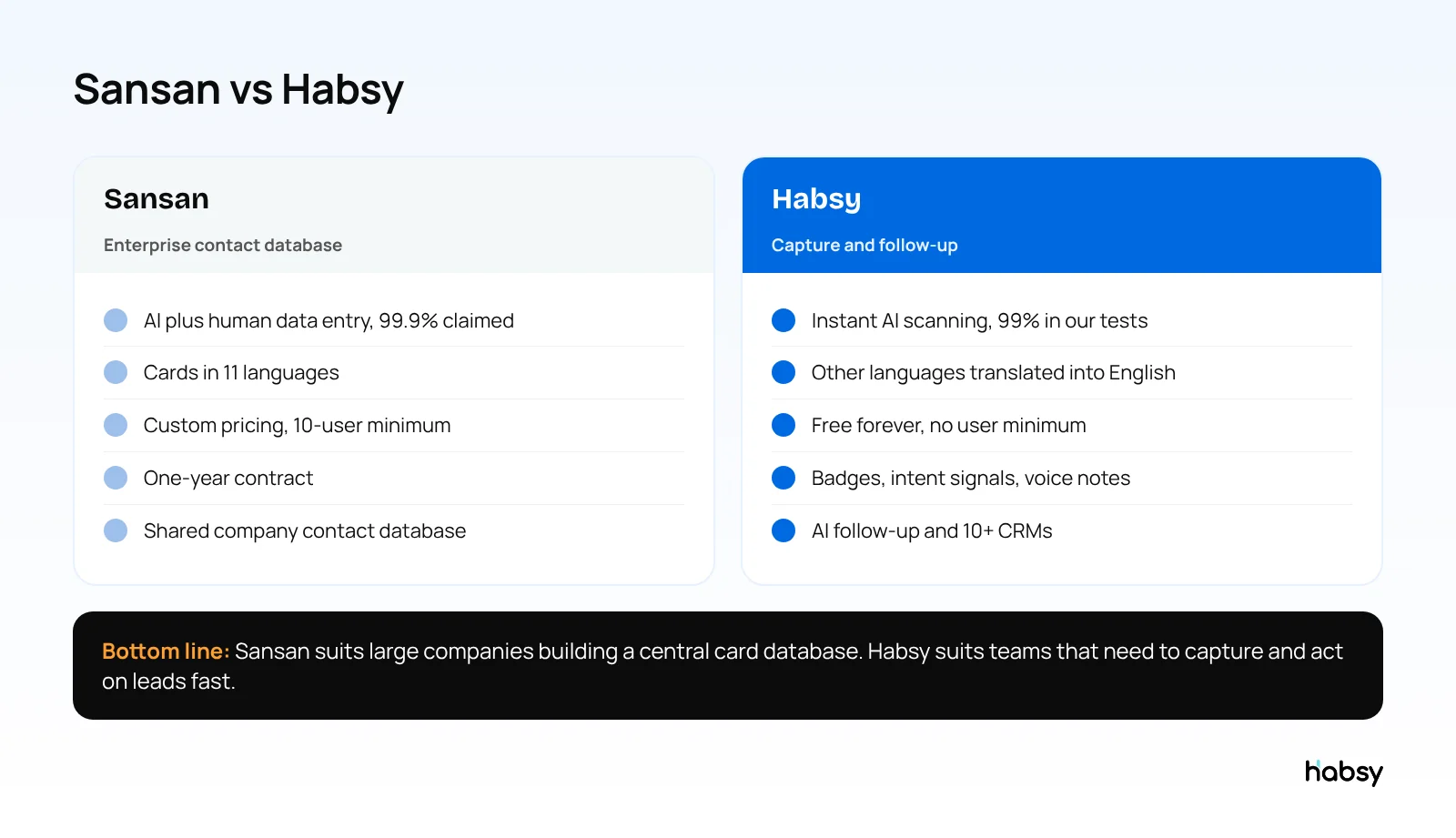
Sansan is an enterprise business card management system that digitises cards with AI and human data entry, builds a shared company contact database, and is sold on custom contracts with a 10-user minimum. Eight is the personal card app from the same company. Habsy scans instantly with AI at 99% accuracy (the highest in our in-house tests), is free forever with no user minimum, and is built for capturing, qualifying and following up with leads at events.
Sansan details are from Sansan’s FAQ, checked in 2026.
How Sansan works
According to Sansan:
- Cards are processed with a dedicated scanner or the mobile app on iOS and Android.
- Digitisation combines AI with human data entry, because card formats vary.
- Sansan claims 99.9% accuracy for both scanner and mobile.
- Its scanners can process 100 cards in about 5 minutes and read handwritten exchange dates.
- Cards in 11 languages can be digitised, and the interface supports English, Japanese and Simplified Chinese.
- Pricing is not published. Plans are customised, with a minimum of 10 users and a standard one-year contract.
- Sansan is used in 60+ countries.
The result is a shared, carefully verified company contact database, which suits large organisations, particularly in Japan, where card exchange is central to business.
What about Eight?
Eight is Sansan, Inc.’s business card app for individuals. You scan cards to build your contacts, keep your own profile, and connect with contacts who also use Eight. It suits individual professionals, especially in markets where Eight is widely used.
Comparison
| Sansan | Habsy | |
|---|---|---|
| Digitisation | AI plus human data entry | OCR and AI, instant, with in-app review |
| Accuracy | 99.9% claimed | 99%, the highest in our in-house tests |
| Languages | 11 languages | Multiple, translated into English |
| Batch | Dedicated scanner, 100 cards in about 5 minutes | Phone batch scan, up to 150 cards in about 5 minutes |
| Event badges and QR codes | Not described in the FAQ | QR and NFC badges, any digital card, LinkedIn QR codes |
| Qualification at capture | Not described in the FAQ | Intent signals, voice notes with searchable transcripts |
| Follow-up | Not described in the FAQ | Reminders, AI-written email and WhatsApp messages, templates |
| CRM | Not described in the FAQ | 10+ CRMs, custom on request |
| Pricing | Custom, 10-user minimum, one-year contract | Free forever; Habsy Plus USD 99.99 per user per year |
See the difference
Compare less. Capture your next contact with Habsy.
Try the workflow built for fast capture, useful context and timely follow-up.
Business cards in Japan and other bilingual markets
Card exchange in Japan follows a careful ritual, and many cards are printed in Japanese on one side and English on the other. A few practical points if you meet people from these markets:
- Scan both sides. In Habsy, add the back of the card so both language versions are captured.
- Other languages are translated into English. Habsy reads cards in 200+ languages, including non-Latin scripts, and translates them into English, so your team can work with the contact even if they do not read the original.
- Review names carefully. Name order and romanisation vary. Check the extracted name in the review step before saving.
- Keep the paper card for the meeting itself. In many cultures, putting a card away immediately is impolite. Scan it afterwards.
Speed vs verification
Sansan’s model adds human data entry for accuracy, which takes time. Habsy’s model gives you the contact instantly, with a review step. For events, the difference matters: with Habsy, a rep can scan, add intent signals and a voice note, and send a follow-up the same evening. With a verification step, the contact is accurate but the follow-up waits.
When Sansan makes sense
- Large companies building a central, verified contact database
- Organisations where many cards use complex layouts or scripts and human verification is worth the wait
- Teams with procurement processes suited to annual enterprise contracts
When Habsy makes sense
- Teams of any size, including one person, with no minimum and no contract to start
- Exhibitors and sales teams who need leads qualified at the booth and followed up on Day 1
- Teams that collect badges and QR codes as well as paper cards
- Companies that want contacts in their own CRM: Salesforce, HubSpot, Zoho CRM, Dynamics 365, Odoo and more
For teams, the Habsy Platform adds shared contacts, event campaigns, team analytics and a post-event report.
Bottom line
Sansan is a strong enterprise system for building a verified contact database. If you need to capture and act on leads quickly, without a 10-user minimum or annual contract, Habsy is the better fit, and it is free to start. See business card management software for a broader buyer’s guide, or try Habsy.
Frequently Asked Questions
What is Sansan?
Sansan is a cloud-based business card and contact management service that builds a shared company database of contacts. Cards are digitised with a scanner or mobile app, using AI combined with human data entry. Sansan states 99.9% accuracy and supports cards in 11 languages.
How much does Sansan cost?
Sansan does not publish prices. According to its FAQ, plans are customised, with a minimum of 10 users and a standard one-year contract.
What is Eight?
Eight is a business card app for individuals from Sansan, Inc. You scan cards to build your contact list, and you can connect with contacts who also use Eight.
Is Habsy a good Sansan alternative?
Yes, especially for small and mid-sized teams and event-driven sales. Habsy is free to start with no user minimum, scans instantly with 99% accuracy, the highest in our in-house tests, and adds batch scanning, badges, intent signals, follow-up messages and 10+ CRM integrations.
Does Habsy use human operators to check cards?
No. Habsy uses OCR and AI, with a quick review step in the app so you can check the fields before saving. Results are ready immediately rather than after a human verification step.
See the difference
Compare less. Capture your next contact with Habsy.
Try the workflow built for fast capture, useful context and timely follow-up.