Job Fair Networking Guide for Students: Before, During and After
A job fair gives you a few minutes with each recruiter. Students who get callbacks are not always the best qualified. They are the ones who prepared, asked good questions, kept track of who they met, and followed up within a day. This guide shows you how.
Marcus Chen5 min read
The quick answer
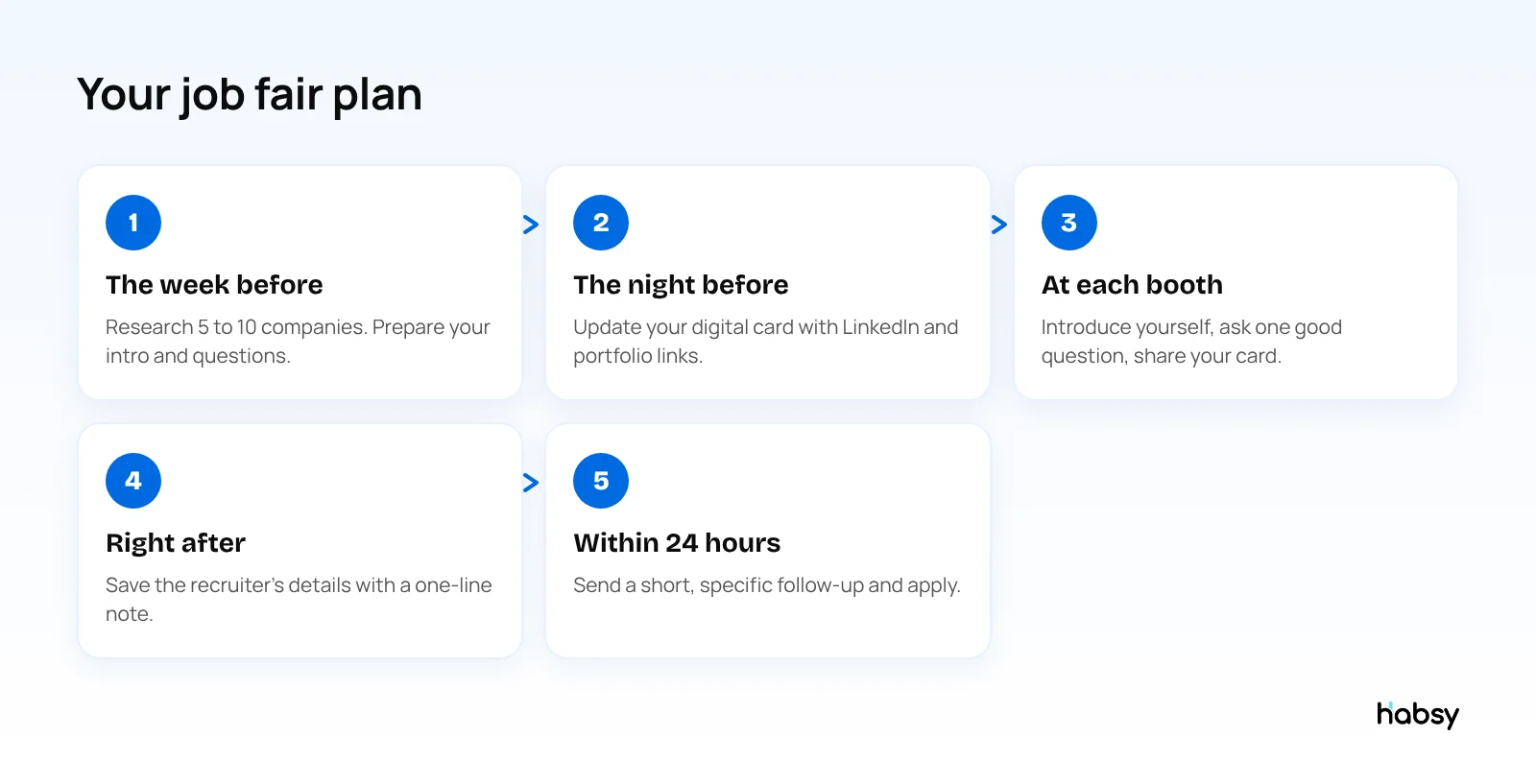
To network well at a job fair, research five to ten target companies, prepare a 30-second introduction and three specific questions, share your details by digital card or resume, save every recruiter you meet with a note, and follow up within 24 hours. Recruiters meet hundreds of students in a day. A specific follow-up is what makes them remember you.
Before the job fair
Research your target companies
Get the list of employers attending and pick five to ten. For each, know:
- What the company does, in one sentence
- Which roles they are hiring for
- One recent thing about them, such as a product launch or expansion
Prepare your introduction
Thirty seconds is enough: who you are, what you are studying or have done, and what you are looking for.
“Hi, I am [Name], final year [course] at [college]. I have done [one relevant project or internship], and I am looking for [type of role]. I saw you are hiring for [role]. Could you tell me what that team works on?”
Prepare three good questions
- What does a typical week look like in this role?
- Which skills are hardest for you to find in graduates?
- What is the next step after today, and can I follow up with you directly?
Set up your digital card
A digital card is easier than paper: it can link to your LinkedIn, portfolio or GitHub, you can share it by QR code from your phone, and it never runs out. Habsy’s free Professional digital card works well. Add a clear photo, your course and year, your email, phone and links. Read what is a digital business card.
Bring a few printed resumes too. Some recruiters still want paper.
At the job fair
- Start with a company that is not your top choice. Warm up before the conversations that matter most.
- Introduce yourself and ask one good question. Listen more than you talk.
- Share your card. Show your QR code, or send the link if they prefer.
- Ask for their details. Take their business card or scan the QR code they show. Habsy reads business cards, LinkedIn QR codes and digital cards from any provider.
- Write a one-line note straight away. “Priya, campus hiring, Infra team, said apply for Graduate Engineer role by Friday.” By the fifth booth, you will not remember who said what.
- Set a reminder for the follow-up.
Put the guide into practice
Turn every event conversation into a follow-up.
Capture accurate contact details, add the context that matters and stay ready for the follow-up.
After the job fair
Follow up within 24 hours
Keep it short and specific:
Subject: Following up from [Job fair], [Your name]
Hi [Recruiter name],
Thank you for talking with me at [Job fair] yesterday about the [role] on the [team]. I enjoyed hearing about [one specific thing they said].
As suggested, I have applied for [role / reference]. My profile is here: [link to your digital card or LinkedIn].
I would be glad to answer any questions.
[Your name]
Habsy can draft a personal follow-up email or WhatsApp message with AI from a short prompt, using the details and note on the contact. This is free.
Connect on LinkedIn
Send a connection request with a one-line note mentioning the job fair.
Keep track
Use tags or notes to track each company: met, applied, interview, offer. For more on why this matters, read why networking is more about memory than contact storage.
Track every company after the fair
A job search runs for weeks. Use one tag per company and a short status note, so you always know where you stand:
| Company | Who you met | Status note | Next reminder |
|---|---|---|---|
| A logistics company | Campus recruiter | Applied for Graduate Analyst, referred by recruiter | Check portal Friday |
| A bank | Team lead, risk | Sent CV and thank-you email | Follow up in 7 days |
| A startup | Founder | Asked for portfolio link, sent | Coffee call Tuesday |
| An FMCG company | HR manager | Said roles open in March | Reminder 1 March |
In Habsy, scan the recruiter’s card or LinkedIn QR code, add the status as a note, and set a reminder. When a reminder comes up, Habsy can draft the follow-up email from a short prompt.
Illustrative example. A final-year student meets recruiters from 11 companies at a campus fair. She scans each recruiter’s card or LinkedIn QR code, adds one line on what they discussed, and sets a reminder for each. By midnight, she has sent 11 personal thank-you emails, each mentioning one thing the recruiter said. Two recruiters reply the next day asking her to apply directly.
Common mistakes
- Collecting brochures instead of contacts. A brochure does not reply to emails.
- Generic follow-ups. “Nice to meet you” is forgotten. One specific detail is remembered.
- Waiting a week. Recruiters move on to the next fair.
- Asking “What do you do?” Research that before you arrive.
Bottom line
Job fair networking is prepared, specific and fast. Research before, ask good questions during, save every contact with a note, and follow up within a day. Habsy gives students a free digital card and a scanner for every recruiter they meet. Create your free digital card.
Frequently Asked Questions
How do I network at a job fair as a student?
Research target companies beforehand, prepare a 30-second introduction and a few specific questions, share your details by digital card or resume, save each recruiter’s contact with a note, and send a short follow-up within 24 hours.
What should I ask recruiters at a job fair?
Ask what the role looks like day to day, what skills they find hardest to hire for, what the next step in their process is, and whether you can follow up with them directly.
Do students need business cards for job fairs?
A digital card is often better. It can link to your LinkedIn and portfolio, you can share it by QR code, and you can update it anytime. Habsy’s free Professional digital card works for this.
How soon should I follow up after a job fair?
Within 24 hours. Mention where you met, one thing you discussed, and the next step, such as applying for a specific role.
Is Habsy free for students?
Yes. Habsy’s free plan includes a Professional digital card, unlimited card and QR scanning, notes, reminders and AI-written email and WhatsApp messages.
Put the guide into practice
Turn every event conversation into a follow-up.
Capture accurate contact details, add the context that matters and stay ready for the follow-up.